A real download link for the export
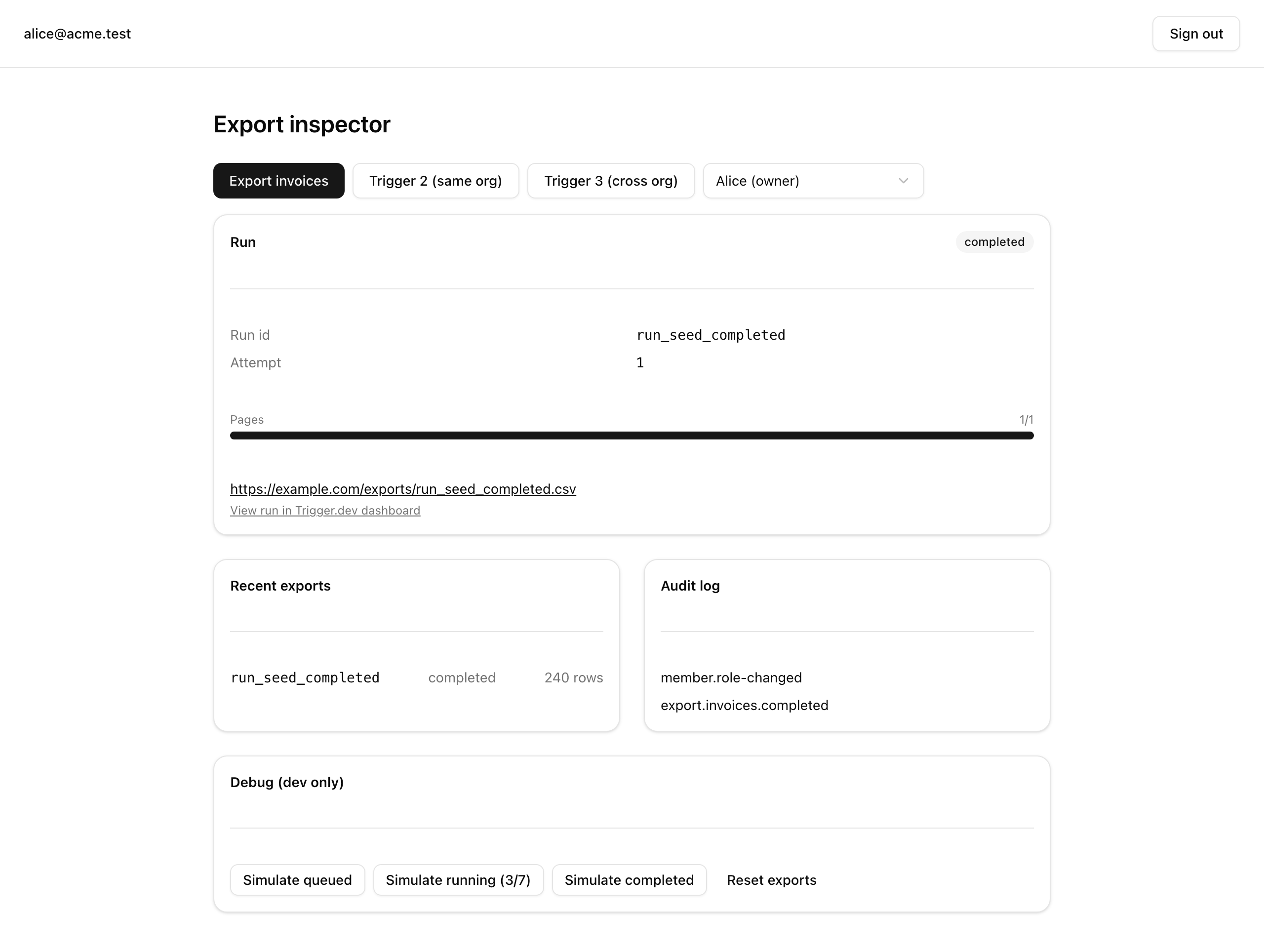
The durable CSV export you built in chapter 67 left one part stubbed: the download link. The job paginates every invoice into one CSV, then sets metadata.downloadUrl to a placeholder, https://example.com/exports/<runId>.csv. That link renders on the inspector panel and ships in the export email, but clicking it goes nowhere. Everything around it was real: the email, the inspector link, the audit trail; only the file was missing. This lesson produces the file. By the end, triggering an export from /inspector writes the CSV to R2 and returns a real link, the same one on the completion panel and in the email, that downloads the file when you click it within ten minutes.
Your mission
Section titled “Your mission”Elsewhere this chapter, the worker signs a PUT and lets the browser push the bytes. The export worker is the other half of that boundary: it already holds the whole CSV in memory after the page loop and has no browser to hand off to, so it PUTs the bytes to R2 itself. Both paths go through the same lib/r2.ts client, so you stand up nothing new.
The export shares the bucket with your user uploads; only the key prefix separates them, exports under exports/, user uploads under org/. The key must lead with exports/ — exports/org/<orgId>/<runId>.csv, org scoping nested inside — because a 7-day lifecycle rule (already in scripts/r2-lifecycle.ts) sweeps everything under exports/, and R2 prefix matching is a literal leading string, not a glob. Lead with the wrong segment and the rule misses the file.
That same rule is why the export writes no file_metadata row. A user upload is a long-lived artifact you list, download, and audit, so it earns a row; an export is a single-consumer throwaway the rule deletes in a week. Sign the download with getSignedGetForKey, the tenant-free signer the file-metadata reads expose for this caller: it takes a raw key and skips the tenancy check, because the worker just wrote that key inside the trust boundary. Give the GET a ten-minute life. That is deliberately short: a user who opens the email an hour later gets a dead link, and the right answer is to re-trigger the export, not to mint a URL that lives long enough to leak.
One placement rule matters: the R2 PUT goes after the page loop and before the close-out transaction. An external network call never sits inside a database transaction, and putting the PUT at the tail of the resumed parent keeps the durable-export chapter’s kill-resume idempotency intact — a parent retry re-PUTs the same run-keyed object, and an overwrite is idempotent.
You touch one place: the placeholder block right after the page loop in trigger/export-invoices.ts. Leave the pagination loop and the email template alone, and reuse the metadata.set('downloadUrl', ...) and sendExportEmail plumbing already wired to carry the URL.
exports/org/<orgId>/<runId>.csv via a server-side PUT.downloadUrl carry the same signed URL — they cannot drift to different links.file_metadata row — select count(*) from file_metadata where object_key like 'exports/%' returns 0.downloadUrl as a real R2 link that downloads the CSV when clicked, saved as export-<day>.csv.exports/ prefix is present, confirmed by logging the effective rules.Coding time
Section titled “Coding time”Open trigger/export-invoices.ts, find the placeholder block after the page loop, and replace it with a real R2 write — a server-side PUT, a signed GET, and the existing metadata.set. Lean on the brief and the lesson’s tests; reach for the reference once you have a version of your own.
Reference solution and walkthrough
The retrofit is contained: the page loop, the email child, and the close-out transaction stay as the durable-export chapter left them.
console.log('export-invoices csv built', { bytes: csv.length });
const downloadUrl = `https://example.com/exports/${ctx.run.id}.csv`;metadata.set('downloadUrl', downloadUrl);
The chapter-067 stub. The link reaches the inspector panel and the email, but the bytes it points at never landed anywhere.
import { PutObjectCommand } from '@aws-sdk/client-s3';import { getSignedGetForKey } from '@/db/queries/file-metadata';import { BUCKET, r2 } from '@/lib/r2';// ...console.log('export-invoices csv built', { bytes: csv.length });
const body = Buffer.from(csv);const objectKey = `exports/org/${organizationId}/${ctx.run.id}.csv`;15 collapsed lines
await r2.send( new PutObjectCommand({ Bucket: BUCKET, Key: objectKey, Body: body, ContentType: 'text/csv', ContentDisposition: `attachment; filename="export-${dayBucket()}.csv"`, }),);
const { url: downloadUrl } = await getSignedGetForKey({ objectKey, expiresIn: 600,});metadata.set('downloadUrl', downloadUrl);The worker writes the bytes itself. It PUTs the CSV it already holds, signs a 10-minute GET on the key it just wrote, and feeds that one URL to metadata.set and the unchanged email child.
Reading the block top to bottom:
Buffer.from(csv) and the object key. csv is the string the page loop accumulated, and the PUT body wants bytes, so you wrap it once. The key is built from the org id and ctx.run.id, so a parent retry re-PUTs the same key, overwriting it with identical bytes — idempotent.
The server-side PUT. The worker holds the bytes and writes them directly, with no presigned round trip back to itself. ContentDisposition is set here, at PUT time, so the download name is baked into the stored object. That is why getSignedGetForKey can stay a bare-key signer: it never touches response headers. Contrast getFileDownloadUrl from the previous lesson, which sets ResponseContentDisposition on the GET because a user file’s original name is only known at read time. An export’s name is yours, so you write it once.
exports/ leads the key. scripts/r2-lifecycle.ts installs one rule, expire-exports-after-7-days, with Filter.Prefix: 'exports/', and R2 matches a literal leading string — a key shaped org/<id>/exports/... would slip past it. Lead with exports/, nest the org scoping under it, and one rule sweeps every org’s CSVs while leaving every user upload under org/ untouched.
Signing the GET, then publishing it once. getSignedGetForKey signs a ten-minute GET on the raw key, no tenancy check, because the worker owns the key it just wrote. That one URL flows to both metadata.set('downloadUrl', downloadUrl), which the inspector panel renders, and the unchanged sendExportEmail child, so the panel and the email cannot drift apart.
No file_metadata row. The block writes nothing to the database, unlike finalizeUpload, which inserts a row for every user upload. An export is a throwaway the rule reaps in a week, so a row would only be an orphan to clean up.
Where the PUT sits. It lands after the page loop and before the tenantDb(...).transaction that flips the exports row to completed and writes the audit entry. An external network call never belongs inside a database transaction: it would hold the transaction open across network latency and can’t be rolled back if the commit fails. Keeping it at the tail of the resumed parent also preserves the durable-export chapter’s cross-step idempotency.
Once the code is in, install the lifecycle rule against your own bucket. This is one-time setup, not part of any request:
pnpm r2:lifecycleThe script pushes the rule and logs back the effective configuration, so you confirm the rule is live in seconds:
[r2:lifecycle] effective rules: [ { "ID": "expire-exports-after-7-days", "Status": "Enabled", "Filter": { "Prefix": "exports/" }, "Expiration": { "Days": 7 } }]Cloudflare's reference for signing GET and PUT URLs with PutObjectCommand and getSignedUrl — the glue behind getSignedGetForKey.
How prefix-scoped expiration rules work, so the 7-day sweep on exports/ reaps the CSVs you just wrote.
Moment of truth
Section titled “Moment of truth”Run the lesson’s suite:
pnpm test:lesson 5The export task imports server-only transitively, so the runner can’t execute it — there is no live R2, no bucket, no database in the test process. Instead it reads the task’s own source (comments stripped, so the file’s prose never trips an assertion) and proves the outcomes structurally: the placeholder is gone; one server-side PutObjectCommand writes Buffer.from(csv) to the shared BUCKET at a key leading with exports/org/<orgId>/<runId>.csv derived from ctx.run.id; a single getSignedGetForKey URL at expiresIn: 600 is the one value handed to both metadata.set and the email child; no fileMetadata insert exists; the PUT sits before the close-out transaction; and exactly one export.invoices.completed audit entry is written. A green run looks like this:
 ✓ Lesson 5 — the export writes a real R2 object and signs its downloadUrl
 Test Files  1 passed (1)      Tests  11 passed (11)
The runner proves the shape that makes kill-resume idempotent, but it can’t drive a real interrupted run, inbox, or bucket. Confirm the rest by hand:
/inspector; the completion panel shows a real https://<bucket>.r2.cloudflarestorage.com/... downloadUrl, and clicking it downloads export-<day>.csv.select count(*) from file_metadata where object_key like 'exports/%' returns 0.pnpm r2:lifecycle logs one expire-exports-after-7-days rule scoped to Filter.Prefix: 'exports/'.pagesDone: 2/7, restart — the export resumes, the PUT happens once at the end, and you end with one CSV, one email, and one audit row.That last check closes the project. Pull up the audit log — select action, count(*) from audit_logs group by action — and read what the chapter recorded. Every export run wrote export.invoices.completed with actorUserId: null, because a background task has no session: the null is information, not a missing value. There is no row for rendering /files, because reads never audit. And file.soft_deleted ships in softDeleteFile but never fires, a capability ready for the day a delete UI lands.
Across these five lessons, the function never touches the bytes, every key and signed URL is server-constructed and never trusted from the client, and tenancy holds at every read. The SDK glue around those calls is the part an agent writes for you.
The same pipeline reversed is a CSV import: a presigned PUT lands the file in R2, a Trigger.dev job stream-parses it, and each row upserts into the tenant table — every primitive on this page, pointed backward. What makes import its own feature is the part export never faces: a row that fails validation at line N forces a real decision — reject the file, or commit the good rows and report the bad ones — so the hard half of import is that partial-failure contract, not the byte plumbing.