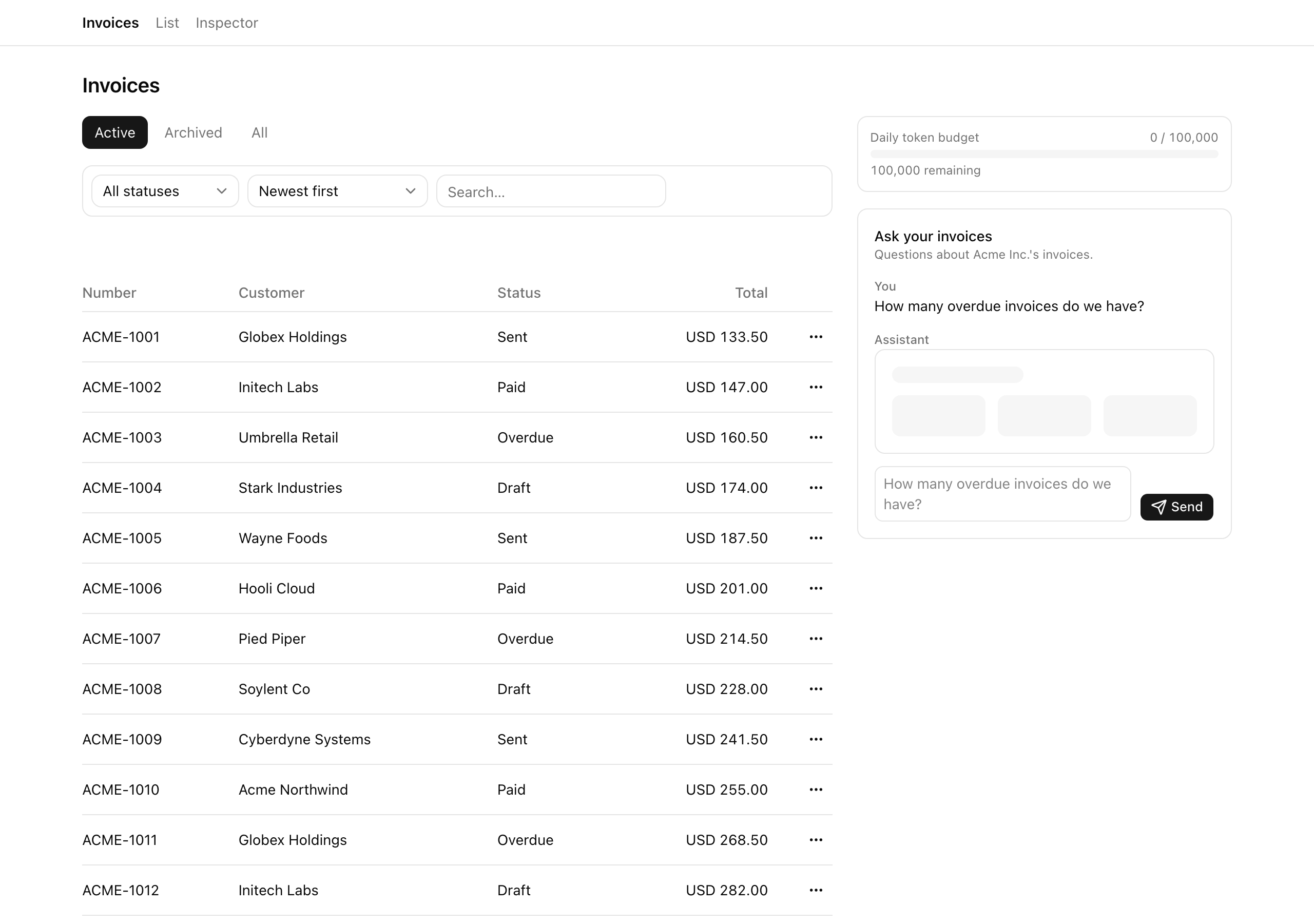
The last three chapters built the pieces of an LLM feature in isolation: deciding when one earns its place and bounding its cost, the streamText and useChat plumbing with the UIMessage parts protocol, and tool calling with a server-owned agentic loop and typed tool parts.
This project wires them into one surface: an “ask-your-invoices” chat in the right rail of the invoices app you built earlier.
A user asks a plain question about their org’s invoices (“how many overdue?”, “total paid this month?”), a tool-calling model answers from real scopedInvoices data, and a panel shows how much of today’s token budget is left.
One rule governs every lesson: the model is untrusted input.
It never sees the store or an orgId, and never touches a row it isn’t allowed to.
Every read happens inside a tool’s execute, under the route’s auth boundary, scoped by an orgId the server closes over and the model can’t reach.
This lesson writes no code.
You leave with the running skeleton and a map of the nine stubs you fill over the next four lessons.
It boots with no database, Docker, or auth wall: the seeded invoices list renders, the chat rail is present, and the panel shows a usage bar, but the two route handlers behind them return 404 until you write them.
The finished surface at the end of the chapter, not this lesson's boot state: a question typed, the tool-part skeleton flashing, the stats card with real numbers, an assistant bubble citing the count, and the usage panel ticking up. Your fresh boot looks emptier — the rail present but unwired until the next lesson.
Every primitive below comes from the previous three chapters; here you wire them together.
Wrapping a streaming LLM endpoint in the same auth boundary that guards every other mutation.
Treating the model as untrusted input: tools as the only doorway into app state, orgId from the server closure rather than the model’s arguments, aggregates returned instead of raw rows.
Owning the agentic loop server-side with an explicit step cap, not an SDK default.
Accounting for cost per user, per day, and refusing gracefully with a typed response rather than a thrown 500.
Rendering a typed useChat surface where each tool’s output is typed at the call site and draws its own loading shape.
The result is a reusable skeleton for any LLM-backed feature: the auth wrapper, the quota wrapper, a tool registry behind a lib/llm seam, and a typed client stay the same; only the tools and the prompt change.
The request path is short: a streaming route handler wrapped twice, a tool registry that is the model’s only window into the data, and a separate inspector for watching it by hand. Five layers:
Client — in the /invoices right rail, invoice-chat.tsx runs useChat<InvoiceUIMessage> over a DefaultChatTransport, rendering text parts and tool-getInvoiceStats parts; token-usage-panel.tsx polls /api/usage.
Route — POST /api/chat, composed as withLlmQuota(authedRoute('member', …)). The quota wrapper reserves budget before the stream starts; inside, streamText runs with the tool-grounded system prompt, stopWhen(stepCountIs(5)), the tool registry, an onStepFinish (quota increment plus per-step audit), and an onFinish (the aggregate audit write).
Feature seam — src/lib/llm/{prompts,tools,quota,audit,with-llm-quota}.ts, the wall the model never sees past: no store reference, no orgId, no raw row crosses it. models.ts holds only the AI Gateway model id.
Data — the invoices array from the earlier list project, read only through scopedInvoices(orgId).active(), plus two new accounting arrays, usageQuota and llmAuditEvents.
Inspector — /inspector, a Server Component mirroring quota and audit state and offering the verification toggles; its mutations are Server Actions in inspector/actions.ts.
The request path, left to right. The route nests three boxes: withLlmQuota wraps authedRoute('member') wraps streamText, so a request clears the quota reservation, then auth, before the stream starts. Inside, the model reaches the store through one doorway, the getInvoiceStats tool, which calls scopedInvoices under an orgId the server closes over. Accounting writes land in usageQuota and llmAuditEvents, which the inspector reads from the side, off the request path.
The starter carries the whole invoices surface from the earlier list project — list, store, auth wrappers, scoped query, model registry, inspector shell — and marks the nine files you write with a TODO(L<n>) stub naming the lesson that fills it. The bolded files below are your build; everything else is carried code you read but don’t change. The one exception is with-llm-quota.ts, which ships complete: you wrap with it in the quota lesson instead of writing it.
next.config.ts
.env.exampleAI_GATEWAY_API_KEY — only the live-model checks need it
package.jsonai@^5, @ai-sdk/react@^2 (no @ai-sdk/openai — the gateway is a plain string)
First read a few carried files so the seams the build hangs off are familiar. These are reads, not edits:
src/lib/llm/models.ts — one handle, chatModel = 'openai/gpt-5-mini', a bare provider/model string the SDK routes through the Vercel AI Gateway using AI_GATEWAY_API_KEY. Swapping providers is a one-line change here, not a provider(...) call at the call site.
src/server/store.ts — the in-memory stand-in for Postgres. Beside invoices sit two new arrays: usageQuota, keyed by (userId, day), and llmAuditEvents, each row carrying an event of 'llm.step' or 'llm.finish' plus a jsonb-shaped payload.
src/server/session.ts — the cookie-driven dev getSession(), the stand-in for a DB-backed app’s requireOrgUser. With no auth wall it never redirects; an absent or unknown acting-identity cookie defaults to org-acme:admin.
src/server/inspector-flags.ts — three flags, all default off: BYPASS_AUTHED_ROUTE, MODEL_FROM_INPUT_ORGID, and FORCE_TOOL_ERROR. None is reachable in normal operation; each exposes one failure mode by hand from the inspector.
The /inspector page — your control room for the chapter: row counts, identity switcher, audit-events tail, live usage counter, the “Force quota to 99,500” button, the “Force tool error” toggle, the forge-orgId explainer, and the debug-flag toggles. Walk it once so you know where each verification lever lives.
One seeded fact the later lessons lean on: member-A starts today at 90,000 tokens used against a 100,000 daily cap, with a separate 99,000-token row for yesterday. The yesterday row proves the daily key resets independently of today’s; the 90k start lets a couple of small questions cross the cap, so you can reach the over-budget refusal path by hand.
Each of the next four lessons fills one slice of the nine stubs and ends on a capability you verify by hand.
Lesson 2 — Streaming route under auth
Adds POST /api/chat: streamText inside authedRoute('member'), capped at five agentic steps, with the tool-grounded system prompt and an onFinish audit write. Ends streaming text-only answers into a throwaway smoke-test box .
Lesson 3 — The org-scoped tool
Adds getInvoiceStats, which closes over ctx.orgId and returns an aggregate to the model. Answers are grounded in real scopedInvoices numbers, and a forged orgId can’t reach another org.
Lesson 4 — The daily token quota
Adds quota.ts, the withLlmQuota reservation around the route, per-user-per-day accounting in onStepFinish, and the /api/usage read endpoint. Ends refusing an over-cap request with a typed 429.
Lesson 5 — Typed client and usage panel
Replaces the smoke-test box with the real typed useChat client: text bubbles, tool-part cards across all four lifecycle states with a per-tool skeleton, and the live usage panel. Ends with the happy and unhappy paths working live.
Everything runs locally: no external accounts, no shell environment variables. The “database” is an in-memory store seeded at boot, and identity comes from a cookie.
Get the starter codebase from the project repository, under Chapter 108/start/.
Install dependencies.
Terminal window
pnpminstall
Boot the dev server.
Terminal window
pnpmdev
Open http://localhost:3000/invoices. The seeded list renders with the right-rail chat panel, and /inspector loads with the member-A usage row and an empty LLM audit-events tail. The store seeds deterministically (member-A at 90k today, 99k yesterday) on first import; the inspector’s “Reset and re-seed” control restores it between demos.
Environment variables. None for this lesson. One key matters only for the manual live-chat checks in the next four lessons: AI_GATEWAY_API_KEY, the server-only key the model handle reads. Get it from the Vercel AI Gateway dashboard, copy .env.example to .env, and paste it in. No test, build, or rendered check calls a live model, so pnpm verify stays green without it.
Expected result./invoices and /inspector both render. POST /api/chat and GET /api/usage return 404 until their handlers exist — the unwired state you build out next.