Sign up creates the account
This is the lesson where the app gets its spine. By the end a visitor can fill in the sign-up form, hit submit, and have a real account waiting for them in Postgres — a user row and an account row that holds the hash of their password. What they do not get is a session. They land on a “check your inbox” screen with no cookie set, because the project runs with email verification required from the first line of config: an account exists, but until the email is verified there is nobody signed in.
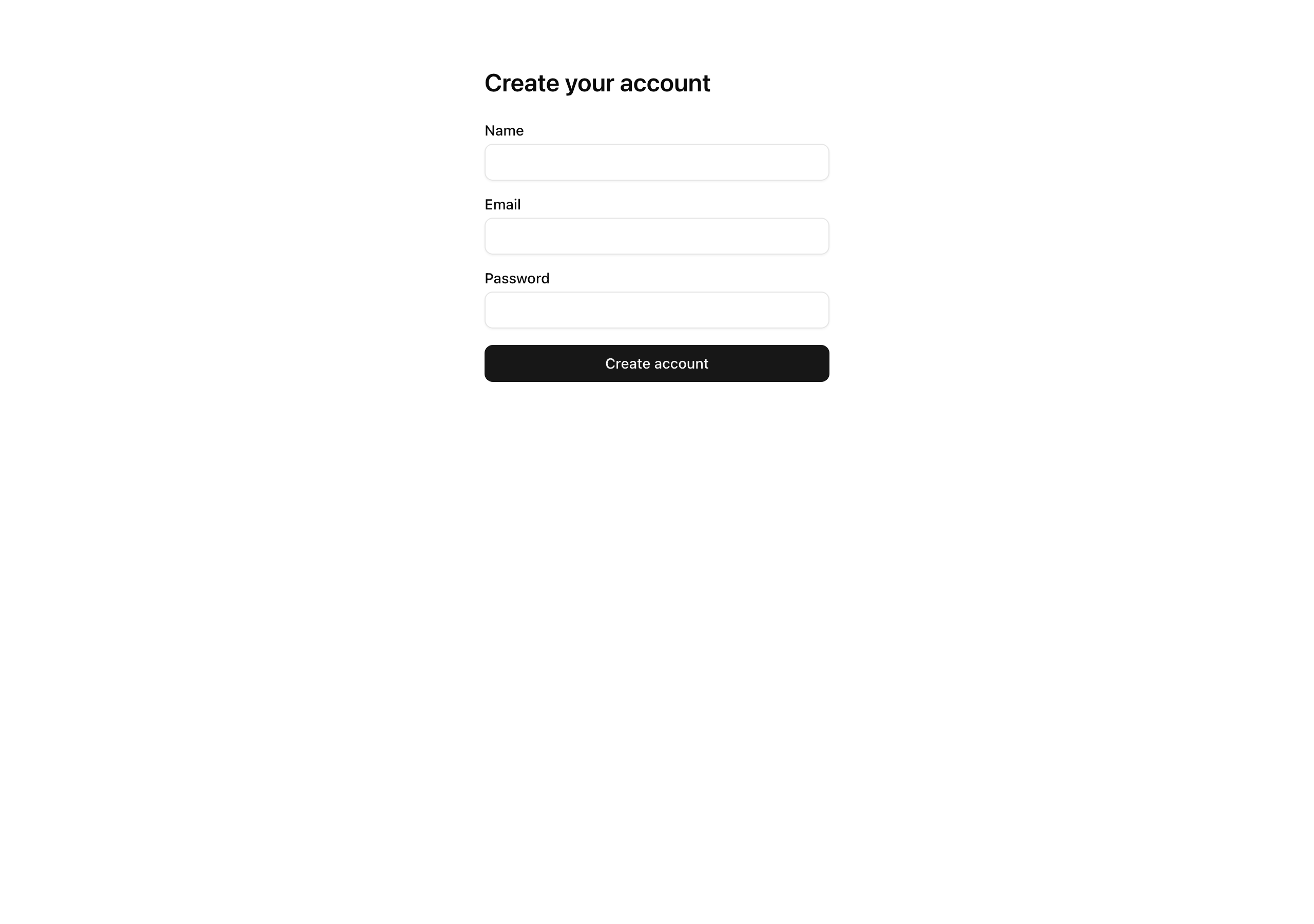
The win here is mostly rows in the database, not pixels on the screen. The form itself already renders — it shipped with the starter — and the verify-email screen it sends you to is still a placeholder until the next lesson. What you are wiring is everything behind the submit button.
Your mission
Section titled “Your mission”This lesson stands up the auth spine and proves it end to end with one working sign-up. You configure the betterAuth instance as the single server-side auth module — Better Auth’s API is consumed directly, with no wrapper layer of your own functions over it. You let the Better Auth CLI generate the four-table Drizzle schema instead of hand-writing it, and you mount one catch-all handler at /api/auth/[...all] that serves every endpoint the library exposes, rather than a route file per action.
The single line that earns the most scrutiny is nextCookies() in the plugin array. It is the bridge that lets a Better Auth call land its Set-Cookie header on the Server Action’s response. Without it a call succeeds on the server and the cookie silently never reaches the browser — the canonical Next.js failure with this library. That failure only bites once a session is actually issued, which does not happen in this lesson, so it is tempting to skip. Wire it now anyway, so the bridge is already in place before the first session lands in the next lesson and you are not debugging a missing cookie under time pressure.
From the start requireEmailVerification: true and autoSignIn: false both hold. Their combined effect is the whole point of the lesson: sign-up creates the account but issues no session and sets no cookie — the user must verify their email before any session exists. Honor the carried-in cookie defaults at the call site: the __Host- prefix, Secure cookies in production only, and minPasswordLength: 12 rather than the library’s default of 8, which is the floor a team would actually ship with in 2026. Secure is production-only for a concrete reason — the browser refuses to store a Secure cookie over http://localhost, so leaving it on in development would make local sign-in silently drop its cookie.
The sign-up action parses the submitted FormData with a Zod schema at the boundary, returns the project’s standard Result shape on a validation miss so the form can re-render an inline message, and routes any genuinely-thrown Better Auth error through the provided mapAuthError in a catch. A taken email is deliberately not one of those errors. Under autoSignIn: false, submitting an email that already has an account returns the same generic success as a fresh sign-up — Better Auth does not throw. So the action ships no “email already exists” branch. Adding one would rebuild the user-enumeration oracle the authentication chapters closed at the source: a public sign-up form that tells an attacker which emails are registered. On success the action redirects to /verify-email?email=….
Out of scope, so you do not reach for them: the verification email itself — both the template and the emailVerification config block — lands in the next lesson; this lesson only confirms the rows and the redirect. The sign-in surface and the protected-route gate arrive in the two lessons after that. One thing you do write now that nothing calls yet: getCurrentUser() and requireUser(). They live in lib/auth.ts alongside the instance and are part of the spine, even though the first code to read them is the protected layout in the final lesson.
/sign-up with a fresh email, a 12-character password, and a name creates a user row whose emailVerified is false.account row with providerId: 'credential' and a scrypt hash in the password column; no verification row is written.session_token after sign-up — and the browser is redirected to /verify-email?email=…src/db/schema/auth.ts with user, session, account, and verification tables, and the migration creates all four in Postgres with their indexes and FK cascades.Coding time
Section titled “Coding time”Build the spine against the brief and the tests first, then open the walkthrough to check your work. The order below is build order — environment, then the schema, then the instance, then the handler and the action — because each step depends on the one before it.
Reference solution and walkthrough
Add the two env vars
Section titled “Add the two env vars”Every later module reads its Better Auth config through the validated env object, never process.env directly — that is the rule the env boundary exists to enforce. So the first move is to teach that boundary about the two new variables. Add them to both the server block (where they are validated) and runtimeEnv (where they are mapped from process.env).
import { createEnv } from '@t3-oss/env-nextjs';import { z } from 'zod';
// The single env boundary: application code imports `env`, never `process.env`.// createEnv validates at build time — a missing/invalid DATABASE_URL fails// `next build` with a message naming the variable.export const env = createEnv({  server: {    DATABASE_URL: z.url(),    DATABASE_URL_UNPOOLED: z.url(),    SEED: z.coerce.number().default(1),    BETTER_AUTH_SECRET: z.string().min(32),    BETTER_AUTH_URL: z.url(),    RESEND_API_KEY: z.string().min(1),    EMAIL_FROM: z.string().min(1),    EMAIL_REPLY_TO: z.email(),  },  client: {    NEXT_PUBLIC_APP_NAME: z.string().min(1),    NEXT_PUBLIC_APP_URL: z.url(),  },  runtimeEnv: {    DATABASE_URL: process.env.DATABASE_URL,    DATABASE_URL_UNPOOLED: process.env.DATABASE_URL_UNPOOLED,    SEED: process.env.SEED,    BETTER_AUTH_SECRET: process.env.BETTER_AUTH_SECRET,    BETTER_AUTH_URL: process.env.BETTER_AUTH_URL,    RESEND_API_KEY: process.env.RESEND_API_KEY,    EMAIL_FROM: process.env.EMAIL_FROM,    EMAIL_REPLY_TO: process.env.EMAIL_REPLY_TO,    NEXT_PUBLIC_APP_NAME: process.env.NEXT_PUBLIC_APP_NAME,    NEXT_PUBLIC_APP_URL: process.env.NEXT_PUBLIC_APP_URL,  },});
The z.string().min(32) on the secret is not arbitrary: a shorter secret weakens every cookie and token signature derived from it, so the boundary refuses to boot the app with a weak one.
Write the CLI-only generator config
Section titled “Write the CLI-only generator config”You are about to let the Better Auth CLI write your schema. The CLI loads a config file and reads its options to decide which tables it needs. It cannot read your real auth.ts, though, because that file opens with import 'server-only' — a marker that throws the instant it loads outside the React Server runtime, and the CLI’s loader is not that runtime. So the project keeps a second, stripped-down config that exists only for the generator: a 'server-only'-free mirror carrying just the options that shape the schema.
import { betterAuth } from 'better-auth';import { drizzleAdapter } from 'better-auth/adapters/drizzle';
import { db } from '@/db';
// CLI-only generator config — the `auth:generate` target. It is a server-only-free// mirror of lib/auth.ts: the CLI's jiti loader executes this whole import graph, and// any `import 'server-only'` in it throws, so this file (and everything it reaches)// stays server-only-free. It must never import @/lib/auth, @/lib/email, or// @/lib/suppressions. The real auth instance lives in src/lib/auth.ts.//// Only the schema-shaping options are mirrored — the adapter `provider` and the// `emailAndPassword` block — which yields the byte-identical four-table schema// (user/session/account/verification); no plugin here adds tables.export const auth = betterAuth({  database: drizzleAdapter(db, { provider: 'pg' }),  emailAndPassword: { enabled: true },});
Only the options that affect the table shape go here. The provider tells the generator it is targeting Postgres; emailAndPassword is what makes it emit the account table with a password column. None of the session, cookie, or plugin settings change the schema, so they are absent — and keeping them out is what keeps this file free of the 'server-only' imports they would drag in.
Generate and commit the schema
Section titled “Generate and commit the schema”Run the generator. The auth:generate script points the CLI at the config above and writes the result to src/db/schema/auth.ts:
-
Run
pnpm auth:generate. The CLI readsauth-schema.config.ts, sees it is targeting Drizzle on Postgres with email+password enabled, and writes the four-table schema tosrc/db/schema/auth.ts.Terminal window pnpm auth:generate -
Open the generated file and read it top to bottom —
user,session,account,verification, plus their indexes and relations. You have seen these four tables before; revisit the Better Auth schema walkthrough in the setup chapter if any column is unfamiliar. Then commit it.Terminal window git add src/db/schema/auth.ts && git commit -m "Generate Better Auth schema"
Committing the generated file is a deliberate choice. The schema is the source of truth your migrations diff against, and a teammate (or CI) checking out the repo must see exactly the tables you generated — not re-run a generator and hope it produces the same bytes on a different Better Auth version. Generate once, read it, commit it, and from then on it is ordinary code under review like any hand-written schema.
This is what the generator wrote. You do not type any of it — it is here so you know what you committed:
import { relations } from 'drizzle-orm';import { boolean, index, pgTable, text, timestamp } from 'drizzle-orm/pg-core';
export const user = pgTable('user', { id: text('id').primaryKey(), name: text('name').notNull(), email: text('email').notNull().unique(), emailVerified: boolean('email_verified').default(false).notNull(), image: text('image'), createdAt: timestamp('created_at').defaultNow().notNull(), updatedAt: timestamp('updated_at') .defaultNow() .$onUpdate(() => /* @__PURE__ */ new Date()) .notNull(),});
18 collapsed lines
export const session = pgTable( 'session', { id: text('id').primaryKey(), expiresAt: timestamp('expires_at').notNull(), token: text('token').notNull().unique(), createdAt: timestamp('created_at').defaultNow().notNull(), updatedAt: timestamp('updated_at') .$onUpdate(() => /* @__PURE__ */ new Date()) .notNull(), ipAddress: text('ip_address'), userAgent: text('user_agent'), userId: text('user_id') .notNull() .references(() => user.id, { onDelete: 'cascade' }), }, (table) => [index('session_userId_idx').on(table.userId)],);
export const account = pgTable( 'account', { id: text('id').primaryKey(), accountId: text('account_id').notNull(), providerId: text('provider_id').notNull(), userId: text('user_id') .notNull() .references(() => user.id, { onDelete: 'cascade' }), accessToken: text('access_token'), refreshToken: text('refresh_token'), idToken: text('id_token'), accessTokenExpiresAt: timestamp('access_token_expires_at'), refreshTokenExpiresAt: timestamp('refresh_token_expires_at'), scope: text('scope'), password: text('password'), createdAt: timestamp('created_at').defaultNow().notNull(), updatedAt: timestamp('updated_at') .$onUpdate(() => /* @__PURE__ */ new Date()) .notNull(), }, (table) => [index('account_userId_idx').on(table.userId)],);
export const verification = pgTable( 'verification', { id: text('id').primaryKey(), identifier: text('identifier').notNull(), value: text('value').notNull(), expiresAt: timestamp('expires_at').notNull(), createdAt: timestamp('created_at').defaultNow().notNull(), updatedAt: timestamp('updated_at') .defaultNow() .$onUpdate(() => /* @__PURE__ */ new Date()) .notNull(), }, (table) => [index('verification_identifier_idx').on(table.identifier)],);
18 collapsed lines
export const userRelations = relations(user, ({ many }) => ({ sessions: many(session), accounts: many(account),}));
export const sessionRelations = relations(session, ({ one }) => ({ user: one(user, { fields: [session.userId], references: [user.id], }),}));
export const accountRelations = relations(account, ({ one }) => ({ user: one(user, { fields: [account.userId], references: [user.id], }),}));Two columns are worth flagging because they explain something this lesson asserts. account.password is where the scrypt hash of the password lands — never the plaintext, and that is what a test checks. And the verification table exists in the schema but stays empty in this whole flow: in this version of Better Auth the email-verification token is a stateless signed JWT carried in the URL, not a row that gets written and consumed. The table is there for the library’s other token types; your email+password flow never touches it.
Spread the schema into the db client
Section titled “Spread the schema into the db client”The Drizzle client only knows about the tables you hand it. Right now it has the suppressions schema; you need to add the generated auth schema so relational queries can resolve user, session, account, and verification.
import { drizzle } from 'drizzle-orm/postgres-js';import postgres from 'postgres';import * as suppressionsSchema from '@/db/schema';import * as authSchema from '@/db/schema/auth';import { env } from '@/env';
// postgres-js is the driver that reaches a vanilla (Docker) Postgres; the Neon// serverless driver speaks HTTP/WebSocket only and cannot. casing lives on the// client, set once — TS property names stay camelCase, columns map to snake_case.const client = postgres(env.DATABASE_URL);
// The client holds the union of the pre-auth tables (email_suppressions) and the// CLI-generated auth tables (user/session/account/verification) so every app query// resolves its table.export const db = drizzle(client, {  schema: { ...suppressionsSchema, ...authSchema },  casing: 'snake_case',});
// The pooled/unpooled split is a no-op locally; this alias exists so seed/migrate// code can read `dbUnpooled` per the convention Unit 20 makes real with Neon.export const dbUnpooled = db;
Migrate the database
Section titled “Migrate the database”The schema file describes the tables; the migration creates them. Generate a named migration from the schema diff, then apply it. Drizzle reads both schema files (the suppressions one and the auth one) and emits the SQL to create the four new tables with their indexes and foreign keys.
-
Generate the migration from the schema diff, giving it a readable name:
Terminal window pnpm db:generate --name add_auth_tables -
Apply it to the running Postgres:
Terminal window pnpm db:migrate -
Open Drizzle Studio and confirm the four tables now exist alongside
email_suppressions. Check thatsessionandaccounteach carry theiruser_idindex and a foreign key back touserwithon delete cascade— deleting a user takes its sessions and accounts with it.Terminal window pnpm db:studio
Configure the auth instance
Section titled “Configure the auth instance”This is the heart of the lesson. src/lib/auth.ts is the one server-side auth module: it constructs the betterAuth instance and exposes the helpers the rest of the app reads through. Walk it in parts.
import 'server-only';
import { betterAuth } from 'better-auth';import { drizzleAdapter } from 'better-auth/adapters/drizzle';import { nextCookies } from 'better-auth/next-js';import type { Route } from 'next';import { headers } from 'next/headers';import { redirect } from 'next/navigation';import { cache } from 'react';
import { db } from '@/db';import * as authSchema from '@/db/schema/auth';import { env } from '@/env';
// Declared once here, imported by the proxy. `__Host-` can't set over// http://localhost, so dev drops the prefix.export const SESSION_COOKIE_PREFIX =  process.env.NODE_ENV === 'production' ? '__Host-better-auth' : 'better-auth';
export const auth = betterAuth({  database: drizzleAdapter(db, { provider: 'pg', schema: authSchema }),  secret: env.BETTER_AUTH_SECRET,  baseURL: env.BETTER_AUTH_URL,  emailAndPassword: {    enabled: true,    requireEmailVerification: true,    minPasswordLength: 12,    autoSignIn: false,  },  session: {    expiresIn: 60 * 60 * 24 * 30,    updateAge: 60 * 60 * 24,    freshAge: 60 * 10,    cookieCache: { enabled: true, maxAge: 5 * 60 },  },  advanced: {    cookiePrefix: SESSION_COOKIE_PREFIX,    useSecureCookies: process.env.NODE_ENV === 'production',  },  // nextCookies() MUST be last in `plugins` — it flushes Set-Cookie from the action  // response; out of order, sign-up/sign-in succeed server-side but no cookie lands.  plugins: [nextCookies()],});
type User = typeof auth.$Infer.Session.user;
// The single direct session read in the codebase; `cache` dedupes it per request.// Every read flows through getCurrentUser / requireUser, never this directly.const getSession = cache(async () =>  auth.api.getSession({ headers: await headers() }),);
export const getCurrentUser = async (): Promise<User | null> =>  (await getSession())?.user ?? null;
export const requireUser = async (next?: string): Promise<User> => {  const user = await getCurrentUser();  if (!user) {    redirect(      (next        ? `/sign-in?next=${encodeURIComponent(next)}`        : '/sign-in') as Route,    );  }  return user;};
import 'server-only' is the very first line. This module reaches the database and holds the auth secret, so it must never end up in a browser bundle — the marker turns an accidental client import into a build error instead of a silent leak.
import 'server-only';
import { betterAuth } from 'better-auth';import { drizzleAdapter } from 'better-auth/adapters/drizzle';import { nextCookies } from 'better-auth/next-js';import type { Route } from 'next';import { headers } from 'next/headers';import { redirect } from 'next/navigation';import { cache } from 'react';
import { db } from '@/db';import * as authSchema from '@/db/schema/auth';import { env } from '@/env';
// Declared once here, imported by the proxy. `__Host-` can't set over// http://localhost, so dev drops the prefix.export const SESSION_COOKIE_PREFIX =  process.env.NODE_ENV === 'production' ? '__Host-better-auth' : 'better-auth';
export const auth = betterAuth({  database: drizzleAdapter(db, { provider: 'pg', schema: authSchema }),  secret: env.BETTER_AUTH_SECRET,  baseURL: env.BETTER_AUTH_URL,  emailAndPassword: {    enabled: true,    requireEmailVerification: true,    minPasswordLength: 12,    autoSignIn: false,  },  session: {    expiresIn: 60 * 60 * 24 * 30,    updateAge: 60 * 60 * 24,    freshAge: 60 * 10,    cookieCache: { enabled: true, maxAge: 5 * 60 },  },  advanced: {    cookiePrefix: SESSION_COOKIE_PREFIX,    useSecureCookies: process.env.NODE_ENV === 'production',  },  // nextCookies() MUST be last in `plugins` — it flushes Set-Cookie from the action  // response; out of order, sign-up/sign-in succeed server-side but no cookie lands.  plugins: [nextCookies()],});
type User = typeof auth.$Infer.Session.user;
// The single direct session read in the codebase; `cache` dedupes it per request.// Every read flows through getCurrentUser / requireUser, never this directly.const getSession = cache(async () =>  auth.api.getSession({ headers: await headers() }),);
export const getCurrentUser = async (): Promise<User | null> =>  (await getSession())?.user ?? null;
export const requireUser = async (next?: string): Promise<User> => {  const user = await getCurrentUser();  if (!user) {    redirect(      (next        ? `/sign-in?next=${encodeURIComponent(next)}`        : '/sign-in') as Route,    );  }  return user;};
SESSION_COOKIE_PREFIX is declared once and exported, then read back by the proxy in the final lesson. Keeping it as one source of truth stops the set and the read from drifting; production locks it to __Host-, dev relaxes it because the browser won’t set a Secure cookie over http://localhost.
import 'server-only';
import { betterAuth } from 'better-auth';import { drizzleAdapter } from 'better-auth/adapters/drizzle';import { nextCookies } from 'better-auth/next-js';import type { Route } from 'next';import { headers } from 'next/headers';import { redirect } from 'next/navigation';import { cache } from 'react';
import { db } from '@/db';import * as authSchema from '@/db/schema/auth';import { env } from '@/env';
// Declared once here, imported by the proxy. `__Host-` can't set over// http://localhost, so dev drops the prefix.export const SESSION_COOKIE_PREFIX =  process.env.NODE_ENV === 'production' ? '__Host-better-auth' : 'better-auth';
export const auth = betterAuth({  database: drizzleAdapter(db, { provider: 'pg', schema: authSchema }),  secret: env.BETTER_AUTH_SECRET,  baseURL: env.BETTER_AUTH_URL,  emailAndPassword: {    enabled: true,    requireEmailVerification: true,    minPasswordLength: 12,    autoSignIn: false,  },  session: {    expiresIn: 60 * 60 * 24 * 30,    updateAge: 60 * 60 * 24,    freshAge: 60 * 10,    cookieCache: { enabled: true, maxAge: 5 * 60 },  },  advanced: {    cookiePrefix: SESSION_COOKIE_PREFIX,    useSecureCookies: process.env.NODE_ENV === 'production',  },  // nextCookies() MUST be last in `plugins` — it flushes Set-Cookie from the action  // response; out of order, sign-up/sign-in succeed server-side but no cookie lands.  plugins: [nextCookies()],});
type User = typeof auth.$Infer.Session.user;
// The single direct session read in the codebase; `cache` dedupes it per request.// Every read flows through getCurrentUser / requireUser, never this directly.const getSession = cache(async () =>  auth.api.getSession({ headers: await headers() }),);
export const getCurrentUser = async (): Promise<User | null> =>  (await getSession())?.user ?? null;
export const requireUser = async (next?: string): Promise<User> => {  const user = await getCurrentUser();  if (!user) {    redirect(      (next        ? `/sign-in?next=${encodeURIComponent(next)}`        : '/sign-in') as Route,    );  }  return user;};
The emailAndPassword block is the lesson’s center: requireEmailVerification: true and autoSignIn: false mean sign-up creates the account but issues no session, and minPasswordLength: 12 pairs with the schema check in the action.
import 'server-only';
import { betterAuth } from 'better-auth';import { drizzleAdapter } from 'better-auth/adapters/drizzle';import { nextCookies } from 'better-auth/next-js';import type { Route } from 'next';import { headers } from 'next/headers';import { redirect } from 'next/navigation';import { cache } from 'react';
import { db } from '@/db';import * as authSchema from '@/db/schema/auth';import { env } from '@/env';
// Declared once here, imported by the proxy. `__Host-` can't set over// http://localhost, so dev drops the prefix.export const SESSION_COOKIE_PREFIX =  process.env.NODE_ENV === 'production' ? '__Host-better-auth' : 'better-auth';
export const auth = betterAuth({  database: drizzleAdapter(db, { provider: 'pg', schema: authSchema }),  secret: env.BETTER_AUTH_SECRET,  baseURL: env.BETTER_AUTH_URL,  emailAndPassword: {    enabled: true,    requireEmailVerification: true,    minPasswordLength: 12,    autoSignIn: false,  },  session: {    expiresIn: 60 * 60 * 24 * 30,    updateAge: 60 * 60 * 24,    freshAge: 60 * 10,    cookieCache: { enabled: true, maxAge: 5 * 60 },  },  advanced: {    cookiePrefix: SESSION_COOKIE_PREFIX,    useSecureCookies: process.env.NODE_ENV === 'production',  },  // nextCookies() MUST be last in `plugins` — it flushes Set-Cookie from the action  // response; out of order, sign-up/sign-in succeed server-side but no cookie lands.  plugins: [nextCookies()],});
type User = typeof auth.$Infer.Session.user;
// The single direct session read in the codebase; `cache` dedupes it per request.// Every read flows through getCurrentUser / requireUser, never this directly.const getSession = cache(async () =>  auth.api.getSession({ headers: await headers() }),);
export const getCurrentUser = async (): Promise<User | null> =>  (await getSession())?.user ?? null;
export const requireUser = async (next?: string): Promise<User> => {  const user = await getCurrentUser();  if (!user) {    redirect(      (next        ? `/sign-in?next=${encodeURIComponent(next)}`        : '/sign-in') as Route,    );  }  return user;};
The session block carries the setup chapter’s values — a 30-day expiry, 1-day sliding renewal, a 10-minute fresh window, and a 5-minute cookie cache. You exercise none of them here, but they belong on the instance from the moment it exists.
import 'server-only';
import { betterAuth } from 'better-auth';import { drizzleAdapter } from 'better-auth/adapters/drizzle';import { nextCookies } from 'better-auth/next-js';import type { Route } from 'next';import { headers } from 'next/headers';import { redirect } from 'next/navigation';import { cache } from 'react';
import { db } from '@/db';import * as authSchema from '@/db/schema/auth';import { env } from '@/env';
// Declared once here, imported by the proxy. `__Host-` can't set over// http://localhost, so dev drops the prefix.export const SESSION_COOKIE_PREFIX =  process.env.NODE_ENV === 'production' ? '__Host-better-auth' : 'better-auth';
export const auth = betterAuth({  database: drizzleAdapter(db, { provider: 'pg', schema: authSchema }),  secret: env.BETTER_AUTH_SECRET,  baseURL: env.BETTER_AUTH_URL,  emailAndPassword: {    enabled: true,    requireEmailVerification: true,    minPasswordLength: 12,    autoSignIn: false,  },  session: {    expiresIn: 60 * 60 * 24 * 30,    updateAge: 60 * 60 * 24,    freshAge: 60 * 10,    cookieCache: { enabled: true, maxAge: 5 * 60 },  },  advanced: {    cookiePrefix: SESSION_COOKIE_PREFIX,    useSecureCookies: process.env.NODE_ENV === 'production',  },  // nextCookies() MUST be last in `plugins` — it flushes Set-Cookie from the action  // response; out of order, sign-up/sign-in succeed server-side but no cookie lands.  plugins: [nextCookies()],});
type User = typeof auth.$Infer.Session.user;
// The single direct session read in the codebase; `cache` dedupes it per request.// Every read flows through getCurrentUser / requireUser, never this directly.const getSession = cache(async () =>  auth.api.getSession({ headers: await headers() }),);
export const getCurrentUser = async (): Promise<User | null> =>  (await getSession())?.user ?? null;
export const requireUser = async (next?: string): Promise<User> => {  const user = await getCurrentUser();  if (!user) {    redirect(      (next        ? `/sign-in?next=${encodeURIComponent(next)}`        : '/sign-in') as Route,    );  }  return user;};
nextCookies() is last in plugins: the bridge that flushes Better Auth’s Set-Cookie onto the Server Action response. Out of order or absent, a call succeeds on the server but the cookie never reaches the browser — invisible this lesson because no session is issued, which is exactly why it is easy to forget.
import 'server-only';
import { betterAuth } from 'better-auth';import { drizzleAdapter } from 'better-auth/adapters/drizzle';import { nextCookies } from 'better-auth/next-js';import type { Route } from 'next';import { headers } from 'next/headers';import { redirect } from 'next/navigation';import { cache } from 'react';
import { db } from '@/db';import * as authSchema from '@/db/schema/auth';import { env } from '@/env';
// Declared once here, imported by the proxy. `__Host-` can't set over// http://localhost, so dev drops the prefix.export const SESSION_COOKIE_PREFIX =  process.env.NODE_ENV === 'production' ? '__Host-better-auth' : 'better-auth';
export const auth = betterAuth({  database: drizzleAdapter(db, { provider: 'pg', schema: authSchema }),  secret: env.BETTER_AUTH_SECRET,  baseURL: env.BETTER_AUTH_URL,  emailAndPassword: {    enabled: true,    requireEmailVerification: true,    minPasswordLength: 12,    autoSignIn: false,  },  session: {    expiresIn: 60 * 60 * 24 * 30,    updateAge: 60 * 60 * 24,    freshAge: 60 * 10,    cookieCache: { enabled: true, maxAge: 5 * 60 },  },  advanced: {    cookiePrefix: SESSION_COOKIE_PREFIX,    useSecureCookies: process.env.NODE_ENV === 'production',  },  // nextCookies() MUST be last in `plugins` — it flushes Set-Cookie from the action  // response; out of order, sign-up/sign-in succeed server-side but no cookie lands.  plugins: [nextCookies()],});
type User = typeof auth.$Infer.Session.user;
// The single direct session read in the codebase; `cache` dedupes it per request.// Every read flows through getCurrentUser / requireUser, never this directly.const getSession = cache(async () =>  auth.api.getSession({ headers: await headers() }),);
export const getCurrentUser = async (): Promise<User | null> =>  (await getSession())?.user ?? null;
export const requireUser = async (next?: string): Promise<User> => {  const user = await getCurrentUser();  if (!user) {    redirect(      (next        ? `/sign-in?next=${encodeURIComponent(next)}`        : '/sign-in') as Route,    );  }  return user;};
The read ladder: a React-cached getSession is the one direct call to auth.api.getSession, getCurrentUser() returns the user or null, and requireUser(next?) redirects to /sign-in when there is nobody. Nothing calls these until the final lesson, but they are the spine’s public read surface.
A few of these choices repay a closer look.
import 'server-only' is the very first line. This module reaches the database and holds the auth secret, so it must never end up in a browser bundle. The marker turns an accidental client import into a build error instead of a silent leak — and it is exactly why the schema generator needs its own config file, since the marker would throw inside the CLI.
SESSION_COOKIE_PREFIX is declared once and exported. In production it is __Host-better-auth; in development it relaxes to plain better-auth. The __Host- prefix is a browser-enforced lock — a cookie carrying it must be Secure, host-only, and path / — and the browser will not set a Secure cookie over http://localhost, so development cannot use the locked name. The reason this is a single exported constant rather than a string literal you write in two places: the proxy in the final lesson reads the cookie back by this exact prefix. If the value drifts between where it is set and where it is read, the proxy’s lookup silently misses the cookie and bounces signed-in users. One source of truth removes that whole class of bug.
The session block carries the values the setup chapter settled on — a 30-day expiry, a 1-day sliding renewal window, a 10-minute “fresh” window for sensitive operations, and a 5-minute cookie cache that lets most requests read the session straight off the cookie without a database round trip. You are not exercising any of these knobs in this lesson, but they belong on the instance from the moment it exists; later lessons and later chapters read them.
nextCookies() is the last entry in plugins, and the comment says why in the file. It is the bridge that flushes Better Auth’s Set-Cookie onto the Server Action response. Plugins run in array order, and this one has to run last so it sees the cookies every earlier plugin queued. Out of order, or absent, a call succeeds on the server and the cookie never reaches the browser. No session is issued in this lesson, so you will not see it fail here — which is exactly why it is easy to forget. Put it in now.
The bottom of the file is the read ladder, and you write it now even though nothing calls it until the final lesson. getSession is the one place that calls auth.api.getSession directly, wrapped in React’s cache so multiple reads in the same request share one result instead of hitting the database repeatedly. getCurrentUser() returns the user or null; requireUser(next?) is the same read but redirects to /sign-in when there is nobody, optionally threading a ?next= so the user returns where they were headed after signing in. These two are the spine’s public read surface, and keeping them next to the instance is what keeps every session read in the app flowing through one deduplicated path.
The browser side of the spine is already provided in src/lib/auth-client.ts — a bare createAuthClient() with no baseURL, because the client and the API live on the same origin. You do not touch it this lesson, but it is what the client islands in later lessons call.
Mount the catch-all handler
Section titled “Mount the catch-all handler”Better Auth exposes dozens of endpoints — sign-up, sign-in, sign-out, verify, session reads, and more. They all live under /api/auth, and one route file serves all of them. The [...all] segment is a catch-all that matches every path beneath it and hands the request to the library’s handler.
import { toNextJsHandler } from 'better-auth/next-js';
import { auth } from '@/lib/auth';
export const { POST, GET } = toNextJsHandler(auth);
The catch-all is not optional and it is not a per-action thing. Writing a route file per endpoint would break the library, which expects to own the entire /api/auth/* surface from one handler — the rule the setup chapter established. This one file, three lines, is the whole server-side route surface for auth in the project.
Write the sign-up action
Section titled “Write the sign-up action”Now the action that ties it together. It parses the form, calls Better Auth, and redirects.
'use server';
import type { Route } from 'next';import { redirect } from 'next/navigation';import { z } from 'zod';
import { auth } from '@/lib/auth';import { mapAuthError } from '@/lib/auth/error-mapping';import { err, type Result } from '@/lib/result';
const SignUpSchema = z.strictObject({  name: z.string().min(1).max(80),  email: z.string().trim().toLowerCase().pipe(z.email()),  password: z.string().min(12),});
export const signUpAction = async (  _prevState: Result<never> | null,  formData: FormData,): Promise<Result<never>> => {  const parsed = SignUpSchema.safeParse(Object.fromEntries(formData));  if (!parsed.success) {    return err(      'validation',      'Check the highlighted fields.',      z.flattenError(parsed.error).fieldErrors,    );  }
  // No authorize seam: sign-up is a public endpoint.
  const { name, email, password } = parsed.data;  try {    // No taken-email branch: under autoSignIn:false a duplicate returns generic    // success, so enumeration is closed at the source (Ch053 L1) — a taken email    // and a fresh one are indistinguishable to the caller.    await auth.api.signUpEmail({ body: { name, email, password } });  } catch (e) {    return mapAuthError(e);  }
  redirect(`/verify-email?email=${encodeURIComponent(email)}` as Route);};
The parse seam comes first and owns all input validation. The schema also normalizes the email — trimmed and lowercased — and its min(12) is the boundary check that pairs with minPasswordLength: 12 on the instance.
'use server';
import type { Route } from 'next';import { redirect } from 'next/navigation';import { z } from 'zod';
import { auth } from '@/lib/auth';import { mapAuthError } from '@/lib/auth/error-mapping';import { err, type Result } from '@/lib/result';
const SignUpSchema = z.strictObject({  name: z.string().min(1).max(80),  email: z.string().trim().toLowerCase().pipe(z.email()),  password: z.string().min(12),});
export const signUpAction = async (  _prevState: Result<never> | null,  formData: FormData,): Promise<Result<never>> => {  const parsed = SignUpSchema.safeParse(Object.fromEntries(formData));  if (!parsed.success) {    return err(      'validation',      'Check the highlighted fields.',      z.flattenError(parsed.error).fieldErrors,    );  }
  // No authorize seam: sign-up is a public endpoint.
  const { name, email, password } = parsed.data;  try {    // No taken-email branch: under autoSignIn:false a duplicate returns generic    // success, so enumeration is closed at the source (Ch053 L1) — a taken email    // and a fresh one are indistinguishable to the caller.    await auth.api.signUpEmail({ body: { name, email, password } });  } catch (e) {    return mapAuthError(e);  }
  redirect(`/verify-email?email=${encodeURIComponent(email)}` as Route);};
On a parse miss the action returns err('validation', …) carrying per-field messages flattened out of the Zod error, and the provided form renders those inline under each input — no rows written.
'use server';
import type { Route } from 'next';import { redirect } from 'next/navigation';import { z } from 'zod';
import { auth } from '@/lib/auth';import { mapAuthError } from '@/lib/auth/error-mapping';import { err, type Result } from '@/lib/result';
const SignUpSchema = z.strictObject({  name: z.string().min(1).max(80),  email: z.string().trim().toLowerCase().pipe(z.email()),  password: z.string().min(12),});
export const signUpAction = async (  _prevState: Result<never> | null,  formData: FormData,): Promise<Result<never>> => {  const parsed = SignUpSchema.safeParse(Object.fromEntries(formData));  if (!parsed.success) {    return err(      'validation',      'Check the highlighted fields.',      z.flattenError(parsed.error).fieldErrors,    );  }
  // No authorize seam: sign-up is a public endpoint.
  const { name, email, password } = parsed.data;  try {    // No taken-email branch: under autoSignIn:false a duplicate returns generic    // success, so enumeration is closed at the source (Ch053 L1) — a taken email    // and a fresh one are indistinguishable to the caller.    await auth.api.signUpEmail({ body: { name, email, password } });  } catch (e) {    return mapAuthError(e);  }
  redirect(`/verify-email?email=${encodeURIComponent(email)}` as Route);};
signUpEmail sits in a try/catch that routes thrown errors through mapAuthError. Note what is not here: no taken-email branch. Under autoSignIn: false a duplicate returns generic success, so the catch never sees one — and inventing a branch would rebuild the enumeration oracle.
'use server';
import type { Route } from 'next';import { redirect } from 'next/navigation';import { z } from 'zod';
import { auth } from '@/lib/auth';import { mapAuthError } from '@/lib/auth/error-mapping';import { err, type Result } from '@/lib/result';
const SignUpSchema = z.strictObject({  name: z.string().min(1).max(80),  email: z.string().trim().toLowerCase().pipe(z.email()),  password: z.string().min(12),});
export const signUpAction = async (  _prevState: Result<never> | null,  formData: FormData,): Promise<Result<never>> => {  const parsed = SignUpSchema.safeParse(Object.fromEntries(formData));  if (!parsed.success) {    return err(      'validation',      'Check the highlighted fields.',      z.flattenError(parsed.error).fieldErrors,    );  }
  // No authorize seam: sign-up is a public endpoint.
  const { name, email, password } = parsed.data;  try {    // No taken-email branch: under autoSignIn:false a duplicate returns generic    // success, so enumeration is closed at the source (Ch053 L1) — a taken email    // and a fresh one are indistinguishable to the caller.    await auth.api.signUpEmail({ body: { name, email, password } });  } catch (e) {    return mapAuthError(e);  }
  redirect(`/verify-email?email=${encodeURIComponent(email)}` as Route);};
On success, redirect to /verify-email carrying the email as a query param. There is no session to set — requireEmailVerification: true means the account exists but nobody is signed in. The redirect is the win this lesson confirms.
The parse seam comes first and owns all input validation. safeParse returns a discriminated result; on failure the action returns err('validation', …) carrying per-field messages flattened out of the Zod error, and the provided form renders those inline under each input. Note the schema also normalizes the email — trimmed and lowercased — before validating it, so Ada@Acme.test and ada@acme.test resolve to the same account. The min(12) on the password is the boundary check that pairs with the minPasswordLength: 12 on the instance.
The signUpEmail call sits inside a try/catch, and the catch routes any thrown error through mapAuthError, which collapses the library’s failures into the project’s Result codes. But look at what is not there: no branch for a taken email. Under autoSignIn: false, signUpEmail does not throw on a duplicate — it returns the same generic success as a fresh sign-up. So the catch never sees a taken-email error, and you must not invent one. A sign-up form that responds differently to a registered email than to a fresh one is a user-enumeration oracle; closing it at the source means the action has nothing to leak.
After a successful call comes the redirect to /verify-email, carrying the email as a query param so the next screen can show the user where the link was sent. There is no session to set here — requireEmailVerification: true means the account exists but nobody is signed in yet. The redirect is the win this lesson confirms: account created, email handed off to the verify screen, no cookie in sight.
The form is already done — src/app/(auth)/sign-up/sign-up-form.tsx wires useActionState(signUpAction, null), renders the top-level userMessage in an error card, and drops a per-field error under each input. You change no page or component code; the action is the only thing you write here.
The toNextJsHandler catch-all route and the nextCookies() plugin, straight from the source.
drizzleAdapter with provider 'pg' and the schema-generation step the CLI runs.
What auth:generate does — the generate command that writes your four-table schema.
Moment of truth
Section titled “Moment of truth”Run the lesson’s test suite:
pnpm test:lesson 2The suite talks to the same local Postgres the app uses, so make sure Docker is up and the migration ran before you run it. It exercises four behaviors: a fresh sign-up writes an unverified user row; the same submission writes a credential account carrying a scrypt hash and writes no verification row; an invalid password and a malformed email are both rejected at the boundary with no rows created; and a second sign-up with a taken email follows the same redirect as the first, proving there is no conflict tell. Expect every test to pass:
 ✓ tests/lessons/Lesson 2.test.ts (5 tests)   ✓ sign-up creates an unverified user   ✓ sign-up creates a credential account and no verification row   ✓ sign-up rejects invalid input without writing rows   ✓ sign-up is enumeration-safe for a taken email
 Test Files  1 passed (1)      Tests  5 passed (5)
The tests cover the rows and the rejection paths, but they do not open a browser or inspect the CLI output. Confirm the rest by hand:
/verify-email?email=… and DevTools (Application → Cookies) shows no session_token cookie — none is issued until the email is verified.pnpm auth:generate produced src/db/schema/auth.ts with all four tables, and Studio shows them in Postgres with their indexes and FK cascades; the verification table is present but empty after a sign-up.src/db/index.ts spreads authSchema into the Drizzle client.src/lib/auth.ts starts with 'server-only' on its first line.With this in place the account exists, but the verify screen it sends you to is still a dead end — nothing sends the link yet. In the next lesson, The email verification gate, you build the verification email, wire the callback that sends it through your Resend pipeline, and prove that clicking the link flips the user to verified and signs them in — the first point in the flow where a session and cookie actually land.