Ship the three-method billing interface
The inbound half of this project is done: a webhook lands, projects three Stripe events into one plan_entitlements row, and writes an audit line. But that row is the end of the story — nobody has started a subscription yet. This lesson builds the outbound half: the three methods that let a user begin paying, manage what they’re paying for, and gate the pages only paying users should see.
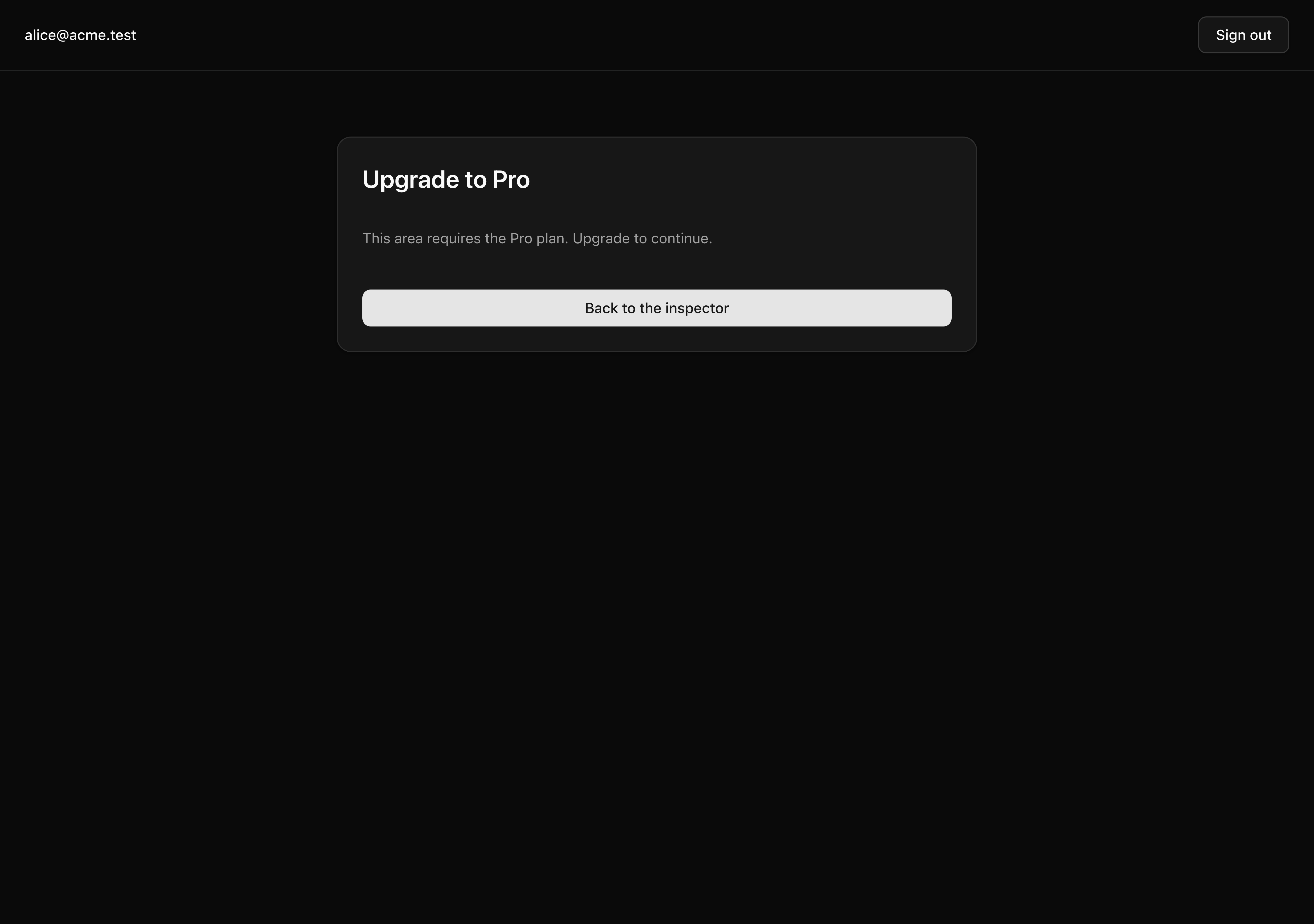
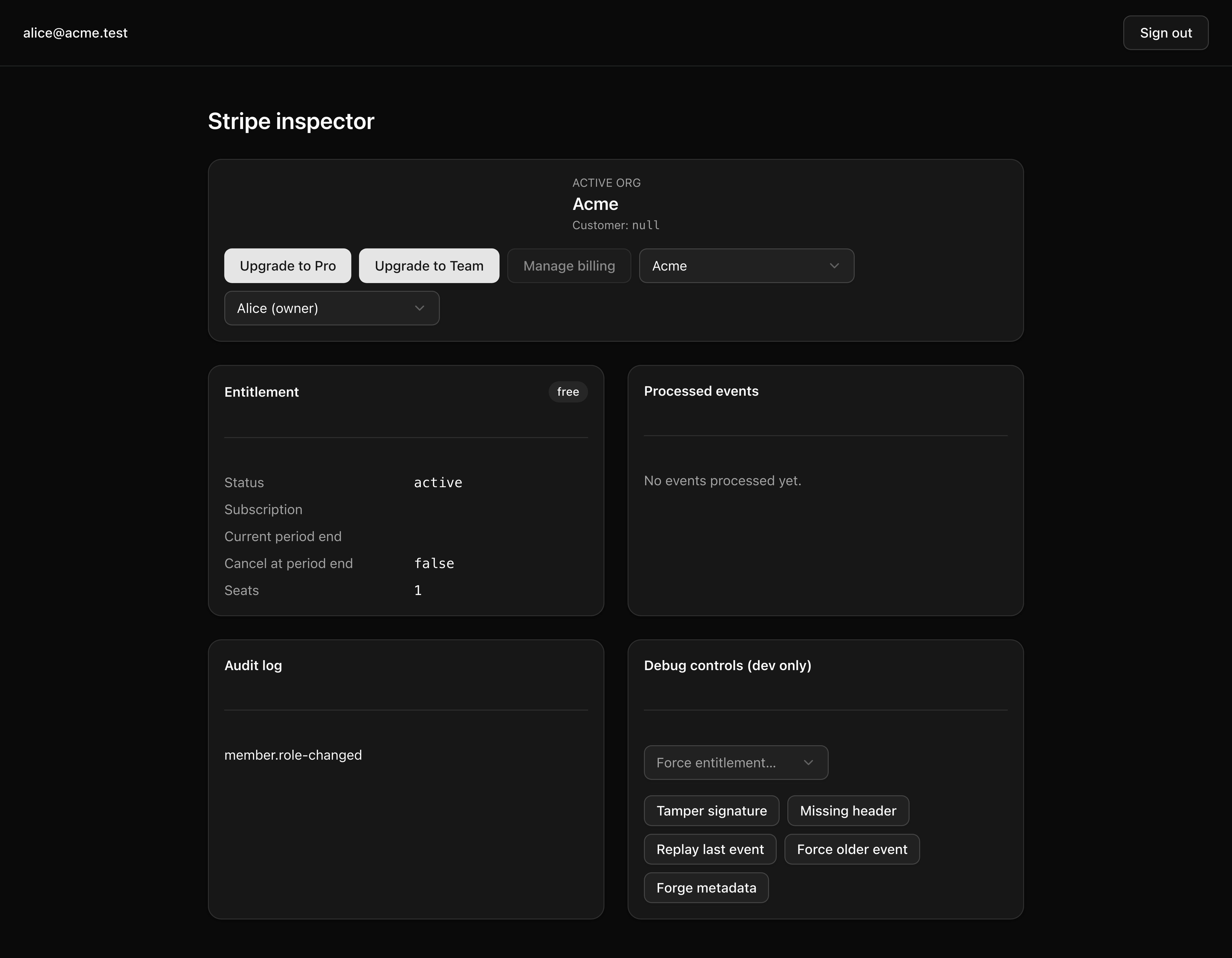
By the end the whole loop closes against a test-mode Stripe account. Clicking Upgrade to Pro in the inspector opens Stripe-hosted Checkout; paying with the test card 4242 4242 4242 4242 drops you on /billing/success, which shows “Finalizing your subscription…” for a beat and then flips to “You are all set” / “Your plan is now pro” the moment the webhook lands and the entitlement panel updates. Manage billing opens the Customer Portal in a new tab — cancel there and cancelAtPeriodEnd: true shows up on the panel within a moment. And /inspector/pro-only, which was rendering an “Upgrade to Pro” wall this whole time, finally serves its protected content.
Your mission
Section titled “Your mission”Everything the app says to Stripe goes through lib/billing/, and that is the whole point of this lesson. The Stripe SDK is imported in exactly one file — lib/billing/stripe.ts, which re-exports a configured stripe singleton — and every other call site in the codebase either reads the entitlement row or calls one of three methods you’re about to write: upgrade, openPortal, requirePlan. There’s no lint rule enforcing that boundary; it’s a convention held by the single re-export and by code review. The payoff is that the day Stripe ships a breaking SDK change, or you swap billing providers entirely, the blast radius is one directory instead of a grep across the app. This is the interface The thin billing interface designed in the teaching chapter; here you build it for real against the running app.
Two of the three are mutations and one is a gate, and the split is deliberate. upgrade and openPortal are authedAction('admin', …) Server Actions: they validate input, do a privileged thing, and return the canonical Result<{ url }> — a Stripe-hosted URL the client island navigates to. requirePlan is not an action. It starts with import 'server-only' rather than 'use server', it’s called from inside Server Components before any data read, and it throws a BillingError instead of returning a Result. That asymmetry is deliberate: actions return a Result the caller branches on, but a gate has nothing useful to return — it either lets the render proceed or it doesn’t, and a throw caught by the segment’s error.tsx is exactly the right shape for “stop rendering this page.” Treat a missing requirePlan on a paywalled component the way you’d treat a missing authedAction on a mutation: same audit class, same severity.
The one genuine cross-system write lives in upgrade. The first time an org upgrades it has no Stripe Customer, so you create one — and the ordering matters more than it looks. The Stripe-side customers.create must happen before the local setStripeCustomerId, never the reverse. Think about the failure: if the local write lands first and the Stripe call then fails, your database holds a pointer to a Customer that doesn’t exist, and nothing you write later can repair it. Flip the order and the worst case on a failed retry is a duplicate Customer on Stripe’s side — an orphan, but a harmless one you can clean up. Pick the recoverable failure. The production hardening here is an idempotency key on customers.create so the retry reuses the first Customer instead of orphaning one; this project ships the simpler path for clarity and names the hardening rather than building it.
A few Checkout details carry weight. The org’s id rides on both the Customer’s metadata and the session’s subscription_data.metadata as organization_id — that’s the carry-channel the webhook reads back off sub.metadata to figure out which tenant the subscription belongs to. You set trial_period_days: 14 and payment_method_collection: 'always' together on purpose: collecting a card at trial start means the trial-end transition is a charge, not a “now go chase the customer for a card” downgrade dance. allow_promotion_codes: false is the conservative default — turn it on deliberately, not by accident. And the Price is resolved from the catalog lookup_key through stripe.prices.list, never a hardcoded price_id string; lookup_key is the only stable handle Stripe IDs should travel by in your code. The success_url carries {CHECKOUT_SESSION_ID}, but notice what the success page does not do with it: it never calls sessions.retrieve. The webhook owns the write; the page reads the entitlement and polls until it flips. Reading-and-polling is structurally cleaner than trusting a session_id the browser handed you. Starting subscriptions with Checkout covers the session shape and the trial mechanics if you want the deeper Checkout background.
openPortal is smaller. Its job is to open a Billing Portal session for the org’s Customer, with one guard: if the org has no stripeCustomerId yet there’s no Portal to open, so it returns err('forbidden', …). The Portal opens in a new tab — its return_url navigation would otherwise fight your SPA’s back button — and STRIPE_PORTAL_RETURN_URL is the default return target the action can override per call. Managing subscriptions with the Portal is where the Portal session and its graceful-cancel flow are taught in full.
What you are explicitly not building: any cancel or changePlan method. The Stripe Customer Portal owns every user-initiated mutation — cancellation, plan switches, card updates — and wrapping more methods “for symmetry” is the named failure mode here. The interface stays at exactly three. The forged-organization_id cross-check is the next lesson’s hardening, not this one’s.
4242 4242 4242 4242 lands on /billing/success, which shows “Finalizing your subscription…” then “You are all set” / “Your plan is now pro” as the entitlement panel flips.stripeCustomerId on the org; the inspector header shows the id populated where it was null before.upgrade returns a successful Result carrying a Checkout url for a valid plan, and resolves the Price from the catalog lookup_key rather than a hardcoded id.upgrade for a plan with no configured Price returns err('not_found', …).cancelAtPeriodEnd: true within a moment.openPortal with no Stripe Customer yet returns err('forbidden', …), and the inspector’s Portal button is disabled with its tooltip until a Checkout has run.requirePlan('pro') resolves when the org’s entitlement is active and ranks at or above pro; throws BillingError('no_access') when the entitlement is inactive; throws BillingError('plan_required') when the tier is too low./inspector/pro-only renders the “Upgrade to Pro” fallback before the upgrade, the protected content after, and reverts to the fallback once the subscription is deleted.Coding time
Section titled “Coding time”Implement the three method bodies against the brief and the lesson’s tests before you open the solution. The surrounding scaffolding ships complete in the starter — BillingError, the index.ts barrel, and the pro-only/error.tsx gate are already written, and this lesson only removes their TODO(L5) markers. Your real work is the three bodies in upgrade.ts, portal.ts, and require-plan.ts.
Reference solution and walkthrough
lib/billing/upgrade.ts
Section titled “lib/billing/upgrade.ts”This is the decision-dense file. It’s an authedAction('admin', …) whose input schema is a strict object with a single planSlug enum, and its body runs four steps: read the org, ensure the Customer, resolve the Price, create the session.
'use server';
import { z } from 'zod';
import {  getOrgWithOwnerEmail,  setStripeCustomerId,} from '@/db/queries/organizations';import { env } from '@/env';import { authedAction } from '@/lib/auth/authed-action';import { loadCatalog } from '@/lib/billing/catalog';import { stripe } from '@/lib/billing/stripe';import { err, ok, type Result } from '@/lib/result';
export const upgrade = authedAction(  'admin',  z.strictObject({ planSlug: z.enum(['pro', 'team']) }),  async ({ planSlug }, ctx): Promise<Result<{ url: string }>> => {    const org = await getOrgWithOwnerEmail(ctx.orgId);
    let customerId = org.stripeCustomerId;    if (!customerId) {      const customer = await stripe.customers.create({        email: org.ownerEmail,        metadata: { organization_id: ctx.orgId },      });      customerId = customer.id;      await setStripeCustomerId(ctx.orgId, customerId);    }
    const catalog = loadCatalog();    const lookupKey = Object.keys(catalog.lookupKeys).find(      (key) => catalog.lookupKeys[key] === planSlug,    );    if (!lookupKey) {      return err('not_found', 'No price is configured for that plan.');    }    const prices = await stripe.prices.list({      lookup_keys: [lookupKey],      active: true,      limit: 1,    });    const price = prices.data[0];    if (!price) {      return err('not_found', 'No price is configured for that plan.');    }
    const session = await stripe.checkout.sessions.create({      mode: 'subscription',      customer: customerId,      line_items: [{ price: price.id, quantity: 1 }],      subscription_data: {        metadata: { organization_id: ctx.orgId },        trial_period_days: 14,      },      payment_method_collection: 'always',      allow_promotion_codes: false,      success_url: `${env.APP_URL}/billing/success?session_id={CHECKOUT_SESSION_ID}`,      cancel_url: `${env.APP_URL}/inspector`,    });
    if (!session.url) {      return err('internal', 'Stripe did not return a Checkout URL.');    }    return ok({ url: session.url });  },);
An authedAction('admin', …) whose input schema is a strict object with a single planSlug enum, returning the canonical Promise<Result<{ url: string }>> — admin-only, validated, and handing back a Stripe-hosted URL the client island navigates to.
'use server';
import { z } from 'zod';
import {  getOrgWithOwnerEmail,  setStripeCustomerId,} from '@/db/queries/organizations';import { env } from '@/env';import { authedAction } from '@/lib/auth/authed-action';import { loadCatalog } from '@/lib/billing/catalog';import { stripe } from '@/lib/billing/stripe';import { err, ok, type Result } from '@/lib/result';
export const upgrade = authedAction(  'admin',  z.strictObject({ planSlug: z.enum(['pro', 'team']) }),  async ({ planSlug }, ctx): Promise<Result<{ url: string }>> => {    const org = await getOrgWithOwnerEmail(ctx.orgId);
    let customerId = org.stripeCustomerId;    if (!customerId) {      const customer = await stripe.customers.create({        email: org.ownerEmail,        metadata: { organization_id: ctx.orgId },      });      customerId = customer.id;      await setStripeCustomerId(ctx.orgId, customerId);    }
    const catalog = loadCatalog();    const lookupKey = Object.keys(catalog.lookupKeys).find(      (key) => catalog.lookupKeys[key] === planSlug,    );    if (!lookupKey) {      return err('not_found', 'No price is configured for that plan.');    }    const prices = await stripe.prices.list({      lookup_keys: [lookupKey],      active: true,      limit: 1,    });    const price = prices.data[0];    if (!price) {      return err('not_found', 'No price is configured for that plan.');    }
    const session = await stripe.checkout.sessions.create({      mode: 'subscription',      customer: customerId,      line_items: [{ price: price.id, quantity: 1 }],      subscription_data: {        metadata: { organization_id: ctx.orgId },        trial_period_days: 14,      },      payment_method_collection: 'always',      allow_promotion_codes: false,      success_url: `${env.APP_URL}/billing/success?session_id={CHECKOUT_SESSION_ID}`,      cancel_url: `${env.APP_URL}/inspector`,    });
    if (!session.url) {      return err('internal', 'Stripe did not return a Checkout URL.');    }    return ok({ url: session.url });  },);
Ensure the Customer behind an if (!customerId) guard. stripe.customers.create runs before setStripeCustomerId — a duplicate orphan Customer on a failed retry is fixable, a local pointer to a non-existent Customer is not. The organization_id metadata is the carry-channel the webhook reads back to resolve the tenant.
'use server';
import { z } from 'zod';
import {  getOrgWithOwnerEmail,  setStripeCustomerId,} from '@/db/queries/organizations';import { env } from '@/env';import { authedAction } from '@/lib/auth/authed-action';import { loadCatalog } from '@/lib/billing/catalog';import { stripe } from '@/lib/billing/stripe';import { err, ok, type Result } from '@/lib/result';
export const upgrade = authedAction(  'admin',  z.strictObject({ planSlug: z.enum(['pro', 'team']) }),  async ({ planSlug }, ctx): Promise<Result<{ url: string }>> => {    const org = await getOrgWithOwnerEmail(ctx.orgId);
    let customerId = org.stripeCustomerId;    if (!customerId) {      const customer = await stripe.customers.create({        email: org.ownerEmail,        metadata: { organization_id: ctx.orgId },      });      customerId = customer.id;      await setStripeCustomerId(ctx.orgId, customerId);    }
    const catalog = loadCatalog();    const lookupKey = Object.keys(catalog.lookupKeys).find(      (key) => catalog.lookupKeys[key] === planSlug,    );    if (!lookupKey) {      return err('not_found', 'No price is configured for that plan.');    }    const prices = await stripe.prices.list({      lookup_keys: [lookupKey],      active: true,      limit: 1,    });    const price = prices.data[0];    if (!price) {      return err('not_found', 'No price is configured for that plan.');    }
    const session = await stripe.checkout.sessions.create({      mode: 'subscription',      customer: customerId,      line_items: [{ price: price.id, quantity: 1 }],      subscription_data: {        metadata: { organization_id: ctx.orgId },        trial_period_days: 14,      },      payment_method_collection: 'always',      allow_promotion_codes: false,      success_url: `${env.APP_URL}/billing/success?session_id={CHECKOUT_SESSION_ID}`,      cancel_url: `${env.APP_URL}/inspector`,    });
    if (!session.url) {      return err('internal', 'Stripe did not return a Checkout URL.');    }    return ok({ url: session.url });  },);
Resolve the Price by lookup_key, never a hardcoded price_id: reverse-scan catalog.lookupKeys for the slug. No key for the plan is the first err('not_found', …) exit — a misconfiguration the admin can act on, so an err, not a throw.
'use server';
import { z } from 'zod';
import {  getOrgWithOwnerEmail,  setStripeCustomerId,} from '@/db/queries/organizations';import { env } from '@/env';import { authedAction } from '@/lib/auth/authed-action';import { loadCatalog } from '@/lib/billing/catalog';import { stripe } from '@/lib/billing/stripe';import { err, ok, type Result } from '@/lib/result';
export const upgrade = authedAction(  'admin',  z.strictObject({ planSlug: z.enum(['pro', 'team']) }),  async ({ planSlug }, ctx): Promise<Result<{ url: string }>> => {    const org = await getOrgWithOwnerEmail(ctx.orgId);
    let customerId = org.stripeCustomerId;    if (!customerId) {      const customer = await stripe.customers.create({        email: org.ownerEmail,        metadata: { organization_id: ctx.orgId },      });      customerId = customer.id;      await setStripeCustomerId(ctx.orgId, customerId);    }
    const catalog = loadCatalog();    const lookupKey = Object.keys(catalog.lookupKeys).find(      (key) => catalog.lookupKeys[key] === planSlug,    );    if (!lookupKey) {      return err('not_found', 'No price is configured for that plan.');    }    const prices = await stripe.prices.list({      lookup_keys: [lookupKey],      active: true,      limit: 1,    });    const price = prices.data[0];    if (!price) {      return err('not_found', 'No price is configured for that plan.');    }
    const session = await stripe.checkout.sessions.create({      mode: 'subscription',      customer: customerId,      line_items: [{ price: price.id, quantity: 1 }],      subscription_data: {        metadata: { organization_id: ctx.orgId },        trial_period_days: 14,      },      payment_method_collection: 'always',      allow_promotion_codes: false,      success_url: `${env.APP_URL}/billing/success?session_id={CHECKOUT_SESSION_ID}`,      cancel_url: `${env.APP_URL}/inspector`,    });
    if (!session.url) {      return err('internal', 'Stripe did not return a Checkout URL.');    }    return ok({ url: session.url });  },);
Ask Stripe to list active Prices for that key with limit: 1. An empty list is the second err('not_found', …) exit (a seed that never ran). The chosen price.id is what flows into line_items — proof the lookup_key indirection is real, not decorative.
'use server';
import { z } from 'zod';
import {  getOrgWithOwnerEmail,  setStripeCustomerId,} from '@/db/queries/organizations';import { env } from '@/env';import { authedAction } from '@/lib/auth/authed-action';import { loadCatalog } from '@/lib/billing/catalog';import { stripe } from '@/lib/billing/stripe';import { err, ok, type Result } from '@/lib/result';
export const upgrade = authedAction(  'admin',  z.strictObject({ planSlug: z.enum(['pro', 'team']) }),  async ({ planSlug }, ctx): Promise<Result<{ url: string }>> => {    const org = await getOrgWithOwnerEmail(ctx.orgId);
    let customerId = org.stripeCustomerId;    if (!customerId) {      const customer = await stripe.customers.create({        email: org.ownerEmail,        metadata: { organization_id: ctx.orgId },      });      customerId = customer.id;      await setStripeCustomerId(ctx.orgId, customerId);    }
    const catalog = loadCatalog();    const lookupKey = Object.keys(catalog.lookupKeys).find(      (key) => catalog.lookupKeys[key] === planSlug,    );    if (!lookupKey) {      return err('not_found', 'No price is configured for that plan.');    }    const prices = await stripe.prices.list({      lookup_keys: [lookupKey],      active: true,      limit: 1,    });    const price = prices.data[0];    if (!price) {      return err('not_found', 'No price is configured for that plan.');    }
    const session = await stripe.checkout.sessions.create({      mode: 'subscription',      customer: customerId,      line_items: [{ price: price.id, quantity: 1 }],      subscription_data: {        metadata: { organization_id: ctx.orgId },        trial_period_days: 14,      },      payment_method_collection: 'always',      allow_promotion_codes: false,      success_url: `${env.APP_URL}/billing/success?session_id={CHECKOUT_SESSION_ID}`,      cancel_url: `${env.APP_URL}/inspector`,    });
    if (!session.url) {      return err('internal', 'Stripe did not return a Checkout URL.');    }    return ok({ url: session.url });  },);
Create the subscription-mode session. subscription_data.metadata repeats the carry-channel; trial_period_days: 14 paired with payment_method_collection: 'always' turns trial-end into a silent charge; allow_promotion_codes: false is the conservative default. The success_url carries {CHECKOUT_SESSION_ID} — but the success page reads-and-polls, it never retrieves the session.
Two of the four steps deserve a second look. The Price resolution is a two-stage indirection on purpose: the catalog maps lookup_key → slug, so resolving a Price means reverse-scanning the catalog for the requested slug to get its lookup_key, then asking Stripe to list Prices by that key. There are two distinct not_found exits — one when the catalog has no lookup_key for the plan, one when the catalog knows the key but Stripe’s account has no active Price for it (a seed that never ran). Both are recoverable misconfigurations the admin can act on, so they’re err, not throws. And the line_items price is price.id returned by stripe.prices.list, not a literal — proof the lookup_key indirection is real and not decorative.
The trial_period_days: 14 and payment_method_collection: 'always' pairing is the trial-flow default worth internalizing. A trial without a collected card means that when the trial ends Stripe has nothing to charge, and you’re left downgrading the account and emailing the user. Collecting the card up front turns trial-end into a silent successful charge. allow_promotion_codes: false keeps the Checkout page from showing a promo field you haven’t set up promos for.
lib/billing/portal.ts
Section titled “lib/billing/portal.ts”Smaller and simpler. An authedAction('admin', …) taking an optional returnPath, with a single guard and a single Stripe call.
'use server';
import { z } from 'zod';
import { getOrgWithOwnerEmail } from '@/db/queries/organizations';import { env } from '@/env';import { authedAction } from '@/lib/auth/authed-action';import { BillingError } from '@/lib/billing/billing-error';import { stripe } from '@/lib/billing/stripe';import { err, ok, type Result } from '@/lib/result';
// 'use server' — the Portal client island imports and calls this. Opens a Stripe// Billing Portal session for the org's Customer and returns its URL (the island opens// it in a new tab). Plan changes and cancellation happen in the Portal, never via// stripe.subscriptions.update from app code.export const openPortal = authedAction(  'admin',  z.strictObject({ returnPath: z.string().optional() }),  async ({ returnPath }, ctx): Promise<Result<{ url: string }>> => {    const org = await getOrgWithOwnerEmail(ctx.orgId);
    // No Customer → no Portal to open. The inspector already disables the button when    // stripeCustomerId is null, so this is belt-and-suspenders; the BillingError carries    // the machine-readable distinction the Result's userMessage cannot.    if (!org.stripeCustomerId) {      const reason = new BillingError(        'no_customer',        'Start a Checkout to create a billing account first.',      );      return err('forbidden', reason.userMessage);    }
    const session = await stripe.billingPortal.sessions.create({      customer: org.stripeCustomerId,      return_url: returnPath ?? env.STRIPE_PORTAL_RETURN_URL,    });
    return ok({ url: session.url });  },);
The no-Customer branch looks redundant — the inspector already disables the button when there’s no Customer — and that’s the point of building a BillingError('no_customer') and returning its userMessage through err('forbidden', …). The UI guard is convenience; the action guard is the real boundary, because a Result’s userMessage is a human string with no machine-readable code, and the BillingError carries the no_customer distinction the Result alone can’t express. Belt and suspenders: never trust the client to have disabled the dangerous path.
lib/billing/require-plan.ts
Section titled “lib/billing/require-plan.ts”The load-bearing gate. Note the very first line.
import 'server-only';
import { getEntitlement, hasActiveAccess } from '@/db/queries/entitlements';import { requireOrgUser } from '@/lib/auth';import { BillingError } from '@/lib/billing/billing-error';import type { PlanSlug } from '@/lib/billing/catalog';
// The tier order, free < pro < team. A higher tier admits a lower-tier gate, so the// gate compares ranks rather than equality. `satisfies` keeps the map exhaustive over// PlanSlug — a new tier without a rank is a tsc error.const PLAN_RANK = { free: 0, pro: 1, team: 2 } as const satisfies Record<  PlanSlug,  number>;
// The load-bearing Server-Component gate. `import 'server-only'` (NOT 'use server') —// it is called from server components, never client-callable. A failure throws a// BillingError, which the segment error.tsx catches and renders as the upgrade// fallback; the gate is fail-closed (a thrown error inside the check is a refusal).//// Two distinct refusals carry distinct codes: an inactive entitlement throws// 'no_access', a too-low tier throws 'plan_required'. error.tsx switches on the code to// render the right message.export const requirePlan = async (planSlug: 'pro' | 'team'): Promise<void> => {  const { orgId } = await requireOrgUser();  const e = await getEntitlement(orgId);
  if (!hasActiveAccess(e)) {    throw new BillingError(      'no_access',      'Your subscription is no longer active.',    );  }
  if (PLAN_RANK[e.plan] < PLAN_RANK[planSlug]) {    throw new BillingError(      'plan_required',      `This area requires the ${planSlug} plan.`,    );  }};
import 'server-only', not 'use server'. The distinction is load-bearing: 'use server' would mark this a Server Action and make it client-callable over the network, which is wrong for a gate that only ever runs inside a Server Component render. import 'server-only' does the opposite — it’s a build-time tripwire that fails the bundle if this module is ever pulled into client code.
The gate compares ranks, not equality. PLAN_RANK orders the tiers free < pro < team, so a team entitlement satisfies a requirePlan('pro') gate — a higher tier admits a lower-tier requirement, the way you’d expect. The satisfies Record<PlanSlug, number> keeps that table honest: add a fourth tier to PlanSlug without giving it a rank and TypeScript fails the build instead of silently treating it as rank zero.
The two refusals are intentionally distinct. An inactive entitlement (a canceled or incomplete subscription) throws no_access; a perfectly active subscription on too low a tier throws plan_required. They mean different things to the user — “your subscription lapsed, reactivate it” versus “this is a Pro feature, upgrade” — and the gate keeps them separate so the fallback can show the right message.
The pieces the starter already ships
Section titled “The pieces the starter already ships”These three are provided complete; you only delete their TODO(L5) comments. They’re worth reading to see how the three methods fit together.
billing-error.ts carries the full code vocabulary the whole billing domain throws — the gate uses no_access and plan_required, openPortal uses no_customer, and the webhook handlers use unknown_customer and unknown_plan:
export class BillingError extends Error {  override readonly name = 'BillingError' as const;  readonly code:    | 'no_access'    | 'plan_required'    | 'no_customer'    | 'unknown_customer'    | 'unknown_plan';
  constructor(    code: BillingError['code'],    public readonly userMessage: string,  ) {    super(userMessage);    this.code = code;  }}
index.ts is the sanctioned barrel — exactly the three methods, no wildcard, and pointedly no stripe / BillingError / catalog re-export, so the SDK and the error class stay internal to the directory:
// The sanctioned billing barrel: re-export EXACTLY the three interface methods.// No wildcard re-export, and no stripe / BillingError / catalog re-export — the SDK// and the error class stay internal to lib/billing. Surfaces import// `billing.upgrade`/`billing.openPortal`/`billing.requirePlan` from here.export { openPortal } from '@/lib/billing/portal';export { requirePlan } from '@/lib/billing/require-plan';export { upgrade } from '@/lib/billing/upgrade';pro-only/error.tsx is the segment boundary that catches what requirePlan throws. It switches on the error’s code to choose the message — and note why it reads error.code off a plain shape rather than instanceof BillingError:
// error.tsx must be a Client Component. The thrown BillingError arrives as a plain// Error here (its prototype is lost across the boundary), so the code is read off the// serialized shape rather than `instanceof`. The discrimination is on BillingError.code:// 'no_access' (the subscription is inactive) vs 'plan_required' (the tier is too low) —// the two refusals requirePlan throws against this gate.type BillingErrorLike = Error & { code?: string };
const ProOnlyGate = ({  error,}: {  error: BillingErrorLike;  reset: () => void;}) => {  const code = error.code ?? 'plan_required';  const message =    code === 'no_access'      ? 'Your subscription is no longer active. Reactivate to regain access.'      : 'This area requires the Pro plan. Upgrade to continue.';
When an error crosses the server-to-client boundary in React, only a serialized shape survives — the prototype chain is gone, so instanceof BillingError would be false on the other side. Discriminating on a plain code property is the pattern that survives the crossing. This is the same error.tsx interop you saw with Result and Server Actions in Result, or throw; the gate leans on it instead of re-deriving it.
Two client islands wire the buttons, both provided. CheckoutButton calls upgrade(null, formData) and, on ok, does a full window.location.assign(result.data.url) — a real navigation off to Stripe’s domain, not a router.push. PortalButton calls openPortal and window.opens the URL in a new tab; when hasCustomer is false it renders a disabled button wrapped in a <span>, because a disabled button fires no pointer events and the tooltip needs a live element to hover.
API reference for the checkout.sessions.create call in upgrade — subscription mode, subscription_data, and metadata.
API reference for billingPortal.sessions.create in openPortal — customer, return_url, and the returned url.
Why the Portal owns cancellation and plan switches — the reason the interface stays at three methods.
Resolving a Price by lookup_key via prices.list instead of a hardcoded price_id — the indirection upgrade relies on.
Moment of truth
Section titled “Moment of truth”Run the lesson’s automated suite:
pnpm test:lesson 5It exercises the seam behavior each method owns without a live Stripe call — upgrade’s Price resolution and its two not_found exits, openPortal’s no-Customer err('forbidden') and its success path, and requirePlan’s three dispositions driven by the entitlement row. The Stripe SDK, the auth context, and the database reads are replaced with inert stand-ins so the assertion lands on each method’s returned Result or thrown error, never on a Stripe fixture. Expect green:
 ✓ FR3: upgrade resolves a Price from the catalog lookup_key and returns a Checkout url (3) ✓ FR4: upgrade returns not_found when no Price is configured for the plan (2) ✓ FR6: openPortal refuses with forbidden when the org has no Stripe Customer (2) ✓ FR7: requirePlan gates on the entitlement row (active / inactive / too-low tier) (4)
 Test Files  1 passed (1)      Tests  11 passed (11)
The suite can’t reach a live Stripe-hosted round-trip, so the rest is yours to confirm by hand. With pnpm dev running and pnpm stripe:listen forwarding events, walk the inspector through each of these:
4242 4242 4242 4242 (any future expiry, any CVC), and confirm /billing/success shows “Finalizing your subscription…” then flips to “You are all set” / “Your plan is now pro” within a second or two as the entitlement panel updates.stripeCustomerId as null; after it, the header shows a populated cus_… id — the Customer was created on the first Checkout.cancelAtPeriodEnd: true within a moment./inspector/pro-only renders the “Upgrade to Pro” fallback before upgrading, the protected content after upgrading, and reverts to the fallback once the subscription is deleted (fire stripe trigger customer.subscription.deleted, or cancel and let the period end).