Organization plugin and the active-org session
The starter runs, but every tenant-aware surface is hollow. Sign in, open /inspector, and the active-org banner reads “No active organization” — there is no organization table, no member table, and nothing on the session that says which org you are acting inside. The role primitives the privileged paths will lean on are stubs that always return false. This is the foundation lesson: by the end, /inspector resolves a real org context. The active-org banner shows the acting user’s org name and role, and the dev acting-user and org switchers re-render it against live data — Alice as owner of Acme, with all four seeded users selectable in the acting-user dropdown.
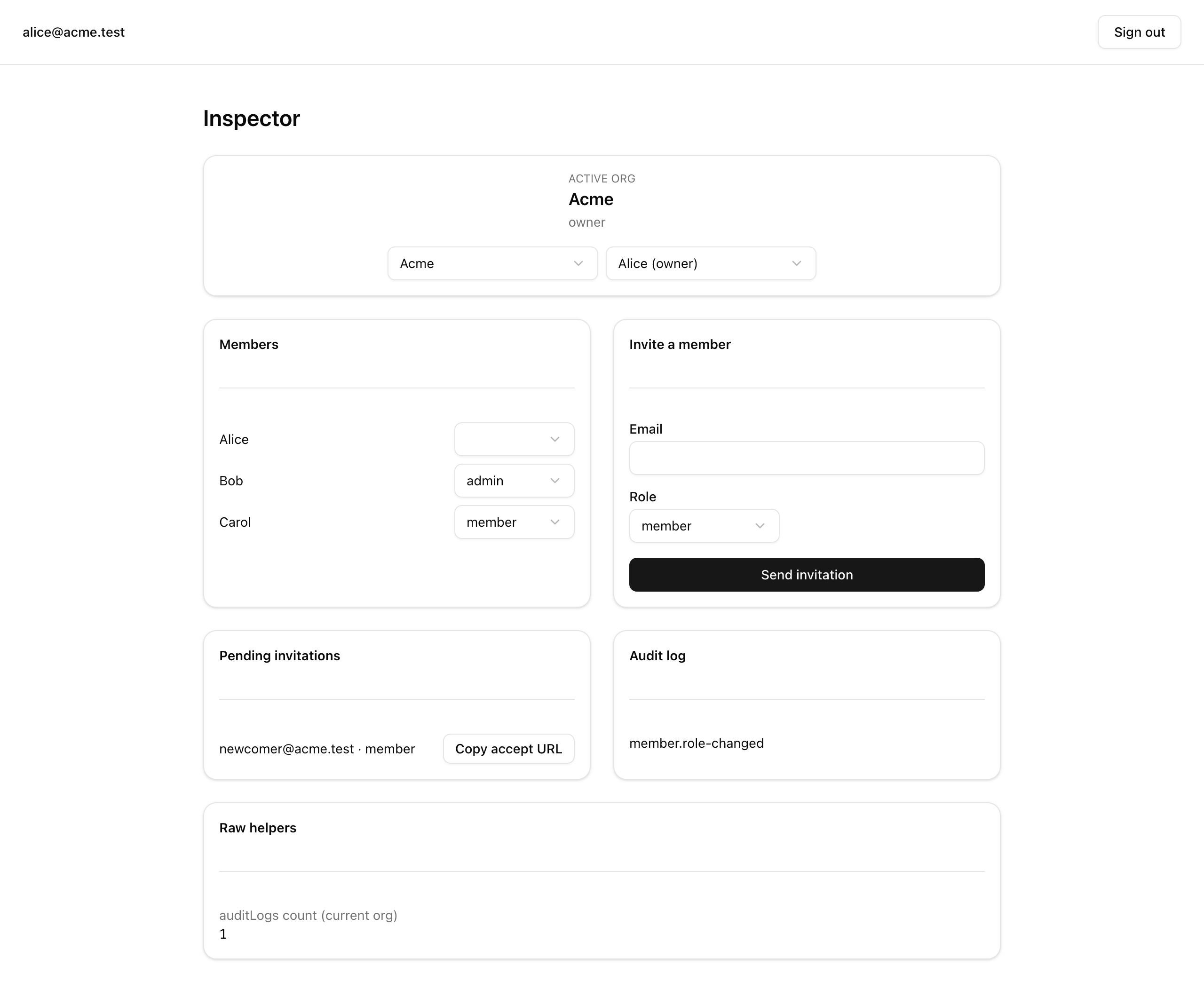
Your mission
Section titled “Your mission”You are wiring the tenancy spine of the app. Three pieces have to land together, and the order in which they land is the lesson. First, the organization, member, and invitation tables are not yours to hand-write — Better Auth’s organization plugin owns them. You register the plugin, and a CLI reads your config and generates the Drizzle schema for you. This project layers two server-managed columns onto invitation (tokenHash and acceptedAt) through the plugin’s additionalFields, marked so the app sets them and the API caller never can; the plugin runs with teams disabled and a seven-day invitation expiry named as a constant rather than buried as a magic number.
Second, the active org belongs on the session, not in a global or a query string. Every path that mints a session — sign-in, sign-up, post-verification — converges on one Better Auth hook, and that single hook is where you seed activeOrganizationId from the user’s membership. Scatter the setter across the individual flows and you will forget one; put it in the one structural place they all flow through and it is correct by construction.
Third, the access primitives. roleAtLeast orders the three roles so a gate can ask “is this identity at least an admin?” without re-deriving the hierarchy each time. requireOrgUser resolves the active-org context for a protected request — and it reads the role fresh from the database, never from the session cookie cache, because that cache can carry a stale role for the freshAge window after a role change. The active-org id comes only from the server-validated session; a query string or route param must never decide which tenant you are acting inside.
One reminder on the CLI step that trips people up: the generated schema file is machine-output. After you change the plugin config you regenerate and commit the diff. Hand-editing the generated file is the kind of thing a reviewer spots instantly and bounces.
Out of scope for this lesson: the create-org onboarding page and the org / acting-user switcher client components are provided. Verify them, don’t re-implement them.
organization, member, and invitation tables exist in the migrated schema, and session carries an activeOrganizationId column, once the regenerated auth schema is committed and migrated.activeOrganizationId populated to the user’s first membership, confirmed for the four seeded users.roleAtLeast orders the three roles correctly: a member does not satisfy admin; an admin satisfies admin but not owner; an owner satisfies all three.requireOrgUser() returns { user, orgId, role } for a member of the active org, redirects to /onboarding/create-org when no active org is set, and redirects there again when no membership is found for that org./onboarding/create-org; submitting creates the org and redirects to /dashboard with the new org active.Coding time
Section titled “Coding time”Build it against the brief and pnpm test:lesson 2 before you open the walkthrough. The TODO stubs you are filling live in src/lib/auth/roles.ts, src/lib/auth.ts, src/lib/auth-schema.config.ts, and src/app/(protected)/inspector/_data.ts, plus the pnpm auth:generate step that regenerates src/db/schema/auth.ts.
Reference solution and walkthrough
The role vocabulary
Section titled “The role vocabulary”Start with the smallest piece, because everything else references it. src/lib/auth/roles.ts defines the three roles and a single comparison:
// No `import 'server-only'` — pure role vocabulary, safe for client components.
export type Role = 'owner' | 'admin' | 'member';
export const ROLE_RANK = {  member: 0,  admin: 1,  owner: 2,} as const satisfies Record<Role, number>;
export const roleAtLeast = (role: Role, required: Role): boolean =>  ROLE_RANK[role] >= ROLE_RANK[required];
Ranking the roles as integers turns “is this identity privileged enough?” into a >= comparison. The satisfies Record<Role, number> is doing real work: it forces the object to cover every role and gives you a compile error the day a fourth role is added without a rank, while keeping the literal 0 | 1 | 2 types intact for the lookup.
The comment on line 1 is deliberate. There is no import 'server-only' here. The role select in the inspector renders client-side, and a client component that imports this module to label its options would crash the build if the module were server-only-poisoned. Role vocabulary is pure data — it is safe to share across the boundary, and keeping it that way is what lets the UI and the server agree on the same Role type. The Role type itself was provided in the starter; you are only filling ROLE_RANK and roleAtLeast.
Registering the organization plugin
Section titled “Registering the organization plugin”Now the plugin. In src/lib/auth.ts you add organization() to the plugins array. Where it sits in that array matters, and so do three of its options — this is the kind of block where one misplaced line produces a bug that looks nothing like its cause.
plugins: [ organization({ teams: { enabled: false }, invitationExpiresIn: INVITATION_TTL_SECONDS, schema: { invitation: { additionalFields: { tokenHash: { type: 'string', required: true, input: false }, acceptedAt: { type: 'date', required: false, input: false }, }, }, }, }), nextCookies(),],nextCookies() MUST stay last in the array — it is the plugin that flushes the Set-Cookie header out of the Server Action response. Register organization() after it and sign-in still “works” on the server, but no session cookie ever reaches the browser, so the next request looks logged-out. The ordering bug is invisible in logs.
plugins: [ organization({ teams: { enabled: false }, invitationExpiresIn: INVITATION_TTL_SECONDS, schema: { invitation: { additionalFields: { tokenHash: { type: 'string', required: true, input: false }, acceptedAt: { type: 'date', required: false, input: false }, }, }, }, }), nextCookies(),],Teams are off — this project models one flat membership layer per org, no nested teams. INVITATION_TTL_SECONDS is the seven-day constant declared at module scope (60 * 60 * 24 * 7); naming it once and passing it here keeps the expiry in one place the send/accept flows can also reference.
plugins: [ organization({ teams: { enabled: false }, invitationExpiresIn: INVITATION_TTL_SECONDS, schema: { invitation: { additionalFields: { tokenHash: { type: 'string', required: true, input: false }, acceptedAt: { type: 'date', required: false, input: false }, }, }, }, }), nextCookies(),],The plugin’s invitation table is extended with two columns this project needs: tokenHash (the SHA-256 of the invite token) and acceptedAt. input: false means these are server-managed — the application sets them, the API caller cannot pass them in. That is what keeps an attacker from supplying their own tokenHash.
Seeding the active org once
Section titled “Seeding the active org once”The session needs to know which org it is acting inside. Better Auth gives you exactly one structural place to set it: a before hook on session creation. Every flow that mints a session — sign-in, sign-up, the auto-sign-in after email verification — passes through this hook, so seeding activeOrganizationId here means you write the setter once and it is never forgotten.
// The session-create hook seeds activeOrganizationId from the user's most-recent// membership. One org per user in this project, so findFirst is enough.const pickInitialActiveOrg = async (userId: string): Promise<string | null> => { const membership = await db.query.member.findFirst({ where: eq(authSchema.member.userId, userId), }); return membership?.organizationId ?? null;};pickInitialActiveOrg reads the user’s membership and returns its organizationId, or null when the user belongs to nowhere yet (a fresh signup). findFirst is enough because this project gives each user a single org; a multi-org product would pick a “last active” org instead, but here there is only one row to find.
The hook itself spreads the session Better Auth is about to write and adds the seeded id:
// Seed activeOrganizationId on every session mint — the one place all sign-in / // sign-up / verification paths flow through, so the setter is never sprinkled // across the individual flows. databaseHooks: { session: { create: { before: async (session) => ({ data: { ...session, activeOrganizationId: await pickInitialActiveOrg(session.userId), }, }), }, }, },The before hook returns { data: ... } — Better Auth takes that as the row it persists. Spreading ...session preserves everything the plugin already computed; you are only adding one field. This is the load-bearing design decision of the lesson: there is no setActiveOrganization call sprinkled into the sign-in action, the sign-up action, or the verification path. There is one hook, and it is correct for all of them.
Mirroring the config for the schema generator
Section titled “Mirroring the config for the schema generator”You did not hand-write the organization / member / invitation tables — the CLI generates them. But the CLI cannot import src/lib/auth.ts: that file starts with import 'server-only', and the CLI’s loader executes the whole import graph in plain Node, where server-only throws on sight. So the project keeps a second, server-only-free config the CLI reads: src/lib/auth-schema.config.ts. It mirrors only the options that shape the schema.
plugins: [ organization({ teams: { enabled: false }, invitationExpiresIn: INVITATION_TTL_SECONDS, schema: { invitation: { additionalFields: { tokenHash: { type: 'string', required: true, input: false }, acceptedAt: { type: 'date', required: false, input: false }, }, }, }, }), nextCookies(), ],The live instance — carries everything. The databaseHooks that seed the active org, invitationExpiresIn, and the input: false flags that govern runtime write behavior. These are runtime concerns; the generator ignores them.
import { betterAuth } from 'better-auth';import { drizzleAdapter } from 'better-auth/adapters/drizzle';import { organization } from 'better-auth/plugins';
import { db } from '@/db';
export const auth = betterAuth({  database: drizzleAdapter(db, { provider: 'pg' }),  emailAndPassword: { enabled: true },  plugins: [    organization({      teams: { enabled: false },      schema: {        invitation: {          additionalFields: {            tokenHash: { type: 'string', required: true },            acceptedAt: { type: 'date', required: false },          },        },      },    }),  ],});
The mirror — only what changes the table shape. Teams off so no team tables emit, and the two extra invitation columns. No databaseHooks, no invitationExpiresIn, no input: false (a schema-only concern is whether the column exists, not who may write it). It imports nothing server-only, because the CLI executes everything it reaches.
Keeping two configs in sync is a real maintenance cost, so be honest about the line you are walking: the mirror exists only because the generator and the runtime have different constraints (one must be Node-safe, the other must be the live instance). The discipline is to change the plugin’s table shape in both files, then regenerate.
With the mirror in place, run the generator and commit what it produces:
pnpm auth:generate— the CLI readsauth-schema.config.tsand rewritessrc/db/schema/auth.tswith the new tables and columns.pnpm db:generate— Drizzle Kit diffs the schema and emits a SQL migration.pnpm db:migrate— applies the migration to your local Postgres.- Review and commit the generated
schema/auth.tsand the new migration file together. Do not hand-edit the generated schema — if it is wrong, fix the config and regenerate.
The generated schema/auth.ts is long and you should not reproduce it by hand — that is the whole point of generating it. What it adds, in diff terms, is three new tables and a column:
export const session = pgTable('session', {  // ...existing columns  activeOrganizationId: text('active_organization_id'),});
export const organization = pgTable('organization', {  id: text('id').primaryKey(),  name: text('name').notNull(),  slug: text('slug').notNull().unique(),  // ...});
export const member = pgTable('member', {  id: text('id').primaryKey(),  organizationId: text('organization_id').notNull().references(() => organization.id, ...),  userId: text('user_id').notNull().references(() => user.id, ...),  role: text('role').default('member').notNull(),  // ...});
export const invitation = pgTable('invitation', {  id: text('id').primaryKey(),  organizationId: text('organization_id').notNull().references(() => organization.id, ...),  email: text('email').notNull(),  role: text('role'),  status: text('status').default('pending').notNull(),  tokenHash: text('token_hash').notNull(),     // the additionalField — required  acceptedAt: timestamp('accepted_at'),         // the additionalField — nullable  // ...});
Notice tokenHash landed as NOT NULL and acceptedAt as nullable — exactly the required: true / required: false you set in the config. The plugin’s table shape flowed through the generator into real DDL without you typing a single column by hand.
requireOrgUser: the active-org gate
Section titled “requireOrgUser: the active-org gate”This is the function every privileged read and write in the project will call to answer three questions at once: who is the user, which org are they acting inside, and what is their role there. The starter shipped a placeholder that returned an empty org so the inspector could render without redirect-looping; you are replacing it with the real thing.
export const requireOrgUser = cache(  async (): Promise<{ user: User; orgId: string; role: Role }> => {    const session = await getSession();    if (!session) {      redirect('/sign-in' as Route);    }
    const orgId = session.session.activeOrganizationId;    if (!orgId) {      redirect('/onboarding/create-org' as Route);    }
    const activeMember = await auth.api.getActiveMember({      headers: await headers(),    });    if (!activeMember) {      redirect('/onboarding/create-org' as Route);    }
    return { user: session.user, orgId, role: activeMember.role as Role };  },);
No session means no signed-in user — bounce to sign-in. getSession is the single cached session read the whole module shares.
export const requireOrgUser = cache(  async (): Promise<{ user: User; orgId: string; role: Role }> => {    const session = await getSession();    if (!session) {      redirect('/sign-in' as Route);    }
    const orgId = session.session.activeOrganizationId;    if (!orgId) {      redirect('/onboarding/create-org' as Route);    }
    const activeMember = await auth.api.getActiveMember({      headers: await headers(),    });    if (!activeMember) {      redirect('/onboarding/create-org' as Route);    }
    return { user: session.user, orgId, role: activeMember.role as Role };  },);
The org id comes only from the server-validated session — never a query string, never a route param. A signed-in user with no active org is one who belongs to no org yet; send them to create one.
export const requireOrgUser = cache(  async (): Promise<{ user: User; orgId: string; role: Role }> => {    const session = await getSession();    if (!session) {      redirect('/sign-in' as Route);    }
    const orgId = session.session.activeOrganizationId;    if (!orgId) {      redirect('/onboarding/create-org' as Route);    }
    const activeMember = await auth.api.getActiveMember({      headers: await headers(),    });    if (!activeMember) {      redirect('/onboarding/create-org' as Route);    }
    return { user: session.user, orgId, role: activeMember.role as Role };  },);
This is a fresh database read of the membership row. The session cookie cache can carry a stale role for the freshAge window after a role change, so reading the role here — not from the cookie — means a demotion takes effect within seconds, not minutes. No membership for the active org also redirects to create-org.
export const requireOrgUser = cache(  async (): Promise<{ user: User; orgId: string; role: Role }> => {    const session = await getSession();    if (!session) {      redirect('/sign-in' as Route);    }
    const orgId = session.session.activeOrganizationId;    if (!orgId) {      redirect('/onboarding/create-org' as Route);    }
    const activeMember = await auth.api.getActiveMember({      headers: await headers(),    });    if (!activeMember) {      redirect('/onboarding/create-org' as Route);    }
    return { user: session.user, orgId, role: activeMember.role as Role };  },);
The role is the one from the fresh read. cache() dedupes the whole resolution per request, so the inspector’s several Suspense panels each calling requireOrgUser cost one set of reads, not one per panel.
The stale-role window is the subtle part, and it is worth being precise about. Better Auth caches the session (including role) in a cookie for freshAge to avoid a database hit on every request. That is the right default for most reads. But an authorization gate is exactly where you cannot tolerate a stale role — if an owner demotes an admin to member, the demoted user must not keep admin powers for the next ten minutes. Reading the role through getActiveMember trades one extra query for correctness on the path where correctness is non-negotiable.
Resolving the inspector’s identity
Section titled “Resolving the inspector’s identity”The last stub is src/app/(protected)/inspector/_data.ts. The inspector is a dev verification surface, and it has a trick the rest of the app does not: a cookie that lets you render the page as any seeded user without a real sign-in dance, so you can eyeball each role’s view in seconds. The critical design point is where that override lives.
import 'server-only';
import { asc, eq } from 'drizzle-orm';import { cookies } from 'next/headers';import { cache } from 'react';
import { ACTING_USER_COOKIE } from '@/app/(protected)/inspector/constants';import { db } from '@/db';import { member, organization } from '@/db/schema/auth';import { requireOrgUser } from '@/lib/auth';import type { Role } from '@/lib/auth/roles';
const isDev = process.env.NODE_ENV !== 'production';
type SwitchableOrg = { id: string; name: string };type SeededUser = { id: string; name: string; role: string };
type InspectorContext = {  userId: string;  orgId: string;  orgName: string;  role: Role;  orgs: SwitchableOrg[];  members: SeededUser[];};
// Resolve the identity the inspector renders as. In production this is exactly the// session identity. In development, an `inspector-acting-user` cookie naming a seeded// user swaps the resolved identity/org/role to that user's active membership.const resolveActingIdentity = async (): Promise<{  userId: string;  orgId: string;  role: Role;}> => {  const sessionContext = await requireOrgUser();  const base = {    userId: sessionContext.user.id,    orgId: sessionContext.orgId,    role: sessionContext.role,  };
  if (!isDev) {    return base;  }
  const jar = await cookies();  const actingUserId = jar.get(ACTING_USER_COOKIE)?.value;  if (!actingUserId) {    return base;  }
  const membership = await db.query.member.findFirst({    where: eq(member.userId, actingUserId),  });  if (!membership) {    return base;  }
  return {    userId: actingUserId,    orgId: membership.organizationId,    role: membership.role as Role,  };};
// `cache` dedupes the resolution across the page's Suspense-wrapped panels so they// all render against the same acting identity in one request.export const getInspectorContext = cache(  async (): Promise<InspectorContext> => {    const identity = await resolveActingIdentity();
    const org = await db.query.organization.findFirst({      where: eq(organization.id, identity.orgId),    });
    const memberships = await db.query.member.findMany({      where: eq(member.userId, identity.userId),      with: { organization: true },    });    const orgs = memberships.map((m) => ({      id: m.organization.id,      name: m.organization.name,    }));
    const orgMembers = await db.query.member.findMany({      where: eq(member.organizationId, identity.orgId),      with: { user: true },      orderBy: asc(member.createdAt),    });    const members = orgMembers.map((m) => ({      id: m.userId,      name: m.user?.name ?? m.userId,      role: m.role,    }));
    return {      userId: identity.userId,      orgId: identity.orgId,      orgName: org?.name ?? 'No active organization',      role: identity.role,      orgs,      members,    };  },);
InspectorContext is the shape the banner and switchers consume: the acting identity (userId, orgId, orgName, role), the orgs the user can switch between, and the org’s members for the acting-user dropdown.
import 'server-only';
import { asc, eq } from 'drizzle-orm';import { cookies } from 'next/headers';import { cache } from 'react';
import { ACTING_USER_COOKIE } from '@/app/(protected)/inspector/constants';import { db } from '@/db';import { member, organization } from '@/db/schema/auth';import { requireOrgUser } from '@/lib/auth';import type { Role } from '@/lib/auth/roles';
const isDev = process.env.NODE_ENV !== 'production';
type SwitchableOrg = { id: string; name: string };type SeededUser = { id: string; name: string; role: string };
type InspectorContext = {  userId: string;  orgId: string;  orgName: string;  role: Role;  orgs: SwitchableOrg[];  members: SeededUser[];};
// Resolve the identity the inspector renders as. In production this is exactly the// session identity. In development, an `inspector-acting-user` cookie naming a seeded// user swaps the resolved identity/org/role to that user's active membership.const resolveActingIdentity = async (): Promise<{  userId: string;  orgId: string;  role: Role;}> => {  const sessionContext = await requireOrgUser();  const base = {    userId: sessionContext.user.id,    orgId: sessionContext.orgId,    role: sessionContext.role,  };
  if (!isDev) {    return base;  }
  const jar = await cookies();  const actingUserId = jar.get(ACTING_USER_COOKIE)?.value;  if (!actingUserId) {    return base;  }
  const membership = await db.query.member.findFirst({    where: eq(member.userId, actingUserId),  });  if (!membership) {    return base;  }
  return {    userId: actingUserId,    orgId: membership.organizationId,    role: membership.role as Role,  };};
// `cache` dedupes the resolution across the page's Suspense-wrapped panels so they// all render against the same acting identity in one request.export const getInspectorContext = cache(  async (): Promise<InspectorContext> => {    const identity = await resolveActingIdentity();
    const org = await db.query.organization.findFirst({      where: eq(organization.id, identity.orgId),    });
    const memberships = await db.query.member.findMany({      where: eq(member.userId, identity.userId),      with: { organization: true },    });    const orgs = memberships.map((m) => ({      id: m.organization.id,      name: m.organization.name,    }));
    const orgMembers = await db.query.member.findMany({      where: eq(member.organizationId, identity.orgId),      with: { user: true },      orderBy: asc(member.createdAt),    });    const members = orgMembers.map((m) => ({      id: m.userId,      name: m.user?.name ?? m.userId,      role: m.role,    }));
    return {      userId: identity.userId,      orgId: identity.orgId,      orgName: org?.name ?? 'No active organization',      role: identity.role,      orgs,      members,    };  },);
resolveActingIdentity starts from the real requireOrgUser result. In production it returns exactly that — there is no override path below this point.
import 'server-only';
import { asc, eq } from 'drizzle-orm';import { cookies } from 'next/headers';import { cache } from 'react';
import { ACTING_USER_COOKIE } from '@/app/(protected)/inspector/constants';import { db } from '@/db';import { member, organization } from '@/db/schema/auth';import { requireOrgUser } from '@/lib/auth';import type { Role } from '@/lib/auth/roles';
const isDev = process.env.NODE_ENV !== 'production';
type SwitchableOrg = { id: string; name: string };type SeededUser = { id: string; name: string; role: string };
type InspectorContext = {  userId: string;  orgId: string;  orgName: string;  role: Role;  orgs: SwitchableOrg[];  members: SeededUser[];};
// Resolve the identity the inspector renders as. In production this is exactly the// session identity. In development, an `inspector-acting-user` cookie naming a seeded// user swaps the resolved identity/org/role to that user's active membership.const resolveActingIdentity = async (): Promise<{  userId: string;  orgId: string;  role: Role;}> => {  const sessionContext = await requireOrgUser();  const base = {    userId: sessionContext.user.id,    orgId: sessionContext.orgId,    role: sessionContext.role,  };
  if (!isDev) {    return base;  }
  const jar = await cookies();  const actingUserId = jar.get(ACTING_USER_COOKIE)?.value;  if (!actingUserId) {    return base;  }
  const membership = await db.query.member.findFirst({    where: eq(member.userId, actingUserId),  });  if (!membership) {    return base;  }
  return {    userId: actingUserId,    orgId: membership.organizationId,    role: membership.role as Role,  };};
// `cache` dedupes the resolution across the page's Suspense-wrapped panels so they// all render against the same acting identity in one request.export const getInspectorContext = cache(  async (): Promise<InspectorContext> => {    const identity = await resolveActingIdentity();
    const org = await db.query.organization.findFirst({      where: eq(organization.id, identity.orgId),    });
    const memberships = await db.query.member.findMany({      where: eq(member.userId, identity.userId),      with: { organization: true },    });    const orgs = memberships.map((m) => ({      id: m.organization.id,      name: m.organization.name,    }));
    const orgMembers = await db.query.member.findMany({      where: eq(member.organizationId, identity.orgId),      with: { user: true },      orderBy: asc(member.createdAt),    });    const members = orgMembers.map((m) => ({      id: m.userId,      name: m.user?.name ?? m.userId,      role: m.role,    }));
    return {      userId: identity.userId,      orgId: identity.orgId,      orgName: org?.name ?? 'No active organization',      role: identity.role,      orgs,      members,    };  },);
The dev-only override lives here, in the read path, and nowhere else. If the inspector-acting-user cookie names a seeded user with a membership, it swaps the rendered identity to that user’s org and role. It never touches requireOrgUser, so a privileged action still derives its actor from the validated session — the cookie cannot spoof a mutation.
import 'server-only';
import { asc, eq } from 'drizzle-orm';import { cookies } from 'next/headers';import { cache } from 'react';
import { ACTING_USER_COOKIE } from '@/app/(protected)/inspector/constants';import { db } from '@/db';import { member, organization } from '@/db/schema/auth';import { requireOrgUser } from '@/lib/auth';import type { Role } from '@/lib/auth/roles';
const isDev = process.env.NODE_ENV !== 'production';
type SwitchableOrg = { id: string; name: string };type SeededUser = { id: string; name: string; role: string };
type InspectorContext = {  userId: string;  orgId: string;  orgName: string;  role: Role;  orgs: SwitchableOrg[];  members: SeededUser[];};
// Resolve the identity the inspector renders as. In production this is exactly the// session identity. In development, an `inspector-acting-user` cookie naming a seeded// user swaps the resolved identity/org/role to that user's active membership.const resolveActingIdentity = async (): Promise<{  userId: string;  orgId: string;  role: Role;}> => {  const sessionContext = await requireOrgUser();  const base = {    userId: sessionContext.user.id,    orgId: sessionContext.orgId,    role: sessionContext.role,  };
  if (!isDev) {    return base;  }
  const jar = await cookies();  const actingUserId = jar.get(ACTING_USER_COOKIE)?.value;  if (!actingUserId) {    return base;  }
  const membership = await db.query.member.findFirst({    where: eq(member.userId, actingUserId),  });  if (!membership) {    return base;  }
  return {    userId: actingUserId,    orgId: membership.organizationId,    role: membership.role as Role,  };};
// `cache` dedupes the resolution across the page's Suspense-wrapped panels so they// all render against the same acting identity in one request.export const getInspectorContext = cache(  async (): Promise<InspectorContext> => {    const identity = await resolveActingIdentity();
    const org = await db.query.organization.findFirst({      where: eq(organization.id, identity.orgId),    });
    const memberships = await db.query.member.findMany({      where: eq(member.userId, identity.userId),      with: { organization: true },    });    const orgs = memberships.map((m) => ({      id: m.organization.id,      name: m.organization.name,    }));
    const orgMembers = await db.query.member.findMany({      where: eq(member.organizationId, identity.orgId),      with: { user: true },      orderBy: asc(member.createdAt),    });    const members = orgMembers.map((m) => ({      id: m.userId,      name: m.user?.name ?? m.userId,      role: m.role,    }));
    return {      userId: identity.userId,      orgId: identity.orgId,      orgName: org?.name ?? 'No active organization',      role: identity.role,      orgs,      members,    };  },);
getInspectorContext fans out the data the page needs and is wrapped in cache() for the same reason requireOrgUser is — the inspector’s several Suspense panels each call it, and you want them all reading one consistent identity from one set of queries per request.
resolveActingIdentity starts from the real requireOrgUser result. In production it returns exactly that — there is no override path. In development, if the inspector-acting-user cookie names a seeded user with a membership, it swaps the rendered identity to that user’s org and role.
Here is the part to internalize. The override lives in the read path — this file — and nowhere else. It never touches requireOrgUser. So when a privileged action runs in a later lesson (changeMemberRole, sendInvitation), it resolves identity through requireOrgUser against the validated session, and the dev cookie has no say in it. You can render the page as Carol the member to see what she sees, but you cannot use the cookie to perform an admin mutation — the server derives the actor from the session, not from what you are pretending to be. A dev affordance that could spoof a real write would be a security hole; scoping it to the read path is what keeps it safe.
The rest of the function fans out the data the banner and switchers need: the active org’s name, the list of orgs the user can switch between, and the org’s members for the acting-user dropdown. It is wrapped in cache() for the same reason requireOrgUser is — the inspector page renders several Suspense panels, each calling getInspectorContext, and you want them all reading one consistent identity from one set of queries per request.
The provided carry-in
Section titled “The provided carry-in”Two pieces you do not write, but should read so you trust the loop. src/app/onboarding/create-org/page.tsx is where requireOrgUser sends a user with no org; it calls authClient.organization.create({ name, slug }), which the plugin makes the new active org by default, then pushes to /dashboard. And src/app/(protected)/dashboard/org-switcher.tsx calls authClient.organization.setActive(...) then router.refresh(), so every Server Component re-reads requireOrgUser against the newly active org. Together they close the loop your session hook and gate opened: create lands you in an org, switch moves you between them, and the gate reads whichever one is active.
Canonical reference for the plugin you register here: additionalFields, activeOrganizationId on the session, and setActive.
The generate command behind pnpm auth:generate, and how it writes the Drizzle schema for you.
Moment of truth
Section titled “Moment of truth”Run the lesson’s test suite:
pnpm test:lesson 2The suite drives the two tested requirements. It checks that roleAtLeast orders the three roles — a member fails the admin gate, an admin clears admin but not owner, an owner clears all three — and it drives the real requireOrgUser through its three branches: it returns { user, orgId, role } for a member of the active org (with orgId taken from the session and role read from the membership), redirects to /onboarding/create-org when the session carries no activeOrganizationId, and redirects there again when no membership is found for the active org. A passing run reports all suites green:
 ✓ req 3 — roleAtLeast orders the three roles (3 tests) ✓ req 4 — requireOrgUser resolves or redirects the active-org context (3 tests)
 Test Files  1 passed (1)      Tests  6 passed (6)
The tests cannot reach the schema, the seeded data, or the rendered UI. Confirm those by hand and tick each off:
pnpm db:migrate, pnpm db:studio shows the organization, member, and invitation tables and the session.activeOrganizationId column./inspector renders the active-org banner with Alice’s owner role for Acme, and the four seeded users appear in the acting-user switcher./onboarding/create-org, and submitting redirects to /dashboard with the new org active.The Members and Pending panels and the Audit log tail still render their empty states, and that is expected — listMembers, the tenantDb read facade, logAudit, and the audit_logs table do not exist yet. You build those next: the audit log infrastructure comes first, then the tenant facade and member management on top of it.