Accept the invitation behind the provided arrival surfaces
A stranger who clicks the emailed invite link becomes a member of the org, with the exact role they were invited at.
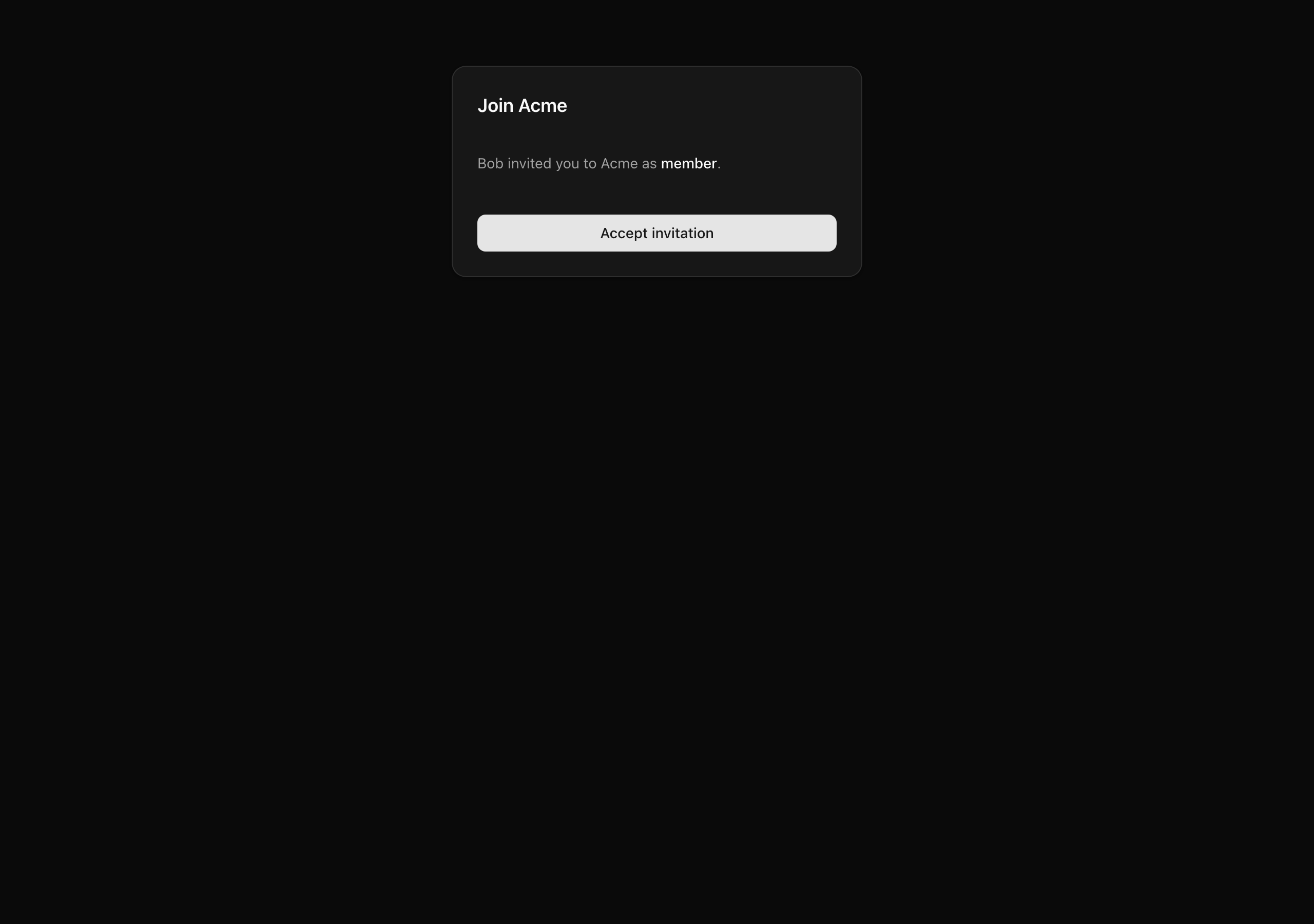
You already shipped the half of the handshake that creates the invitation: last lesson’s sendInvitation wrote the pending row, hashed the token at rest, and dropped a signed /accept-invite?id=&token=&sig= URL into a real inbox. The page on the other end of that URL is built too — open the link in a private window and it renders the right arrival surface depending on who you are: a generic refusal for a tampered link, an “expired” card for a stale one, “you’re already in” for a redeemed one, a “wrong account” card if you are signed in as someone else, a prefilled sign-up or sign-in if you have no session, and finally — when everything lines up — a consent card with an Accept button. Click it today and nothing happens. The button posts to an action that doesn’t exist yet.
This lesson writes that action. By the end, signing up through the prefilled flow and clicking Accept lands you on /dashboard with the invited org already active; the inspector shows the new member row carrying the invited role, an invitation.accepted row at the head of the audit tail, and user.emailVerified flipped to true. That closes every goal in this project: the invite handshake now works end to end across all six arrival surfaces.
Your mission
Section titled “Your mission”Accepting an emailed invite turns the recipient into a member of the inviting org at the role they were invited to hold. The provided Server Component at /accept-invite does the gatekeeping: it runs a fixed-order verify ladder — signature, then row, then hash, then expiry, then status, then identity — and from that picks exactly one of the seven surfaces to render. You are writing only the action that sits behind the consent screen’s Accept button, plus the one unscoped read the ladder leans on to load the invitation.
The reflex this lesson is built around is the line between verifying a render and verifying a write. The page already verified everything before it drew the consent card — so why re-check any of it in the action? Because the form POST is a brand-new request. It does not inherit the page’s checks; it arrives with its own form body, against a database row that may have changed in the seconds since the page rendered. So the action re-fetches the row, re-hashes the token and compares it to the stored tokenHash, and re-checks expiry, status, and the signed-in email — independently. Note what is not in that list: sig. The signature is the page’s pre-database doorman, the thing that decides whether to even look up the row; it is not an input to the action, and the action never receives it.
A few more decisions shape the code, and each one has a reason worth holding onto. This action is not wrapped in authedAction — the authority here is the signed invitation itself, not an org role the caller already holds; a stranger with no membership anywhere is exactly who is supposed to succeed. The read it depends on, getInvitationById, is the one deliberately unscoped query in the whole project: the invitee belongs to no org yet, so there is no tenant to scope to, and it goes through the unwrapped db rather than tenantDb. The seat-grant, the status flip, the email-verify flip, and the audit row all co-transact inside one withTenant transaction keyed on the invitation’s org — write them all through the transaction handle directly, never through the plugin’s own accept endpoint, whose post-commit hooks would split the audit row out of the transaction that grants the seat. That audit row is the single row in this project inserted directly through tx instead of through the shared logAudit helper, and the reason is structural: logAudit derives its org from the acting member’s session, but the accepting user is not a member yet, so that derivation resolves to nothing and would redirect mid-transaction. Switching the active org happens after commit — the plugin refuses to activate an org the caller cannot yet see, and the membership only becomes visible once the transaction lands. When the accepting user is unverified, flip emailVerified to true in the same transaction: receiving the click on the invited address is itself proof they own it, so making them run a separate verify-your-email loop right after joining would be theatre.
The explicit Accept button matters too: it is a consent gate, not a formality. If accepting fired on a plain GET of the URL, a corporate link-rewriter or a URL-scanning crawler would silently consume the invite before the human ever saw it. Two humans racing the button resolve cleanly because the status flip is guarded on status = 'pending' — the second writer matches no row. Email comparison is case-insensitive on both ends: the invitation was lowercased when it was written, and you lowercase the session email at compare time.
Out of scope: the verify ladder and the six arrival-surface components are provided in full — you read them to understand the shape your action plugs into, you don’t write them — and there is no revoke or resend affordance in this project.
accepted, stamps acceptedAt, and appends one invitation.accepted audit row — all in a single transaction, so a failure in any one write rolls the seat-grant back along with its audit row.sha256 does not match the stored hash is refused, with no row written — the action re-verifies the hash itself.sig, a missing row, and a hash mismatch all collapse to the same generic refusal — the public is never told which check failed./dashboard in the invited org.Coding time
Section titled “Coding time”Implement against the brief and the lesson’s tests, then read the reference walkthrough.
Reference solution and walkthrough
Two files. The unscoped read comes first because both the page and the action depend on it; then the action itself.
The unscoped read
Section titled “The unscoped read”getInvitationById is the project’s lone deliberately non-scoped query. Every other read in this codebase flows through tenantDb(orgId) so that forgetting the org filter doesn’t compile — but here there is no org to scope to. The person loading this row is not a member of anything yet; the signed token in the URL is their authorization, and the org is derived from the row once it loads. So it goes through the unwrapped db, and it returns the full row so that both the page’s verify ladder and your action can read tokenHash, status, expiresAt, organizationId, and role off it.
// getInvitationById is the deliberate non-scoped read: the invitee is not yet a// member, so there is no tenant to scope to — the signed token is the authorization// and the org is derived from the loaded row. Goes through the unwrapped db (never// tenantDb), and returns the full row so the accept page's verify ladder and the// accept action can read tokenHash / status / expiresAt / organizationId / role.export const getInvitationById = async (id: string) => (await db.query.invitation.findFirst({ where: eq(invitation.id, id), })) ?? null;The file already carries import 'server-only' at the top from the previous lesson, so this read can never be pulled into a client bundle.
The accept action
Section titled “The accept action”The action reads top to bottom as: validate the form, re-verify the invitation independently of the page, check identity, then do every write in one transaction, and only after that switch the active org and redirect.
'use server';
import { and, eq } from 'drizzle-orm';import type { Route } from 'next';import { headers } from 'next/headers';import { redirect } from 'next/navigation';import { z } from 'zod';
import { auditLogs } from '@/db/audit';import { getInvitationById } from '@/db/queries/invitations';import { invitation, member, user } from '@/db/schema/auth';import { withTenant } from '@/db/tenant';import { auth, getCurrentUser } from '@/lib/auth';import { sha256 } from '@/lib/invitations/url';import type { Result } from '@/lib/result';import { err } from '@/lib/result';
// Module-local, NOT exported: a "use server" module may export only async functions// (Next 16.2.7 rejects a non-function export at runtime). id is the Better Auth// invitation text id — z.string().min(1), never z.uuid().const acceptInvitationSchema = z.strictObject({  id: z.string().min(1),  token: z.string(),});
// Accept is NOT an authedAction: the signed invitation is the authority, not a role.// The POST is a separate request from the page render, so the action re-verifies the// token independently (hash / expiry / status) — sig is not an action input. The// member insert, the invitation status flip (guarded on status='pending', the// optimistic-concurrency / double-click guard), the emailVerified flip (the invite// click IS the email-ownership proof, so no verify-your-email loop right after), and// the 'invitation.accepted' audit row all co-transact in ONE withTenant tx, so a// failure anywhere rolls the seat-grant back with its audit row. Direct tx writes// throughout — never the plugin's own accept endpoint, whose after hooks run// post-commit and would break the one-transaction audit contract.//// Deviation from the per-slice plan, forced by the installed surface: the audit row// is inserted directly through tx rather than via the shared logAudit helper, because// logAudit derives its org from the session's active org (requireOrgUser) — but the// accepting user is not yet a member of any org, so that read resolves to nothing and// redirects mid-transaction. The invitation row is the authority here, so org + actor// come from it and the validated session user. setActiveOrganization is therefore the// one auth.api write and runs AFTER commit: the installed plugin refuses to activate// an org the caller is not yet a member of, and that membership is visible only once// the tx commits.export const acceptInvitation = async (  _prev: Result<{ ok: true }> | null,  formData: FormData,): Promise<Result<{ ok: true }>> => {  const parsed = acceptInvitationSchema.safeParse(Object.fromEntries(formData));  if (!parsed.success) {    return err('validation', 'This invitation link is malformed.');  }  const { id, token } = parsed.data;
  const currentUser = await getCurrentUser();  const row = await getInvitationById(id);
  if (    !row ||    (await sha256(token)) !== row.tokenHash ||    row.expiresAt < new Date() ||    row.status !== 'pending'  ) {    return err('not_found', 'This invitation is no longer valid.');  }
  if (!currentUser || currentUser.email.toLowerCase() !== row.email) {    return err(      'forbidden',      `This invitation was sent to ${row.email}. Sign in with that address to accept it.`,    );  }
  const h = await headers();
  await withTenant(row.organizationId, async (tx) => {    const [newMember] = await tx      .insert(member)      .values({        id: crypto.randomUUID(),        userId: currentUser.id,        organizationId: row.organizationId,        role: row.role ?? 'member',        createdAt: new Date(),      })      .returning({ id: member.id });
    await tx      .update(invitation)      .set({ status: 'accepted', acceptedAt: new Date() })      .where(and(eq(invitation.id, id), eq(invitation.status, 'pending')));
    if (!currentUser.emailVerified) {      await tx        .update(user)        .set({ emailVerified: true })        .where(eq(user.id, currentUser.id));    }
    await tx.insert(auditLogs).values({      organizationId: row.organizationId,      actorUserId: currentUser.id,      actorIp: h.get('x-forwarded-for'),      actorUserAgent: h.get('user-agent')?.slice(0, 512),      action: 'invitation.accepted',      subjectType: 'invitation',      subjectId: id,      payload: { newMemberId: newMember?.id, role: row.role },    });  });
  await auth.api.setActiveOrganization({    headers: h,    body: { organizationId: row.organizationId },  });
  redirect('/dashboard' as Route);};
The schema is module-local, not exported. A 'use server' module may export only async functions; Next.js 16 rejects a non-function export at runtime, so the Zod schema stays a private const. Note that id is the Better Auth invitation text id, validated z.string().min(1), never z.uuid() — Better Auth ids are base62 text.
'use server';
import { and, eq } from 'drizzle-orm';import type { Route } from 'next';import { headers } from 'next/headers';import { redirect } from 'next/navigation';import { z } from 'zod';
import { auditLogs } from '@/db/audit';import { getInvitationById } from '@/db/queries/invitations';import { invitation, member, user } from '@/db/schema/auth';import { withTenant } from '@/db/tenant';import { auth, getCurrentUser } from '@/lib/auth';import { sha256 } from '@/lib/invitations/url';import type { Result } from '@/lib/result';import { err } from '@/lib/result';
// Module-local, NOT exported: a "use server" module may export only async functions// (Next 16.2.7 rejects a non-function export at runtime). id is the Better Auth// invitation text id — z.string().min(1), never z.uuid().const acceptInvitationSchema = z.strictObject({  id: z.string().min(1),  token: z.string(),});
// Accept is NOT an authedAction: the signed invitation is the authority, not a role.// The POST is a separate request from the page render, so the action re-verifies the// token independently (hash / expiry / status) — sig is not an action input. The// member insert, the invitation status flip (guarded on status='pending', the// optimistic-concurrency / double-click guard), the emailVerified flip (the invite// click IS the email-ownership proof, so no verify-your-email loop right after), and// the 'invitation.accepted' audit row all co-transact in ONE withTenant tx, so a// failure anywhere rolls the seat-grant back with its audit row. Direct tx writes// throughout — never the plugin's own accept endpoint, whose after hooks run// post-commit and would break the one-transaction audit contract.//// Deviation from the per-slice plan, forced by the installed surface: the audit row// is inserted directly through tx rather than via the shared logAudit helper, because// logAudit derives its org from the session's active org (requireOrgUser) — but the// accepting user is not yet a member of any org, so that read resolves to nothing and// redirects mid-transaction. The invitation row is the authority here, so org + actor// come from it and the validated session user. setActiveOrganization is therefore the// one auth.api write and runs AFTER commit: the installed plugin refuses to activate// an org the caller is not yet a member of, and that membership is visible only once// the tx commits.export const acceptInvitation = async (  _prev: Result<{ ok: true }> | null,  formData: FormData,): Promise<Result<{ ok: true }>> => {  const parsed = acceptInvitationSchema.safeParse(Object.fromEntries(formData));  if (!parsed.success) {    return err('validation', 'This invitation link is malformed.');  }  const { id, token } = parsed.data;
  const currentUser = await getCurrentUser();  const row = await getInvitationById(id);
  if (    !row ||    (await sha256(token)) !== row.tokenHash ||    row.expiresAt < new Date() ||    row.status !== 'pending'  ) {    return err('not_found', 'This invitation is no longer valid.');  }
  if (!currentUser || currentUser.email.toLowerCase() !== row.email) {    return err(      'forbidden',      `This invitation was sent to ${row.email}. Sign in with that address to accept it.`,    );  }
  const h = await headers();
  await withTenant(row.organizationId, async (tx) => {    const [newMember] = await tx      .insert(member)      .values({        id: crypto.randomUUID(),        userId: currentUser.id,        organizationId: row.organizationId,        role: row.role ?? 'member',        createdAt: new Date(),      })      .returning({ id: member.id });
    await tx      .update(invitation)      .set({ status: 'accepted', acceptedAt: new Date() })      .where(and(eq(invitation.id, id), eq(invitation.status, 'pending')));
    if (!currentUser.emailVerified) {      await tx        .update(user)        .set({ emailVerified: true })        .where(eq(user.id, currentUser.id));    }
    await tx.insert(auditLogs).values({      organizationId: row.organizationId,      actorUserId: currentUser.id,      actorIp: h.get('x-forwarded-for'),      actorUserAgent: h.get('user-agent')?.slice(0, 512),      action: 'invitation.accepted',      subjectType: 'invitation',      subjectId: id,      payload: { newMemberId: newMember?.id, role: row.role },    });  });
  await auth.api.setActiveOrganization({    headers: h,    body: { organizationId: row.organizationId },  });
  redirect('/dashboard' as Route);};
The validity guard re-verifies, and collapses four failures into one refusal. The POST is a separate request from the page render, so the action re-checks the invitation independently: missing row, wrong token, expired, or no-longer-pending all return the same generic message. Note sig is absent — it is the page’s doorman, never an action input. Covers requirements 3 and 5.
'use server';
import { and, eq } from 'drizzle-orm';import type { Route } from 'next';import { headers } from 'next/headers';import { redirect } from 'next/navigation';import { z } from 'zod';
import { auditLogs } from '@/db/audit';import { getInvitationById } from '@/db/queries/invitations';import { invitation, member, user } from '@/db/schema/auth';import { withTenant } from '@/db/tenant';import { auth, getCurrentUser } from '@/lib/auth';import { sha256 } from '@/lib/invitations/url';import type { Result } from '@/lib/result';import { err } from '@/lib/result';
// Module-local, NOT exported: a "use server" module may export only async functions// (Next 16.2.7 rejects a non-function export at runtime). id is the Better Auth// invitation text id — z.string().min(1), never z.uuid().const acceptInvitationSchema = z.strictObject({  id: z.string().min(1),  token: z.string(),});
// Accept is NOT an authedAction: the signed invitation is the authority, not a role.// The POST is a separate request from the page render, so the action re-verifies the// token independently (hash / expiry / status) — sig is not an action input. The// member insert, the invitation status flip (guarded on status='pending', the// optimistic-concurrency / double-click guard), the emailVerified flip (the invite// click IS the email-ownership proof, so no verify-your-email loop right after), and// the 'invitation.accepted' audit row all co-transact in ONE withTenant tx, so a// failure anywhere rolls the seat-grant back with its audit row. Direct tx writes// throughout — never the plugin's own accept endpoint, whose after hooks run// post-commit and would break the one-transaction audit contract.//// Deviation from the per-slice plan, forced by the installed surface: the audit row// is inserted directly through tx rather than via the shared logAudit helper, because// logAudit derives its org from the session's active org (requireOrgUser) — but the// accepting user is not yet a member of any org, so that read resolves to nothing and// redirects mid-transaction. The invitation row is the authority here, so org + actor// come from it and the validated session user. setActiveOrganization is therefore the// one auth.api write and runs AFTER commit: the installed plugin refuses to activate// an org the caller is not yet a member of, and that membership is visible only once// the tx commits.export const acceptInvitation = async (  _prev: Result<{ ok: true }> | null,  formData: FormData,): Promise<Result<{ ok: true }>> => {  const parsed = acceptInvitationSchema.safeParse(Object.fromEntries(formData));  if (!parsed.success) {    return err('validation', 'This invitation link is malformed.');  }  const { id, token } = parsed.data;
  const currentUser = await getCurrentUser();  const row = await getInvitationById(id);
  if (    !row ||    (await sha256(token)) !== row.tokenHash ||    row.expiresAt < new Date() ||    row.status !== 'pending'  ) {    return err('not_found', 'This invitation is no longer valid.');  }
  if (!currentUser || currentUser.email.toLowerCase() !== row.email) {    return err(      'forbidden',      `This invitation was sent to ${row.email}. Sign in with that address to accept it.`,    );  }
  const h = await headers();
  await withTenant(row.organizationId, async (tx) => {    const [newMember] = await tx      .insert(member)      .values({        id: crypto.randomUUID(),        userId: currentUser.id,        organizationId: row.organizationId,        role: row.role ?? 'member',        createdAt: new Date(),      })      .returning({ id: member.id });
    await tx      .update(invitation)      .set({ status: 'accepted', acceptedAt: new Date() })      .where(and(eq(invitation.id, id), eq(invitation.status, 'pending')));
    if (!currentUser.emailVerified) {      await tx        .update(user)        .set({ emailVerified: true })        .where(eq(user.id, currentUser.id));    }
    await tx.insert(auditLogs).values({      organizationId: row.organizationId,      actorUserId: currentUser.id,      actorIp: h.get('x-forwarded-for'),      actorUserAgent: h.get('user-agent')?.slice(0, 512),      action: 'invitation.accepted',      subjectType: 'invitation',      subjectId: id,      payload: { newMemberId: newMember?.id, role: row.role },    });  });
  await auth.api.setActiveOrganization({    headers: h,    body: { organizationId: row.organizationId },  });
  redirect('/dashboard' as Route);};
The identity guard names the invited address. The invitation email was lowercased at write time, so only the session email needs lowercasing here. The message names row.email so a user signed in as the wrong account knows which one to switch to. Covers requirement 4.
'use server';
import { and, eq } from 'drizzle-orm';import type { Route } from 'next';import { headers } from 'next/headers';import { redirect } from 'next/navigation';import { z } from 'zod';
import { auditLogs } from '@/db/audit';import { getInvitationById } from '@/db/queries/invitations';import { invitation, member, user } from '@/db/schema/auth';import { withTenant } from '@/db/tenant';import { auth, getCurrentUser } from '@/lib/auth';import { sha256 } from '@/lib/invitations/url';import type { Result } from '@/lib/result';import { err } from '@/lib/result';
// Module-local, NOT exported: a "use server" module may export only async functions// (Next 16.2.7 rejects a non-function export at runtime). id is the Better Auth// invitation text id — z.string().min(1), never z.uuid().const acceptInvitationSchema = z.strictObject({  id: z.string().min(1),  token: z.string(),});
// Accept is NOT an authedAction: the signed invitation is the authority, not a role.// The POST is a separate request from the page render, so the action re-verifies the// token independently (hash / expiry / status) — sig is not an action input. The// member insert, the invitation status flip (guarded on status='pending', the// optimistic-concurrency / double-click guard), the emailVerified flip (the invite// click IS the email-ownership proof, so no verify-your-email loop right after), and// the 'invitation.accepted' audit row all co-transact in ONE withTenant tx, so a// failure anywhere rolls the seat-grant back with its audit row. Direct tx writes// throughout — never the plugin's own accept endpoint, whose after hooks run// post-commit and would break the one-transaction audit contract.//// Deviation from the per-slice plan, forced by the installed surface: the audit row// is inserted directly through tx rather than via the shared logAudit helper, because// logAudit derives its org from the session's active org (requireOrgUser) — but the// accepting user is not yet a member of any org, so that read resolves to nothing and// redirects mid-transaction. The invitation row is the authority here, so org + actor// come from it and the validated session user. setActiveOrganization is therefore the// one auth.api write and runs AFTER commit: the installed plugin refuses to activate// an org the caller is not yet a member of, and that membership is visible only once// the tx commits.export const acceptInvitation = async (  _prev: Result<{ ok: true }> | null,  formData: FormData,): Promise<Result<{ ok: true }>> => {  const parsed = acceptInvitationSchema.safeParse(Object.fromEntries(formData));  if (!parsed.success) {    return err('validation', 'This invitation link is malformed.');  }  const { id, token } = parsed.data;
  const currentUser = await getCurrentUser();  const row = await getInvitationById(id);
  if (    !row ||    (await sha256(token)) !== row.tokenHash ||    row.expiresAt < new Date() ||    row.status !== 'pending'  ) {    return err('not_found', 'This invitation is no longer valid.');  }
  if (!currentUser || currentUser.email.toLowerCase() !== row.email) {    return err(      'forbidden',      `This invitation was sent to ${row.email}. Sign in with that address to accept it.`,    );  }
  const h = await headers();
  await withTenant(row.organizationId, async (tx) => {    const [newMember] = await tx      .insert(member)      .values({        id: crypto.randomUUID(),        userId: currentUser.id,        organizationId: row.organizationId,        role: row.role ?? 'member',        createdAt: new Date(),      })      .returning({ id: member.id });
    await tx      .update(invitation)      .set({ status: 'accepted', acceptedAt: new Date() })      .where(and(eq(invitation.id, id), eq(invitation.status, 'pending')));
    if (!currentUser.emailVerified) {      await tx        .update(user)        .set({ emailVerified: true })        .where(eq(user.id, currentUser.id));    }
    await tx.insert(auditLogs).values({      organizationId: row.organizationId,      actorUserId: currentUser.id,      actorIp: h.get('x-forwarded-for'),      actorUserAgent: h.get('user-agent')?.slice(0, 512),      action: 'invitation.accepted',      subjectType: 'invitation',      subjectId: id,      payload: { newMemberId: newMember?.id, role: row.role },    });  });
  await auth.api.setActiveOrganization({    headers: h,    body: { organizationId: row.organizationId },  });
  redirect('/dashboard' as Route);};
One transaction, four writes. In order: insert the member row with the invited role: row.role ?? 'member', capturing the new id via .returning; flip the invitation to accepted guarded by status = 'pending' (the double-click guard, so a second concurrent accept matches no row); conditionally verify the email; and insert the audit row directly through tx. Covers requirements 1, 2, 7, and 8.
'use server';
import { and, eq } from 'drizzle-orm';import type { Route } from 'next';import { headers } from 'next/headers';import { redirect } from 'next/navigation';import { z } from 'zod';
import { auditLogs } from '@/db/audit';import { getInvitationById } from '@/db/queries/invitations';import { invitation, member, user } from '@/db/schema/auth';import { withTenant } from '@/db/tenant';import { auth, getCurrentUser } from '@/lib/auth';import { sha256 } from '@/lib/invitations/url';import type { Result } from '@/lib/result';import { err } from '@/lib/result';
// Module-local, NOT exported: a "use server" module may export only async functions// (Next 16.2.7 rejects a non-function export at runtime). id is the Better Auth// invitation text id — z.string().min(1), never z.uuid().const acceptInvitationSchema = z.strictObject({  id: z.string().min(1),  token: z.string(),});
// Accept is NOT an authedAction: the signed invitation is the authority, not a role.// The POST is a separate request from the page render, so the action re-verifies the// token independently (hash / expiry / status) — sig is not an action input. The// member insert, the invitation status flip (guarded on status='pending', the// optimistic-concurrency / double-click guard), the emailVerified flip (the invite// click IS the email-ownership proof, so no verify-your-email loop right after), and// the 'invitation.accepted' audit row all co-transact in ONE withTenant tx, so a// failure anywhere rolls the seat-grant back with its audit row. Direct tx writes// throughout — never the plugin's own accept endpoint, whose after hooks run// post-commit and would break the one-transaction audit contract.//// Deviation from the per-slice plan, forced by the installed surface: the audit row// is inserted directly through tx rather than via the shared logAudit helper, because// logAudit derives its org from the session's active org (requireOrgUser) — but the// accepting user is not yet a member of any org, so that read resolves to nothing and// redirects mid-transaction. The invitation row is the authority here, so org + actor// come from it and the validated session user. setActiveOrganization is therefore the// one auth.api write and runs AFTER commit: the installed plugin refuses to activate// an org the caller is not yet a member of, and that membership is visible only once// the tx commits.export const acceptInvitation = async (  _prev: Result<{ ok: true }> | null,  formData: FormData,): Promise<Result<{ ok: true }>> => {  const parsed = acceptInvitationSchema.safeParse(Object.fromEntries(formData));  if (!parsed.success) {    return err('validation', 'This invitation link is malformed.');  }  const { id, token } = parsed.data;
  const currentUser = await getCurrentUser();  const row = await getInvitationById(id);
  if (    !row ||    (await sha256(token)) !== row.tokenHash ||    row.expiresAt < new Date() ||    row.status !== 'pending'  ) {    return err('not_found', 'This invitation is no longer valid.');  }
  if (!currentUser || currentUser.email.toLowerCase() !== row.email) {    return err(      'forbidden',      `This invitation was sent to ${row.email}. Sign in with that address to accept it.`,    );  }
  const h = await headers();
  await withTenant(row.organizationId, async (tx) => {    const [newMember] = await tx      .insert(member)      .values({        id: crypto.randomUUID(),        userId: currentUser.id,        organizationId: row.organizationId,        role: row.role ?? 'member',        createdAt: new Date(),      })      .returning({ id: member.id });
    await tx      .update(invitation)      .set({ status: 'accepted', acceptedAt: new Date() })      .where(and(eq(invitation.id, id), eq(invitation.status, 'pending')));
    if (!currentUser.emailVerified) {      await tx        .update(user)        .set({ emailVerified: true })        .where(eq(user.id, currentUser.id));    }
    await tx.insert(auditLogs).values({      organizationId: row.organizationId,      actorUserId: currentUser.id,      actorIp: h.get('x-forwarded-for'),      actorUserAgent: h.get('user-agent')?.slice(0, 512),      action: 'invitation.accepted',      subjectType: 'invitation',      subjectId: id,      payload: { newMemberId: newMember?.id, role: row.role },    });  });
  await auth.api.setActiveOrganization({    headers: h,    body: { organizationId: row.organizationId },  });
  redirect('/dashboard' as Route);};
Activate the org and redirect, after commit. setActiveOrganization is the one sanctioned auth.api write here and runs only once the transaction has committed, because the plugin refuses to activate an org whose membership the caller cannot yet see. The redirect() throws to abort the action and send the new member to their dashboard. Covers requirements 6 and 12.
A few of these calls look unusual at a glance, so they are worth naming. The writes are hand-rolled tx inserts and updates rather than a call to Better Auth’s own acceptInvitation endpoint — deliberately, because that endpoint’s after hooks run post-commit, which would split the audit row out of the transaction that grants the seat and break the one-transaction guarantee requirement 2 depends on. And the audit insert does not go through logAudit, the helper every other privileged write in this project uses. That is the project’s single, deliberate exception. logAudit resolves the acting org and actor through requireOrgUser, which reads the caller’s active membership — but the accepting user has no membership yet, so that read finds nothing and redirects mid-transaction. Here the invitation row is the authority, so org and actor come from the row and the validated session, written straight through tx. The logAudit transaction contract itself was covered when you built it — see “Append-only audit_logs with RLS” earlier in this chapter for why audit writes must share the work’s transaction, and lesson 5 of the chapter on roles and the audit trail for the helper’s design.
The signed-URL generation, the token, and the hash-at-rest were all built last lesson in “Send an invitation with a signed accept URL” — the action just re-runs sha256 over the raw token and compares. And the email-mismatch refusal and the double-click race are derived in full in lesson 5 of the chapter on invitations and the seat-handoff lifecycle, where the status='pending' filter as an optimistic-concurrency guard is worked through.
The provided surface your action plugs into
Section titled “The provided surface your action plugs into”Before you run the tests, it’s worth reading src/app/(auth)/accept-invite/page.tsx once. You don’t write it, but seeing the ladder makes the action’s re-verification obvious: the page checks the same things your action checks, in the same order, and picks a screen — the action then re-checks them against the write. The consent card is the one branch that mounts the form posting to your acceptInvitation; every other branch is a dead end the action never sees.
%%{init: {'themeCSS': '.nodeLabel, .nodeLabel p, .edgeLabel, .edgeLabel p { font-size: 15px !important; }'} }%%
flowchart TD
  integrity{"signature ok?<br/>row exists?<br/>hash matches?"}
  exp{not expired?}
  status{status pending?}
  signed{signed in?}
  account{has account?}
  email{email matches?}

  refused([Refused])
  expired([Expired])
  member([Already member])
  signup([Sign up])
  signin([Sign in])
  wrong([Wrong account])
  consent([Consent card<br/>#8592; the action you write sits here])

  integrity -->|yes| exp
  exp -->|yes| status
  status -->|yes| signed
  signed -->|yes| email
  email -->|yes| consent

  integrity -->|"no (any)"| refused
  exp -->|no| expired
  status -->|accepted| member
  signed -->|no| account
  account -->|yes| signin
  account -->|no| signup
  email -->|no| wrong

  classDef surface fill:#1e293b,stroke:#475569,color:#e2e8f0;
  classDef target fill:#14532d,stroke:#22c55e,color:#dcfce7,font-weight:bold;
  class refused,expired,member,signup,signin,wrong surface;
class consent target; Reference for acceptInvitation and setActiveOrganization — the plugin surface your action sits behind.
db.transaction(tx => …) and its roll-back-on-throw guarantee — the contract your four writes lean on.
The Web Crypto SHA-256 primitive your sha256 helper wraps to re-hash the token at compare time.
Why redirect() throws to abort the action, and why it stays outside the transaction's try block.
Moment of truth
Section titled “Moment of truth”Run the lesson’s test suite:
pnpm test:lesson 6You should see all suites pass:
[0;32m✓[0m tests/lessons/Lesson 6.test.ts [0;90m(9 tests)[0m[0;32m Test Files [0m [0;32m1 passed[0m[0;90m (1)[0m[0;32m Tests [0m [0;32m9 passed[0m[0;90m (9)[0mThe suite drives your acceptInvitation action directly against the live Docker Postgres and the dev seed, standing up its own throwaway user and invitation rows for each case and tearing them down so the run stays repeatable. It asserts the writes that matter: a valid accept grants the seat with the invited role, flips the invitation to accepted with acceptedAt stamped, and appends exactly one invitation.accepted audit row — and that force-failing the audit write rolls all of it back, leaving no member, no status flip, no orphaned row. It checks the refusals: a token whose sha256 doesn’t match is refused with nothing written, a mismatched email is refused with the invited address in the message, and an expired or already-accepted invite is refused. It confirms the active-org switch fires only after the membership is committed, that an unverified accepter ends up verified with no separate verification email sent, and that two accepts in a row yield exactly one membership.
One prerequisite for confirming the full flow by hand: the accept-across-email-sessions check needs the verified domain you set up in the welcome email send path project — Resend’s sandbox sender will not deliver an invite to a personal inbox, so without the verified domain you can’t receive the link to click.
Continue from the pending invite you sent last lesson and confirm the rest by hand, ticking each off as you go.
/dashboard with the invited org active. In the inspector, the new member row exists with the right role, the audit tail shows invitation.accepted, and user.emailVerified is true.sig query param in the URL: the generic refusal renders.status): the “you’re already in” screen renders.status='pending' filter, and exactly one membership exists.That’s the whole project. The invite handshake now runs end to end across all six arrival surfaces, and every goal under the project’s framing is satisfied: organizations live on the session, the authedAction wrapper refuses under-privileged callers, the audit_logs table is protected by the database itself, role changes and invites both audit in-transaction, and a stranger can carry a signed link from their inbox to a seat in the org.
The shapes you built here keep coming back. The list view chapter later in the course layers active() and archived() lifecycle methods straight onto the tenantDb facade; the notifications chapter dispatches on the invitation.sent and member.role-changed events you’ve been writing to the audit log; the rate-limiting chapter wraps a limiter around sendInvitation; and the pre-launch security chapter hardens the audit table with retention. This project’s data layer, action wrappers, and audit trail are the foundation the rest of the app is built on.