Declare the Redis client and three module-scope limiters
You stand up the Redis client and the three Ratelimit instances so the inspector reports each limiter’s live remaining budget straight from Redis instead of n/a. Nothing gets gated yet — by the end of this lesson the limiter infrastructure is standing and reporting, but every auth endpoint behaves exactly as it does now.
The finished result is a single panel coming alive. Open /inspector and the “Upstash up?” badge reads green, because the health-check reaches the live database. The “Remaining tokens” panel, which read n/a on every row when you left the overview, now shows five live readouts at full budget: signin → ip:<addr> → 10/10, signin → email:<active-email> → 10/10, signup → ip:<addr> → 5/5, reset → ip:<addr> → 3/3, and reset → email:eve@example.com → 3/3. That last row tracks the reset spam target eve@example.com, not whichever identity you are signed in as, because that is the address the reset spam runner hammers in later lessons. The panel is reading state, not spending it — refresh the page as many times as you like and no number moves.
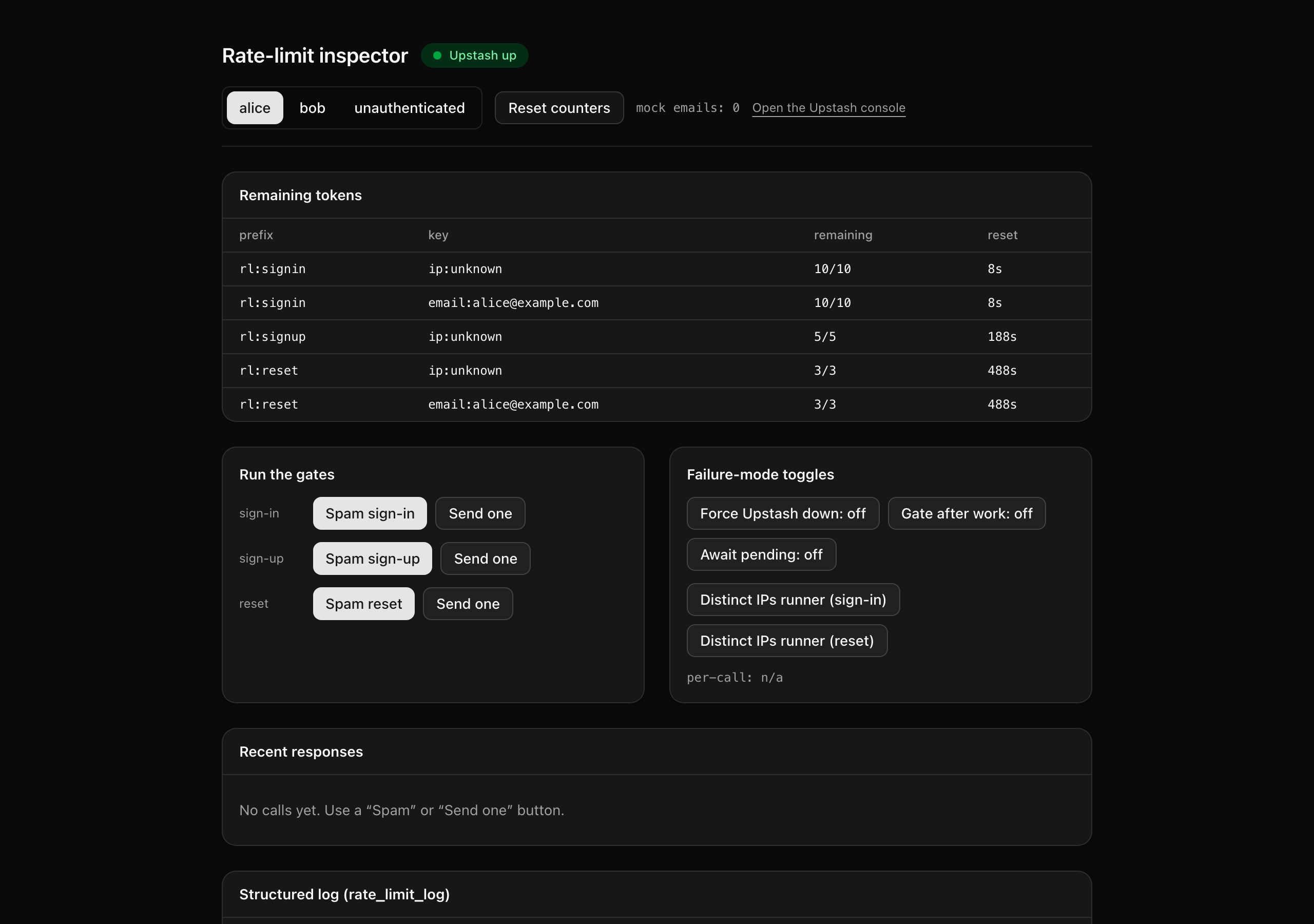
Your mission
Section titled “Your mission”This lesson stands up the limiter infrastructure without wiring it to a single endpoint, so the only thing you should be able to observe afterward is the inspector reporting live budgets where it used to report n/a. That narrow surface hides the actual lesson, which is a set of decisions about where limiters are allowed to exist and how they are read. The limiter is a named seam: lib/rate-limit.ts is the one and only place new Ratelimit(...) may appear. Construct one inline inside a handler or a route and you get a fresh instance per call, which defeats the in-memory ephemeralCache the library keeps and risks two call sites writing under colliding prefixes. Module scope is the other half of that rule and it is load-bearing: the library caches counters and the pending analytics writes in process memory, and that cache only survives across hot invocations when the same instance is reused, so a limiter declared inside a function body throws away its cache on every request and sends a sustained hot key back to Redis every single time. Each limiter also gets its own ephemeralCache: new Map() — sharing one map across all three works but blurs which limiter is evicting what — and a distinct prefix (rl:signin, rl:signup, rl:reset) so two limiters can never collide on a shared key; collisions across applications are already prevented for you by per-database scope, so the prefix is purely about keeping these three apart inside one database.
A few smaller decisions ride along. analytics: true adds one rolling-counter write per call to feed the Upstash dashboard; that write returns a pending promise which is the deferral seam a later lesson wires through after() — you set the flag here and ignore the promise. The inspector reads every budget through getRemaining(key), which does not consume a token, and that is the whole reason it works: wire a readout to limit(key) instead and the panel would burn a token every time it rendered, eventually locking a user out through the very page meant to observe them. The budgets themselves are deliberate calls carried in from Dual-keying the auth endpoints — sign-in is the most lenient at 10 per minute because legitimate users fat-finger passwords, sign-up sits at 5 per ten minutes, and reset is the tightest in the project at 3 per fifteen minutes because its abuse cost is concrete: every accepted reset sends real mail, so flooding it means inbox noise for a victim and a dent in your Resend deliverability. Finally, the env boundary is the prerequisite gate. The Zod-validated env you built in Type-safe environment variables with @t3-oss/env-nextjs is where the two new Upstash variables get declared, so a missing credential fails the boot with a named error rather than surfacing as a cryptic throw at the first Redis call. Out of scope: gating, the RateLimit-* headers, and fail-open handling all arrive once an action actually exercises a limiter, in the next lesson.
signin → ip → 10/10, signin → email → 10/10, signup → ip → 5/5, reset → ip → 3/3, reset → email:eve@example.com → 3/3.rl:signin, rl:signup, rl:reset), with no collision between limiters.Coding time
Section titled “Coding time”Implement the two Upstash entries in src/env.ts, then src/lib/redis.ts and src/lib/rate-limit.ts, against the brief and the tests. This lesson gates no endpoint, so the inspector’s “Remaining tokens” panel is the only surface that confirms the work — there is no behavior change anywhere else to look for.
Reference solution and walkthrough
Three short files, in the order the data flows: the env boundary that must validate before anything reads Redis, the client itself, then the limiters built on top of it.
src/env.ts — the file is provided; you add two pairs of lines. Each new variable goes in both the server schema (so it is validated) and the runtimeEnv map (so the validated value is actually read from process.env). The URL is a z.url() and the token is a non-empty string:
import { createEnv } from '@t3-oss/env-nextjs';import { z } from 'zod';
13 collapsed lines
// The single env boundary: application code imports `env`, never `process.env`.// createEnv validates at build time — a missing/invalid DATABASE_URL fails// `next build` with a message naming the variable.export const env = createEnv({ server: { DATABASE_URL: z.url(), DATABASE_URL_UNPOOLED: z.url(), SEED: z.coerce.number().default(1), BETTER_AUTH_SECRET: z.string().min(32), BETTER_AUTH_URL: z.url(), RESEND_API_KEY: z.string().min(1), EMAIL_FROM: z.string().min(1), EMAIL_REPLY_TO: z.email(), UPSTASH_REDIS_REST_URL: z.url(), UPSTASH_REDIS_REST_TOKEN: z.string().min(1), }, client: { NEXT_PUBLIC_APP_NAME: z.string().min(1), NEXT_PUBLIC_APP_URL: z.url(), }, runtimeEnv: {8 collapsed lines
DATABASE_URL: process.env.DATABASE_URL, DATABASE_URL_UNPOOLED: process.env.DATABASE_URL_UNPOOLED, SEED: process.env.SEED, BETTER_AUTH_SECRET: process.env.BETTER_AUTH_SECRET, BETTER_AUTH_URL: process.env.BETTER_AUTH_URL, RESEND_API_KEY: process.env.RESEND_API_KEY, EMAIL_FROM: process.env.EMAIL_FROM, EMAIL_REPLY_TO: process.env.EMAIL_REPLY_TO, UPSTASH_REDIS_REST_URL: process.env.UPSTASH_REDIS_REST_URL, UPSTASH_REDIS_REST_TOKEN: process.env.UPSTASH_REDIS_REST_TOKEN, NEXT_PUBLIC_APP_NAME: process.env.NEXT_PUBLIC_APP_NAME, NEXT_PUBLIC_APP_URL: process.env.NEXT_PUBLIC_APP_URL, },});Adding the variables here, rather than reading process.env.UPSTASH_REDIS_REST_URL directly at the call site, is what turns a missing credential into a boot failure that names the offending variable instead of a cryptic error on the first Redis round-trip. The @t3-oss/env-nextjs mechanics are the subject of Type-safe environment variables with @t3-oss/env-nextjs — the only new thing here is which two keys to add.
src/lib/redis.ts — the client plus a health-check the badge reads:
import 'server-only';
import { Redis } from '@upstash/redis';
export const redis = Redis.fromEnv();
export const pingRedis = async (): Promise<boolean> => {  try {    await redis.ping();    return true;  } catch {    return false;  }};
Redis.fromEnv() is the connectionless HTTP/REST client you met in The @upstash/ratelimit API surface — it reads UPSTASH_REDIS_REST_URL and UPSTASH_REDIS_REST_TOKEN itself, which is exactly why the env boundary had to validate them first. The import 'server-only' at the top is a tripwire: it throws if this module is ever pulled into a client bundle, keeping the token server-side. pingRedis deliberately swallows any failure down to false so the “Upstash up?” badge degrades to red instead of throwing and crashing the inspector — a health-check that can take down the page it reports on is worse than no health-check.
src/lib/rate-limit.ts — the three limiters, the one place in the codebase new Ratelimit(...) is allowed:
import 'server-only';
import { Ratelimit } from '@upstash/ratelimit';
import { redis } from '@/lib/redis';
export const signInLimiter = new Ratelimit({  redis,  limiter: Ratelimit.slidingWindow(10, '1 m'),  prefix: 'rl:signin',  analytics: true,  ephemeralCache: new Map(),});
export const signUpLimiter = new Ratelimit({  redis,  limiter: Ratelimit.slidingWindow(5, '10 m'),  prefix: 'rl:signup',  analytics: true,  ephemeralCache: new Map(),});
export const resetLimiter = new Ratelimit({  redis,  limiter: Ratelimit.slidingWindow(3, '15 m'),  prefix: 'rl:reset',  analytics: true,  ephemeralCache: new Map(),});
export const LIMITER_MAX = { signin: 10, signup: 5, reset: 3 } as const;
These three export const declarations live at module scope, evaluated once when the module first loads and reused on every import. That is what lets each ephemeralCache survive across hot invocations: the same Map is consulted before Redis is, so a hot key served from the cache costs zero round-trips. Declare a limiter inside a handler and the Map is born and discarded on every call, so the cache never holds anything and every request pays a Redis round-trip. The Ratelimit constructor, slidingWindow, ephemeralCache, and the { success, limit, remaining, reset, pending } shape are all covered in The @upstash/ratelimit API surface; what this file adds is the specific three-limiter layout.
Each limiter carries its own ephemeralCache: new Map() rather than sharing one — a shared map works, but it muddies which limiter is responsible for evicting which entry, and separate maps keep eviction legible. The distinct prefixes (rl:signin, rl:signup, rl:reset) namespace the keys inside Redis so the three can never collide: hand all three the identical key ip:1.2.3.4 and they still write to three separate Redis keys, which is what the prefix-isolation test confirms by spending a token on one limiter and reading the same identifier at full budget on another.
analytics: true is the one line worth a second look. It writes a rolling counter to Redis on every limit() call to feed the Upstash dashboard, and that write hands back a pending promise. This lesson never calls limit(), so the promise never appears yet — but when an action does start gating in the next lesson, that pending is the seam handed to after() so the analytics write happens off the response path. You are setting the flag now and wiring its deferral later.
LIMITER_MAX was already present in the stub and stays exactly as it is. It is the static cap the inspector pairs with the live getRemaining(key).remaining to render a fraction. getRemaining returns the remaining count but not the ceiling, so the panel reads the live remaining from Redis, takes the denominator from LIMITER_MAX, and prints 10/10. The tests lean on the same pairing — they assert the live limiter’s reported limit equals LIMITER_MAX.signin, never a constant re-declared in the test — so the cap and the configured slidingWindow budget have to agree.
One thing you will not find here is any reading of budget — the inspector handles that in its provided inspector-reads.ts, calling getRemaining(key) on each of these limiters. getRemaining is the non-consuming read; a readout wired to limit() would spend a token per render. That is the reason the panel can refresh forever without moving a number, and the reason this lesson can stand up live budgets without gating anything.
Official reference for slidingWindow, ephemeralCache, and analytics — the exact options the three limiters configure.
Setting up the database and the connectionless Redis.fromEnv() client this lesson's src/lib/redis.ts builds on.
How createEnv validates server vars and why every key needs a runtimeEnv entry — the pattern behind the two Upstash additions.
Moment of truth
Section titled “Moment of truth”Run the lesson’s test suite:
pnpm test:lesson 2The suite loads your real .env, re-evaluates the env boundary with a credential removed to prove the boot fails, and calls each limiter’s getRemaining against the same live Upstash the inspector reads — so it needs both Upstash variables set, exactly as the inspector does at runtime. Its reads are non-consuming and every write uses a unique per-run key, so running it never burns a real user’s budget. All tests pass when the env boundary names a missing Upstash variable, each limiter reads full budget on a fresh key (10, 5, 3), two reads of one key never decrement, and spending on one limiter leaves another untouched on the same identifier.
The tests cannot reach the live inspector page or the boot itself, so confirm these by hand and tick each off as you go:
UPSTASH_REDIS_REST_URL in .env and restart pnpm dev → the boot fails with the Zod error naming the variable. Uncomment it and restart → the server boots./inspector → the “Upstash up?” badge is green, and the “Remaining tokens” panel reads the five full-budget rows.internal / “Not implemented” outcomes, confirming this lesson stood up state only — the sign-in action is still unwrapped, so nothing is gated.ephemeralCache with no round-trip.With the limiters standing and the inspector reading live budgets, the next lesson puts the first one to work — wrapping sign-in with per-IP and per-email gates and making the application limiter the single enforcement point.