Gate sign-in with dual-keying and swap out Better Auth's built-in
Last lesson stood up the machinery: the Redis client, the three Ratelimit instances, and an inspector that reads each limiter’s remaining budget straight from Upstash.
But no endpoint is gated yet — the “Remaining tokens” panel reports state, it never moves.
This lesson is where the limiter first meets traffic.
Your job is to gate the sign-in action so the eleventh rapid attempt is rejected with an opaque rate_limited Result, and to make your application limiter the single enforcement point by turning Better Auth’s own built-in limiter off.
Sign-in is the endpoint that matters most — it’s the one an attacker hammers with a stolen credential dump — so it gets the most careful key design in the whole project: a gate per IP and a gate per email.
Here is the feedback loop you are building toward.
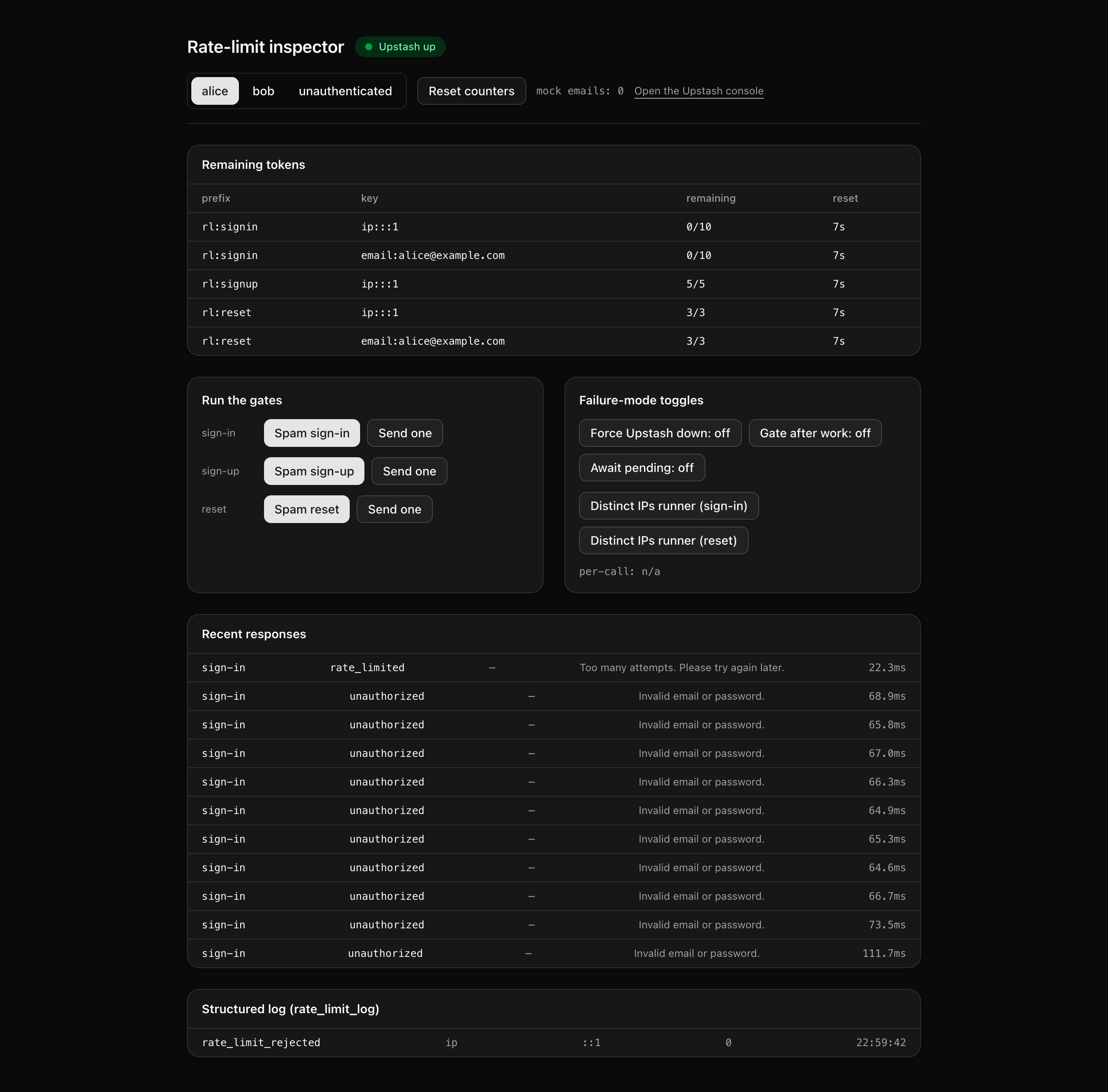
On /inspector, “Spam sign-in” against the active identity fires eleven sign-in calls with a wrong password.
The first ten come back unauthorized (Better Auth rejecting the bad password) with the per-IP remaining readout counting 9 → 0; the eleventh flips to rate_limited with the message Too many attempts. Please try again later. and remaining: 0.
The “Distinct IPs runner” hammers the same email from a fresh synthetic IP every call, and it’s still caught — on the per-email gate.
Flip “Force Upstash down” on and sign-ins keep working, while the structured-log tail fills with rate_limit_unavailable rows.
Your mission
Section titled “Your mission”Wrapping sign-in pulls in three small helper files — keys.ts, safe-limit.ts, and rate-limit-headers.ts — because none of them become observable until a gated action exercises them, plus the deliberate swap of Better Auth’s built-in limiter.
The two limiter checks run on one shared limiter with two keys: ip:<addr> first, then email:<normalized>, the cheaper one first.
Both must pass.
Per-IP alone misses credential stuffing spread across a botnet — each request comes from a different host, so no single IP bucket ever fills — and per-email alone is a lockout vector that lets an attacker freeze a victim out of their own account by spamming their address.
You need both, and the structural enforcement is an early return on each gate that fails.
Crucially, the two checks run before auth.api.signInEmail: gating after the call pays the password-hash cost on every request even past the budget, which is exactly the work the limiter exists to avoid.
The rejection has to be identical whichever gate tripped.
Returning “IP rate-limited” versus “email rate-limited” leaks which gate fired, and the per-email variant quietly confirms that an account with that address exists — a free enumeration oracle.
So the user-facing message is one opaque string, while the honest gate-and-key land only in the structured rate_limit_log row, the operator-only surface.
The budget — limit, remaining, and reset — travels inside the success Result, not in HTTP response headers, because a Server Action’s headers() is read-only and cannot set them.
The literal RateLimit-* headers exist only on the read-only route-handler twin at /api/limit-demo, present for parity.
The limiter fails open: a Redis outage logs an alertable event and lets the request through, because auth must not go down just because Redis is unreachable — and that fail-open decision lives in exactly one place, so flipping to fail-closed later is a one-line change.
Finally, Better Auth’s built-in limiter goes off, because two limiters with different budgets and keys competing over one surface is a debugging trap; the application wrapper is the one enforcement point.
A couple of trust calls are worth naming before you start.
getClientIp trusts the platform’s x-forwarded-for header — correct on Vercel, where the platform sets it, so its first entry is the real client.
normalizeEmail is trim-and-lowercase only; it does not strip +-aliases, and the same normalization runs at the database lookup so the limiter key and the lookup count one identifier.
Out of scope here: the sign-up and reset gates, which are the next two lessons.
rate_limited; calls 1–10 return unauthorized with the per-IP remaining counting 9 → 0.rate_limited with the logged key: 'email:<active-email>', while each per-IP key stays fresh.ok payload’s rateLimit field (limit / remaining / reset); it sets no RateLimit-* HTTP headers — those exist only on /api/limit-demo.Too many attempts. Please try again later., identical whichever gate tripped; the gate and key surface only in the rate_limit_log row.rate_limit_unavailable rows.unauthorized again with remaining: 9.src/lib/auth.ts carries rateLimit: { enabled: false } as its only rateLimit entry, and a successful sign-in still lands on /dashboard.verify_ms ≈ 0); with it on, every call pays the hash even past the budget.Coding time
Section titled “Coding time”Implement src/lib/keys.ts, src/lib/safe-limit.ts, and src/lib/rate-limit-headers.ts, then wrap src/app/(auth)/sign-in/actions.ts and flip src/lib/auth.ts — against the brief above and the lesson tests.
Open the walkthrough once you’ve made your attempt.
Reference solution and walkthrough
The files build on each other, so we’ll go in dependency order: the pure helpers first, then the fail-open wrapper, then the budget-and-reject helpers, then the action that composes all three, and finally the one-line auth flip.
The key helpers
Section titled “The key helpers”src/lib/keys.ts is two pure functions with no I/O — they just parse a Headers object and a string into the identifiers the limiter keys on.
// The limiter-key parse helpers. `x-forwarded-for` is the trust boundary: on// Vercel the platform sets it, so the first entry is the real client IP. The// 'unknown' fallback is deliberately loose — strict rejection of a missing/spoofed// forwarded chain is Chapter 081. `normalizeEmail` is trim+lowercase only (no// +-alias stripping); the same normalization runs at the limiter key and the DB// lookup, so an alias and its base address stay distinct keys on purpose.export const getClientIp = (headers: Headers): string => {  const forwardedFor = headers.get('x-forwarded-for');  const first = forwardedFor?.split(',')[0]?.trim();  if (first) {    return first;  }  return headers.get('x-real-ip') ?? 'unknown';};
export const normalizeEmail = (email: string): string =>  email.trim().toLowerCase();
x-forwarded-for is a comma-separated chain of every proxy the request passed through; the leftmost entry is the original client.
You read the first segment, fall back to x-real-ip, and only then to 'unknown'.
That 'unknown' fallback is intentionally loose: it means a request with no forwarded chain shares one bucket rather than crashing, and the strict rejection of a missing or spoofed chain is a security-hardening concern deferred to the security-baseline chapter’s The abusable-endpoint matrix.
The decision not to strip +-aliases is the same call carried in from Dual-keying the auth endpoints: stripping alice+spam@example.com down to alice@example.com closes a Gmail bypass but breaks on the many providers that treat aliases as genuinely distinct mailboxes, so an alias and its base stay distinct keys — and because the database lookup normalizes the same way, the limiter and the lookup never disagree about which account is which.
The fail-open wrapper
Section titled “The fail-open wrapper”safeLimit is the single seam every gate calls through, and it’s the one place the fail-open policy lives.
import 'server-only';
import type { Ratelimit } from '@upstash/ratelimit';
import { logRateLimit } from '@/lib/rate-limit-log';
// The fail-open wrapper — the one place the fail-open policy lives. On a Redis// outage `limiter.limit` throws; we log `rate_limit_unavailable` and return a// success result so the auth path stays up. Flipping to fail-closed is changing// the returned `success` to false here, once. The `prefix` is a param because// `Ratelimit.prefix` is `protected readonly` in @upstash/ratelimit 2.0.8 (reading// `limiter.prefix` from outside the class is TS2445); call sites pass the limiter's// prefix literal alongside it.export type RateLimitResult = Awaited<ReturnType<Ratelimit['limit']>>;
export const safeLimit = async (  limiter: Ratelimit,  prefix: string,  key: string,): Promise<RateLimitResult> => {  try {    return await limiter.limit(key);  } catch {    await logRateLimit({      event: 'rate_limit_unavailable',      limiter: prefix,      key,    });    return {      success: true,      limit: 0,      remaining: 0,      reset: 0,      pending: Promise.resolve(),    };  }};
Two details earn their keep here.
First, RateLimitResult is derived from the library — Awaited<ReturnType<Ratelimit['limit']>> — not a hand-written interface that parallels it.
A parallel interface silently rots the day Upstash adds a field; this one tracks the real return shape for free.
Second, notice that prefix is a parameter rather than something we read off the limiter.
Ratelimit.prefix is protected readonly in @upstash/ratelimit@2.0.8, so reading limiter.prefix from outside the class is a compile error (TS2445).
The call sites pass the literal — 'rl:signin' — alongside the limiter, and that literal is what lands in the outage log so an operator can see which surface lost Redis.
The budget and reject helpers
Section titled “The budget and reject helpers”rate-limit-headers.ts holds four exports with two distinct audiences — the action path and the route-handler twin. The walkthrough below steps through which is which.
import 'server-only';
import { logRateLimit } from '@/lib/rate-limit-log';import { err, type Result } from '@/lib/result';import type { RateLimitResult } from '@/lib/safe-limit';
// `reset` from the library is a Unix ms timestamp; the budget and headers carry it// as delta-seconds via Math.ceil((reset - Date.now()) / 1000) — raw ms is a bug.//// The budget rides the action `Result` (no HTTP headers on the action path —// headers() is read-only in a Server Action). `RateLimit-*` headers + Retry-After +// the JSON 429 body exist only on the route-handler twin (`/api/limit-demo`),// present for parity. `rateLimited` is the action reject helper: it logs the honest// `rate_limit_rejected` event (gate + key) and returns the same opaque message// regardless of which gate tripped — no information leak.export type RateLimitBudget = {  limit: number;  remaining: number;  reset: number;};
export const rateLimitBudget = (r: RateLimitResult): RateLimitBudget => ({  limit: r.limit,  remaining: r.remaining,  reset: Math.ceil((r.reset - Date.now()) / 1000),});
export const rateLimitHeaders = (  r: RateLimitResult,): Record<string, string> => ({  'RateLimit-Limit': String(r.limit),  'RateLimit-Remaining': String(r.remaining),  'RateLimit-Reset': String(Math.ceil((r.reset - Date.now()) / 1000)),});
export const rateLimited = async (  r: RateLimitResult,  gate: 'ip' | 'email',  key: string,): Promise<Result<never>> => {  await logRateLimit({    event: 'rate_limit_rejected',    limiter: gate,    key,    remaining: r.remaining,    reset: r.reset,  });  return err('rate_limited', 'Too many attempts. Please try again later.');};
export const rateLimitedResponse = (r: RateLimitResult): Response =>  Response.json(    { error: 'Too many attempts. Please try again later.' },    {      status: 429,      headers: {        ...rateLimitHeaders(r),        'Retry-After': String(Math.ceil((r.reset - Date.now()) / 1000)),      },    },  );
The file imports logRateLimit and the Result helpers, and re-uses the library-derived RateLimitResult from safe-limit. The header comment states the rule: reset is delta-seconds, the budget rides the action Result, and the literal headers live only on the route-handler twin.
import 'server-only';
import { logRateLimit } from '@/lib/rate-limit-log';import { err, type Result } from '@/lib/result';import type { RateLimitResult } from '@/lib/safe-limit';
// `reset` from the library is a Unix ms timestamp; the budget and headers carry it// as delta-seconds via Math.ceil((reset - Date.now()) / 1000) — raw ms is a bug.//// The budget rides the action `Result` (no HTTP headers on the action path —// headers() is read-only in a Server Action). `RateLimit-*` headers + Retry-After +// the JSON 429 body exist only on the route-handler twin (`/api/limit-demo`),// present for parity. `rateLimited` is the action reject helper: it logs the honest// `rate_limit_rejected` event (gate + key) and returns the same opaque message// regardless of which gate tripped — no information leak.export type RateLimitBudget = {  limit: number;  remaining: number;  reset: number;};
export const rateLimitBudget = (r: RateLimitResult): RateLimitBudget => ({  limit: r.limit,  remaining: r.remaining,  reset: Math.ceil((r.reset - Date.now()) / 1000),});
export const rateLimitHeaders = (  r: RateLimitResult,): Record<string, string> => ({  'RateLimit-Limit': String(r.limit),  'RateLimit-Remaining': String(r.remaining),  'RateLimit-Reset': String(Math.ceil((r.reset - Date.now()) / 1000)),});
export const rateLimited = async (  r: RateLimitResult,  gate: 'ip' | 'email',  key: string,): Promise<Result<never>> => {  await logRateLimit({    event: 'rate_limit_rejected',    limiter: gate,    key,    remaining: r.remaining,    reset: r.reset,  });  return err('rate_limited', 'Too many attempts. Please try again later.');};
export const rateLimitedResponse = (r: RateLimitResult): Response =>  Response.json(    { error: 'Too many attempts. Please try again later.' },    {      status: 429,      headers: {        ...rateLimitHeaders(r),        'Retry-After': String(Math.ceil((r.reset - Date.now()) / 1000)),      },    },  );
rateLimitBudget is what rides the success Result. The library hands you reset as a Unix-millisecond timestamp; you convert it to delta-seconds with Math.ceil((r.reset - Date.now()) / 1000). Shipping the raw ms is the documented bug — a 60-second window must read ~60, not a 13-digit number.
import 'server-only';
import { logRateLimit } from '@/lib/rate-limit-log';import { err, type Result } from '@/lib/result';import type { RateLimitResult } from '@/lib/safe-limit';
// `reset` from the library is a Unix ms timestamp; the budget and headers carry it// as delta-seconds via Math.ceil((reset - Date.now()) / 1000) — raw ms is a bug.//// The budget rides the action `Result` (no HTTP headers on the action path —// headers() is read-only in a Server Action). `RateLimit-*` headers + Retry-After +// the JSON 429 body exist only on the route-handler twin (`/api/limit-demo`),// present for parity. `rateLimited` is the action reject helper: it logs the honest// `rate_limit_rejected` event (gate + key) and returns the same opaque message// regardless of which gate tripped — no information leak.export type RateLimitBudget = {  limit: number;  remaining: number;  reset: number;};
export const rateLimitBudget = (r: RateLimitResult): RateLimitBudget => ({  limit: r.limit,  remaining: r.remaining,  reset: Math.ceil((r.reset - Date.now()) / 1000),});
export const rateLimitHeaders = (  r: RateLimitResult,): Record<string, string> => ({  'RateLimit-Limit': String(r.limit),  'RateLimit-Remaining': String(r.remaining),  'RateLimit-Reset': String(Math.ceil((r.reset - Date.now()) / 1000)),});
export const rateLimited = async (  r: RateLimitResult,  gate: 'ip' | 'email',  key: string,): Promise<Result<never>> => {  await logRateLimit({    event: 'rate_limit_rejected',    limiter: gate,    key,    remaining: r.remaining,    reset: r.reset,  });  return err('rate_limited', 'Too many attempts. Please try again later.');};
export const rateLimitedResponse = (r: RateLimitResult): Response =>  Response.json(    { error: 'Too many attempts. Please try again later.' },    {      status: 429,      headers: {        ...rateLimitHeaders(r),        'Retry-After': String(Math.ceil((r.reset - Date.now()) / 1000)),      },    },  );
rateLimited is the action’s reject helper. It logs the honest rate_limit_rejected row carrying the real gate and key, then returns the opaque err('rate_limited', 'Too many attempts. Please try again later.'). The user-safe contract lives here, in one function — not at each call site — so every gate that rejects is byte-identical to the user while the operator still sees which gate fired.
import 'server-only';
import { logRateLimit } from '@/lib/rate-limit-log';import { err, type Result } from '@/lib/result';import type { RateLimitResult } from '@/lib/safe-limit';
// `reset` from the library is a Unix ms timestamp; the budget and headers carry it// as delta-seconds via Math.ceil((reset - Date.now()) / 1000) — raw ms is a bug.//// The budget rides the action `Result` (no HTTP headers on the action path —// headers() is read-only in a Server Action). `RateLimit-*` headers + Retry-After +// the JSON 429 body exist only on the route-handler twin (`/api/limit-demo`),// present for parity. `rateLimited` is the action reject helper: it logs the honest// `rate_limit_rejected` event (gate + key) and returns the same opaque message// regardless of which gate tripped — no information leak.export type RateLimitBudget = {  limit: number;  remaining: number;  reset: number;};
export const rateLimitBudget = (r: RateLimitResult): RateLimitBudget => ({  limit: r.limit,  remaining: r.remaining,  reset: Math.ceil((r.reset - Date.now()) / 1000),});
export const rateLimitHeaders = (  r: RateLimitResult,): Record<string, string> => ({  'RateLimit-Limit': String(r.limit),  'RateLimit-Remaining': String(r.remaining),  'RateLimit-Reset': String(Math.ceil((r.reset - Date.now()) / 1000)),});
export const rateLimited = async (  r: RateLimitResult,  gate: 'ip' | 'email',  key: string,): Promise<Result<never>> => {  await logRateLimit({    event: 'rate_limit_rejected',    limiter: gate,    key,    remaining: r.remaining,    reset: r.reset,  });  return err('rate_limited', 'Too many attempts. Please try again later.');};
export const rateLimitedResponse = (r: RateLimitResult): Response =>  Response.json(    { error: 'Too many attempts. Please try again later.' },    {      status: 429,      headers: {        ...rateLimitHeaders(r),        'Retry-After': String(Math.ceil((r.reset - Date.now()) / 1000)),      },    },  );
These two are the route-handler twin, used only by /api/limit-demo. rateLimitHeaders builds the literal RateLimit-* header set; rateLimitedResponse wraps a JSON 429 with those headers plus Retry-After. A Server Action can’t set response headers, so the action never touches these — they exist so the read-only demo route shows the real HTTP shape for parity.
The split between the action path and the route-handler twin is the whole point of this file.
The action carries its budget in the Result via rateLimitBudget, and rejects through rateLimited so the opaque message is defined once.
The two header functions are dead weight on the action path — they’re only there so the demo route can show the literal RateLimit-* headers and a real 429 for parity, since you genuinely cannot produce those from inside a Server Action.
The sign-in action
Section titled “The sign-in action”Now the action that composes everything. This is the shape every other gated endpoint in the project copies.
'use server';
import { headers } from 'next/headers';import { after } from 'next/server';import { z } from 'zod';
import { auth } from '@/lib/auth';import { mapAuthError } from '@/lib/auth/error-mapping';import { getClientIp } from '@/lib/keys';import { signInLimiter } from '@/lib/rate-limit';import {  type RateLimitBudget,  rateLimitBudget,  rateLimited,} from '@/lib/rate-limit-headers';import { safeNext } from '@/lib/redirects';import { err, ok, type Result } from '@/lib/result';import { safeLimit } from '@/lib/safe-limit';
const SignInSchema = z.strictObject({  email: z.string().trim().toLowerCase().pipe(z.email()),  password: z.string().min(1),  next: z.string().optional(),});
// Gate before work, dual-keyed: per-IP then per-email (cheaper first), both// through `safeLimit`, both before `auth.api.signInEmail`. The budget rides the// success `Result` (no HTTP headers — headers() is read-only here); the reject// path returns the opaque `rateLimited(...)`. `pending` analytics flush via// `after()`, never awaited on the path.export const signInAction = async (  _state: Result<{ redirectTo: string; rateLimit: RateLimitBudget }> | null,  formData: FormData,): Promise<Result<{ redirectTo: string; rateLimit: RateLimitBudget }>> => {  const parsed = SignInSchema.safeParse(Object.fromEntries(formData));  if (!parsed.success) {    return err(      'validation',      'Check the highlighted fields.',      z.flattenError(parsed.error).fieldErrors,    );  }
  const ip = getClientIp(await headers());  const email = parsed.data.email;
  const ipLimit = await safeLimit(signInLimiter, 'rl:signin', `ip:${ip}`);  if (!ipLimit.success) {    return rateLimited(ipLimit, 'ip', ip);  }
  const emailLimit = await safeLimit(    signInLimiter,    'rl:signin',    `email:${email}`,  );  if (!emailLimit.success) {    return rateLimited(emailLimit, 'email', email);  }
  try {    await auth.api.signInEmail({      body: { email, password: parsed.data.password },    });  } catch (e) {    after(ipLimit.pending);    after(emailLimit.pending);    return mapAuthError(e);  }
  after(ipLimit.pending);  after(emailLimit.pending);  const next = safeNext(parsed.data.next);  return ok({    redirectTo: next ?? '/dashboard',    rateLimit: rateLimitBudget(ipLimit),  });};
Parse the form with a strictObject — the email is trimmed and lowercased in the schema and then piped to z.email(), so the normalized address is what flows downstream. A strict object rejects any field the form shouldn’t send.
'use server';
import { headers } from 'next/headers';import { after } from 'next/server';import { z } from 'zod';
import { auth } from '@/lib/auth';import { mapAuthError } from '@/lib/auth/error-mapping';import { getClientIp } from '@/lib/keys';import { signInLimiter } from '@/lib/rate-limit';import {  type RateLimitBudget,  rateLimitBudget,  rateLimited,} from '@/lib/rate-limit-headers';import { safeNext } from '@/lib/redirects';import { err, ok, type Result } from '@/lib/result';import { safeLimit } from '@/lib/safe-limit';
const SignInSchema = z.strictObject({  email: z.string().trim().toLowerCase().pipe(z.email()),  password: z.string().min(1),  next: z.string().optional(),});
// Gate before work, dual-keyed: per-IP then per-email (cheaper first), both// through `safeLimit`, both before `auth.api.signInEmail`. The budget rides the// success `Result` (no HTTP headers — headers() is read-only here); the reject// path returns the opaque `rateLimited(...)`. `pending` analytics flush via// `after()`, never awaited on the path.export const signInAction = async (  _state: Result<{ redirectTo: string; rateLimit: RateLimitBudget }> | null,  formData: FormData,): Promise<Result<{ redirectTo: string; rateLimit: RateLimitBudget }>> => {  const parsed = SignInSchema.safeParse(Object.fromEntries(formData));  if (!parsed.success) {    return err(      'validation',      'Check the highlighted fields.',      z.flattenError(parsed.error).fieldErrors,    );  }
  const ip = getClientIp(await headers());  const email = parsed.data.email;
  const ipLimit = await safeLimit(signInLimiter, 'rl:signin', `ip:${ip}`);  if (!ipLimit.success) {    return rateLimited(ipLimit, 'ip', ip);  }
  const emailLimit = await safeLimit(    signInLimiter,    'rl:signin',    `email:${email}`,  );  if (!emailLimit.success) {    return rateLimited(emailLimit, 'email', email);  }
  try {    await auth.api.signInEmail({      body: { email, password: parsed.data.password },    });  } catch (e) {    after(ipLimit.pending);    after(emailLimit.pending);    return mapAuthError(e);  }
  after(ipLimit.pending);  after(emailLimit.pending);  const next = safeNext(parsed.data.next);  return ok({    redirectTo: next ?? '/dashboard',    rateLimit: rateLimitBudget(ipLimit),  });};
Resolve the two identifiers: the client IP off the request headers via getClientIp, and the already-normalized email from the parsed data. These are the keys both gates will use.
'use server';
import { headers } from 'next/headers';import { after } from 'next/server';import { z } from 'zod';
import { auth } from '@/lib/auth';import { mapAuthError } from '@/lib/auth/error-mapping';import { getClientIp } from '@/lib/keys';import { signInLimiter } from '@/lib/rate-limit';import {  type RateLimitBudget,  rateLimitBudget,  rateLimited,} from '@/lib/rate-limit-headers';import { safeNext } from '@/lib/redirects';import { err, ok, type Result } from '@/lib/result';import { safeLimit } from '@/lib/safe-limit';
const SignInSchema = z.strictObject({  email: z.string().trim().toLowerCase().pipe(z.email()),  password: z.string().min(1),  next: z.string().optional(),});
// Gate before work, dual-keyed: per-IP then per-email (cheaper first), both// through `safeLimit`, both before `auth.api.signInEmail`. The budget rides the// success `Result` (no HTTP headers — headers() is read-only here); the reject// path returns the opaque `rateLimited(...)`. `pending` analytics flush via// `after()`, never awaited on the path.export const signInAction = async (  _state: Result<{ redirectTo: string; rateLimit: RateLimitBudget }> | null,  formData: FormData,): Promise<Result<{ redirectTo: string; rateLimit: RateLimitBudget }>> => {  const parsed = SignInSchema.safeParse(Object.fromEntries(formData));  if (!parsed.success) {    return err(      'validation',      'Check the highlighted fields.',      z.flattenError(parsed.error).fieldErrors,    );  }
  const ip = getClientIp(await headers());  const email = parsed.data.email;
  const ipLimit = await safeLimit(signInLimiter, 'rl:signin', `ip:${ip}`);  if (!ipLimit.success) {    return rateLimited(ipLimit, 'ip', ip);  }
  const emailLimit = await safeLimit(    signInLimiter,    'rl:signin',    `email:${email}`,  );  if (!emailLimit.success) {    return rateLimited(emailLimit, 'email', email);  }
  try {    await auth.api.signInEmail({      body: { email, password: parsed.data.password },    });  } catch (e) {    after(ipLimit.pending);    after(emailLimit.pending);    return mapAuthError(e);  }
  after(ipLimit.pending);  after(emailLimit.pending);  const next = safeNext(parsed.data.next);  return ok({    redirectTo: next ?? '/dashboard',    rateLimit: rateLimitBudget(ipLimit),  });};
The dual gate, before any credential work. The per-IP check runs first (cheaper), then per-email; each goes through safeLimit, and the first to fail returns the opaque rateLimited(...) and stops. This early-return structure is what makes “both must pass” the enforced rule.
'use server';
import { headers } from 'next/headers';import { after } from 'next/server';import { z } from 'zod';
import { auth } from '@/lib/auth';import { mapAuthError } from '@/lib/auth/error-mapping';import { getClientIp } from '@/lib/keys';import { signInLimiter } from '@/lib/rate-limit';import {  type RateLimitBudget,  rateLimitBudget,  rateLimited,} from '@/lib/rate-limit-headers';import { safeNext } from '@/lib/redirects';import { err, ok, type Result } from '@/lib/result';import { safeLimit } from '@/lib/safe-limit';
const SignInSchema = z.strictObject({  email: z.string().trim().toLowerCase().pipe(z.email()),  password: z.string().min(1),  next: z.string().optional(),});
// Gate before work, dual-keyed: per-IP then per-email (cheaper first), both// through `safeLimit`, both before `auth.api.signInEmail`. The budget rides the// success `Result` (no HTTP headers — headers() is read-only here); the reject// path returns the opaque `rateLimited(...)`. `pending` analytics flush via// `after()`, never awaited on the path.export const signInAction = async (  _state: Result<{ redirectTo: string; rateLimit: RateLimitBudget }> | null,  formData: FormData,): Promise<Result<{ redirectTo: string; rateLimit: RateLimitBudget }>> => {  const parsed = SignInSchema.safeParse(Object.fromEntries(formData));  if (!parsed.success) {    return err(      'validation',      'Check the highlighted fields.',      z.flattenError(parsed.error).fieldErrors,    );  }
  const ip = getClientIp(await headers());  const email = parsed.data.email;
  const ipLimit = await safeLimit(signInLimiter, 'rl:signin', `ip:${ip}`);  if (!ipLimit.success) {    return rateLimited(ipLimit, 'ip', ip);  }
  const emailLimit = await safeLimit(    signInLimiter,    'rl:signin',    `email:${email}`,  );  if (!emailLimit.success) {    return rateLimited(emailLimit, 'email', email);  }
  try {    await auth.api.signInEmail({      body: { email, password: parsed.data.password },    });  } catch (e) {    after(ipLimit.pending);    after(emailLimit.pending);    return mapAuthError(e);  }
  after(ipLimit.pending);  after(emailLimit.pending);  const next = safeNext(parsed.data.next);  return ok({    redirectTo: next ?? '/dashboard',    rateLimit: rateLimitBudget(ipLimit),  });};
Only once both gates pass do we call auth.api.signInEmail. We never invent the credential outcomes inline — a wrong password or unverified email throws, and mapAuthError translates the Better Auth error into the right Result code (unauthorized / forbidden). On that branch we still flush both pending promises before returning.
'use server';
import { headers } from 'next/headers';import { after } from 'next/server';import { z } from 'zod';
import { auth } from '@/lib/auth';import { mapAuthError } from '@/lib/auth/error-mapping';import { getClientIp } from '@/lib/keys';import { signInLimiter } from '@/lib/rate-limit';import {  type RateLimitBudget,  rateLimitBudget,  rateLimited,} from '@/lib/rate-limit-headers';import { safeNext } from '@/lib/redirects';import { err, ok, type Result } from '@/lib/result';import { safeLimit } from '@/lib/safe-limit';
const SignInSchema = z.strictObject({  email: z.string().trim().toLowerCase().pipe(z.email()),  password: z.string().min(1),  next: z.string().optional(),});
// Gate before work, dual-keyed: per-IP then per-email (cheaper first), both// through `safeLimit`, both before `auth.api.signInEmail`. The budget rides the// success `Result` (no HTTP headers — headers() is read-only here); the reject// path returns the opaque `rateLimited(...)`. `pending` analytics flush via// `after()`, never awaited on the path.export const signInAction = async (  _state: Result<{ redirectTo: string; rateLimit: RateLimitBudget }> | null,  formData: FormData,): Promise<Result<{ redirectTo: string; rateLimit: RateLimitBudget }>> => {  const parsed = SignInSchema.safeParse(Object.fromEntries(formData));  if (!parsed.success) {    return err(      'validation',      'Check the highlighted fields.',      z.flattenError(parsed.error).fieldErrors,    );  }
  const ip = getClientIp(await headers());  const email = parsed.data.email;
  const ipLimit = await safeLimit(signInLimiter, 'rl:signin', `ip:${ip}`);  if (!ipLimit.success) {    return rateLimited(ipLimit, 'ip', ip);  }
  const emailLimit = await safeLimit(    signInLimiter,    'rl:signin',    `email:${email}`,  );  if (!emailLimit.success) {    return rateLimited(emailLimit, 'email', email);  }
  try {    await auth.api.signInEmail({      body: { email, password: parsed.data.password },    });  } catch (e) {    after(ipLimit.pending);    after(emailLimit.pending);    return mapAuthError(e);  }
  after(ipLimit.pending);  after(emailLimit.pending);  const next = safeNext(parsed.data.next);  return ok({    redirectTo: next ?? '/dashboard',    rateLimit: rateLimitBudget(ipLimit),  });};
On success, after(pending) hands each limiter’s analytics write to Next.js’s after() so it flushes off the response path rather than blocking the user (awaiting it on the path costs 5–10ms per call). We return ok with redirectTo — not redirect() — keeping the (state, formData) useActionState shape this auth surface already uses, so the form navigates client-side; the per-IP budget rides along in the rateLimit field.
A few decisions are worth pausing on.
The gates run before signInEmail because the password hash is the expensive part — verifying a bcrypt-class hash is deliberately slow, and an attacker past the budget should pay nothing.
mapAuthError is doing real work on the failure branch: it’s the pre-provided translator that maps Better Auth’s INVALID_EMAIL_OR_PASSWORD to unauthorized and EMAIL_NOT_VERIFIED to forbidden, so the action never hand-rolls credential outcomes.
And the action returns ok({ redirectTo }) rather than calling redirect(): the form keeps the (state, formData) useActionState shape this auth surface already uses and navigates client-side off state.data.redirectTo, which is also how the budget gets back to the UI — it rides inside the success payload.
The after() calls appear on both the success and the failure branch, because the analytics write should flush regardless of whether the credentials were good; for the full story on after(), see Inline, then after().
Turn off the built-in limiter
Section titled “Turn off the built-in limiter”The last change is one line in src/lib/auth.ts — the architectural swap.
// The app-level limiters are the single enforcement point; leaving the built-in // on means two limiters competing over the same surface. rateLimit: { enabled: false },Better Auth ships an in-memory limiter of its own.
Left on, you’d have two limiters with different budgets, different keys, and different storage racing on the same sign-in surface — and when a request gets throttled you wouldn’t know which one did it.
Turning it off makes your application wrapper the one place rate limiting happens.
The alternative — pointing Better Auth’s built-in at Upstash through its secondaryStorage adapter — is the road not taken, covered as the named alternative in Dual-keying the auth endpoints; we chose the application-wrapper seam because it gives one consistent budget, one opaque message, and one fail-open policy across every endpoint, auth and non-auth alike.
The exact return shape your safeLimit and rateLimitBudget helpers wrap: success, limit, remaining, and reset as a Unix-ms timestamp.
The built-in limiter you turn off here, plus the secondary-storage-Redis path this lesson chose not to take.
Moment of truth
Section titled “Moment of truth”Run the lesson’s test suite:
pnpm test:lesson 3The suite drives your real helpers — getClientIp, normalizeEmail, safeLimit, rateLimited, and rateLimitBudget — composed exactly the way the sign-in action composes them: per-IP gate then per-email gate, both before any credential work, against a deterministic in-test limiter so the run never waits on a live Upstash window.
It reads back the honest rate_limit_log rows your helpers write through the same database and table the inspector’s log-tail reads, and checks the opaque Result they return, so it needs DATABASE_URL set just as the inspector does.
All eleven tests pass when the eleventh rapid call from one IP returns rate_limited while calls 1–10 surface remaining counting 9 → 0, the same email across fresh IPs trips on the per-email gate and leaves a rate_limit_rejected row keyed on email:<addr>, the carried budget converts reset to delta-seconds, both gates return the byte-identical opaque message while the honest rows still distinguish them, fifteen calls against a throwing limiter all fail open and log fifteen rate_limit_unavailable rows, and a fresh key reads back at remaining: 9.
The tests can’t reach into auth.ts config, drive a real login, or read the inspector’s timing readout, so confirm the rest by hand on /inspector:
unauthorized rows with the per-IP remaining declining 9 → 0, then an eleventh rate_limited row carrying the opaque message and remaining: 0; the “Remaining tokens” panel reads signin → ip:<addr> → 0/10, and the structured-log tail shows the honest rate_limit_rejected row keyed on ip:<addr>.spoof-ip-runner). Each iteration uses a fresh synthetic ip: key but the same email:<active-email> key, so every per-IP key stays fresh while the per-email gate counts down; the eleventh returns rate_limited with the logged key: 'email:<active-email>'. This cross-IP per-email catch is the chapter’s load-bearing result.rate_limit_unavailable rows. Toggle it back off.unauthorized with remaining: 9, confirming a reset releases the budget.src/lib/auth.ts and confirm rateLimit: { enabled: false } is the only rateLimit entry; then sign in for real as alice and confirm you still land on /dashboard./api/limit-demo repeatedly: after the budget is spent it returns a real 429 with literal RateLimit-* headers, a Retry-After header, and the opaque JSON body — the one place in the project those HTTP headers exist.With sign-in gated and Better Auth’s built-in off, the application limiter is now the single enforcement point on the highest-value endpoint.
The next lesson reuses every helper you just wrote — keys.ts, safe-limit.ts, and rate-limit-headers.ts ship unchanged — to gate sign-up, where one limiter and one wrap is the entire diff.