Real downloadUrl for the export
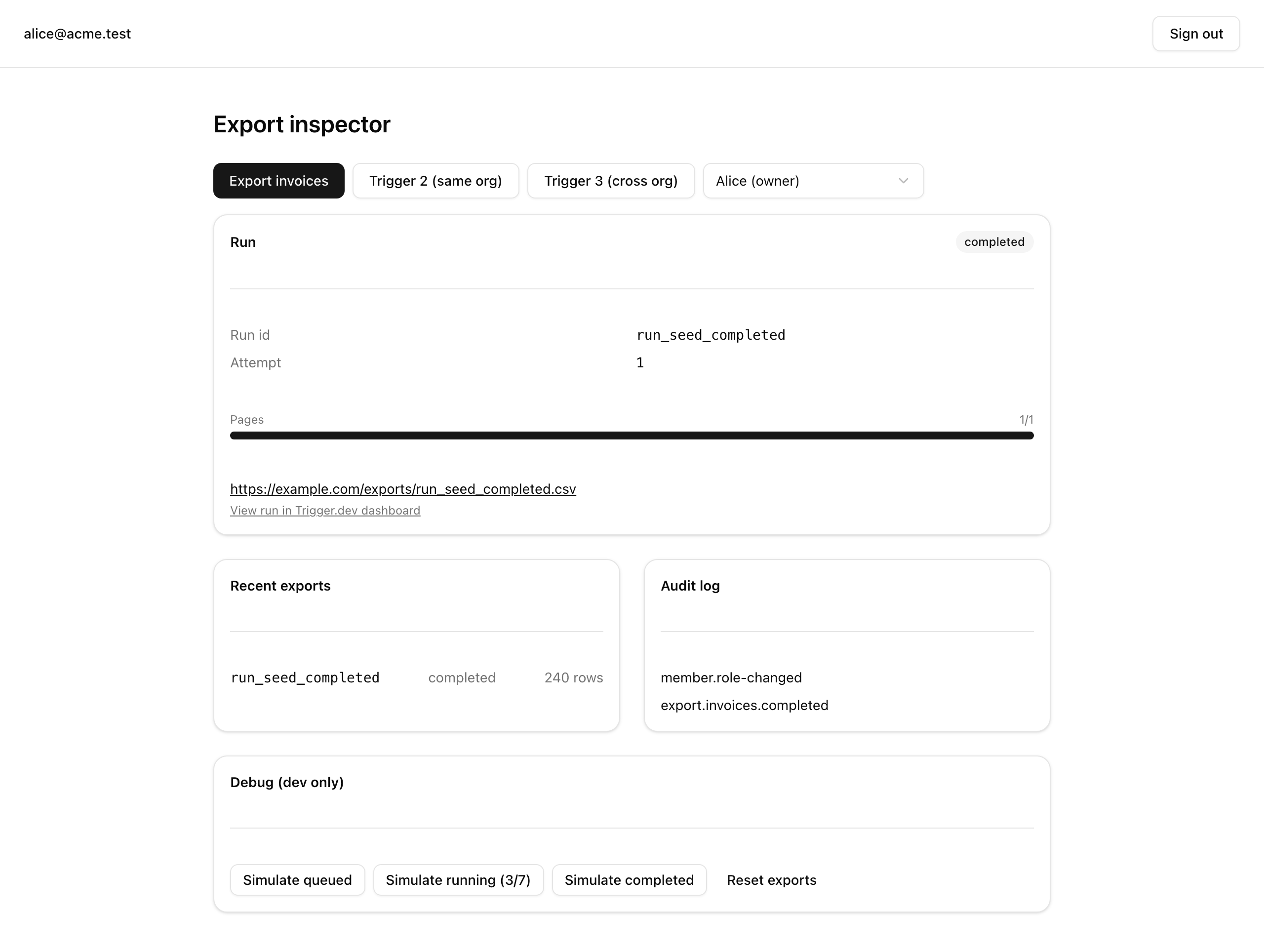
Back in the chapter on the durable CSV export, the export job ended on a lie. After it paginated every invoice into one CSV, it set metadata.downloadUrl to https://example.com/exports/<runId>.csv — a placeholder that renders as a real, clickable link on the inspector panel and rides along in the export email, and goes nowhere when you click it. That was the right shape with a stubbed payload: the email plumbing, the inspector link, the audit trail were all real; only the bytes were missing. This lesson fills in the bytes. By the end, triggering an export from /inspector writes the CSV to R2 and hands back a working download link — the same link on the completion panel and in the email — that downloads the file when you click it within ten minutes.
Your mission
Section titled “Your mission”Everything you have built in this chapter signs a PUT and lets the browser push the bytes — the function never touches them. The export worker is the other side of that boundary. It already holds the whole CSV in memory after the page loop, and it has no browser to offload to, so it does the one thing the upload path never does: it PUTs the bytes to R2 itself. That is not a violation of the byte-pipe rule, it is the rule’s other half — browser-PUT for user-facing flows, server-PUT for workers. Both PUTs go through the same lib/r2.ts client; you do not stand up a second one. And the export shares the same bucket as your user uploads — what separates them is the key prefix, not a separate bucket. Exports land under exports/, user uploads under org/. That single prefix is load-bearing later: a 7-day lifecycle rule (already written for you in scripts/r2-lifecycle.ts) sweeps everything under exports/, so a throwaway export CSV cleans itself up. R2 prefix matching is a literal leading string, not a glob, so the key must lead with exports/ — exports/org/<orgId>/<runId>.csv, with the org scoping nested under the prefix — or the rule misses it.
That lifecycle rule is also why the export writes no file_metadata row. A user upload is a long-lived artifact with an identity you list, download, and audit — it earns a row. An export is a single-consumer throwaway: the user clicks the link once, and a week later the lifecycle rule deletes it. A row for that is dead weight you would have to sweep yourself. Sign the download with getSignedGetForKey — the tenant-free signer the file-metadata reads expose for exactly this caller. It takes a raw key and skips the tenancy check, because the worker just wrote this key inside the trust boundary; there is no org row to scope a read against. You give that GET a ten-minute life. That is deliberately short: a user who opens the email an hour later gets a dead link, and the right answer is to re-trigger the export, not to mint a URL that lives long enough to leak. The accumulated CSV sitting in memory is bounded by page count times page size — fine at this project’s scale; the escape hatch past roughly 100 MB is streaming each page straight into a multipart upload, named here, not built. One placement rule carries the chapter on durable exports forward: the R2 PUT goes after the page loop and before the close-out transaction — an external network call never sits inside a database transaction, and putting it at the tail of the resumed parent keeps that chapter’s kill-resume idempotency intact. A parent retry re-PUTs the same run-keyed object, and an overwrite is idempotent.
You are touching exactly one place: the block right after the page loop in trigger/export-invoices.ts, where the placeholder is set. Leave the pagination loop and the email template alone — reuse the metadata.set('downloadUrl', ...) and sendExportEmail plumbing that is already wired to carry the URL.
exports/org/<orgId>/<runId>.csv via a server-side PUT.downloadUrl carry the same signed URL — they cannot drift to different links.file_metadata row — select count(*) from file_metadata where object_key like 'exports/%' returns 0.downloadUrl as a real R2 link that downloads the CSV when clicked, saved as export-<day>.csv.exports/ prefix is present, confirmed by logging the effective rules.Coding time
Section titled “Coding time”Open trigger/export-invoices.ts, find the placeholder block after the page loop, and replace it with a real R2 write — a server-side PUT, a signed GET, and the existing metadata.set. Lean on the brief and the lesson’s tests; reach for the reference below once you have a version of your own.
Reference solution and walkthrough
The whole retrofit is local. The page loop, the email child, and the close-out transaction stay exactly as the durable-export chapter left them — you swap two lines of placeholder for a PUT-sign-set block, and add three imports.
console.log('export-invoices csv built', { bytes: csv.length });
const downloadUrl = `https://example.com/exports/${ctx.run.id}.csv`;metadata.set('downloadUrl', downloadUrl);
The chapter-067 stub. The link is real on the inspector panel and rides along in the email — but the bytes it points at never landed anywhere, so the click goes nowhere.
import { PutObjectCommand } from '@aws-sdk/client-s3';import { getSignedGetForKey } from '@/db/queries/file-metadata';import { BUCKET, r2 } from '@/lib/r2';// ...console.log('export-invoices csv built', { bytes: csv.length });
const body = Buffer.from(csv);const objectKey = `exports/org/${organizationId}/${ctx.run.id}.csv`;15 collapsed lines
await r2.send( new PutObjectCommand({ Bucket: BUCKET, Key: objectKey, Body: body, ContentType: 'text/csv', ContentDisposition: `attachment; filename="export-${dayBucket()}.csv"`, }),);
const { url: downloadUrl } = await getSignedGetForKey({ objectKey, expiresIn: 600,});metadata.set('downloadUrl', downloadUrl);The worker writes the bytes itself. It PUTs the CSV it already holds, signs a 10-minute GET on the key it just wrote, and feeds that single URL to metadata.set and the unchanged email child. Three new imports come along for the ride.
Reading the block top to bottom:
Buffer.from(csv) and the object key. csv is the string the page loop accumulated; the PUT body wants bytes, so you wrap it once. The key is constructed from the org id and ctx.run.id — one object per run. Because it is keyed on the run, a parent retry re-PUTs the same key, and overwriting an object with identical bytes is idempotent. That is what keeps the kill-resume drill honest: restart a half-finished run and you get one object, not two.
The server-side PUT. This is the one place in the whole project where a function holds the bytes and writes them, and that is correct. The upload path offloads to the browser because the browser is where the file already is; the worker has no browser, the file is already in its memory, so presigning a PUT back to itself would be pure ceremony. The split between the two flows — browser-PUT versus worker-PUT — is the object-storage chapter’s to teach; this is its worker half landing. Note the ContentDisposition is set here, at PUT time, not on the GET. The download name is baked into the stored object, which is why getSignedGetForKey can stay a bare-key signer with no response-header overrides. Contrast that with getFileDownloadUrl from the previous lesson, which does set ResponseContentDisposition on the GET — it has to, because a user file’s original name is only known at read time, not when the object was stored. An export’s name is yours; you write it once.
exports/ leads, and there is no second bucket. The key reads exports/org/${organizationId}/${ctx.run.id}.csv. The leading exports/ is the part that matters. The provided scripts/r2-lifecycle.ts installs a single rule, expire-exports-after-7-days, with Filter.Prefix: 'exports/' — and R2 matches a literal leading string, so a key shaped org/<id>/exports/... would slip past the rule entirely. Lead with exports/, nest the org scoping under it, and one rule sweeps every org’s CSVs while leaving every user upload under org/ untouched.
Signing the GET, then publishing it once. getSignedGetForKey takes the raw key and signs a ten-minute GET — no tenancy check, because the worker is inside the trust boundary and owns the key it just wrote. You destructure the URL into downloadUrl and that single value is what flows to both metadata.set('downloadUrl', downloadUrl) (the inspector panel renders this) and, a few lines down, the unchanged sendExportEmail child (which already accepts downloadUrl in its payload). One signed URL, two consumers — the panel and the email cannot drift to different links because there is only one link.
No file_metadata row. The block writes nothing to the database. That is the deliberate difference from finalizeUpload, which inserts a row for every user upload: an export is a throwaway the lifecycle rule reaps in a week, so a row would be an orphan you would have to clean up yourself. The verification confirms this directly — the count of export-prefixed metadata rows stays zero.
Where the PUT sits. It lands after the page loop and before the tenantDb(...).transaction that flips the exports row to completed and writes the audit entry. An external network call never belongs inside a database transaction — it would hold the transaction open across network latency and can’t be rolled back if the commit fails. Keeping it outside, at the tail of the resumed parent, is also what preserves the durable-export chapter’s cross-step idempotency. The mechanics of that kill-resume — the per-page idempotency keys, the cached child results on retry — are that chapter’s to explain; here you just respect the placement it depends on.
Once the code is in, install the lifecycle rule against your own bucket. It is a one-time setup, not part of any request:
pnpm r2:lifecycleThe script pushes the rule and then reads the effective configuration back, logging it — so you confirm the rule is live in seconds instead of waiting seven days for the first sweep:
[r2:lifecycle] effective rules: [ { "ID": "expire-exports-after-7-days", "Status": "Enabled", "Filter": { "Prefix": "exports/" }, "Expiration": { "Days": 7 } }]Cloudflare's reference for signing GET and PUT URLs with PutObjectCommand and getSignedUrl — the glue behind getSignedGetForKey.
How prefix-scoped expiration rules work, so the 7-day sweep on exports/ reaps the CSVs you just wrote.
Moment of truth
Section titled “Moment of truth”Run the lesson’s suite:
pnpm test:lesson 5The export task imports server-only transitively, so the runner can’t execute it — there is no live R2, no bucket, no database in the test process. Instead it reads the task’s own source (comments stripped, so the long prose in the file never trips an assertion) and proves the four tested outcomes structurally: the placeholder is gone; one server-side PutObjectCommand writes a Body of Buffer.from(csv) to the shared BUCKET at a key leading with exports/org/<orgId>/<runId>.csv; a single getSignedGetForKey URL at expiresIn: 600 is the one value handed to both metadata.set and the email child; no insert into fileMetadata exists; the key derives from ctx.run.id; the PUT sits before the close-out transaction; and exactly one export.invoices.completed audit entry is written. A green run looks like this:
 ✓ Lesson 5 — the export writes a real R2 object and signs its downloadUrl
 Test Files  1 passed (1)      Tests  11 passed (11)
The runner can prove the shape that makes kill-resume idempotent, but it can’t drive a real interrupted run, a real inbox, or a real bucket. Confirm the rest by hand:
/inspector; the completion panel shows a real https://<bucket>.r2.cloudflarestorage.com/... downloadUrl, and clicking it downloads export-<day>.csv.select count(*) from file_metadata where object_key like 'exports/%' returns 0.pnpm r2:lifecycle logs one expire-exports-after-7-days rule scoped to Filter.Prefix: 'exports/'.pagesDone: 2/7, restart — the export resumes, the PUT happens once at the end, and you end with one CSV, one email, and one audit row.That last check closes the project. Pull up the audit log — select action, count(*) from audit_logs group by action — and you will see two stories the chapter wrote. Every user upload left a file.uploaded row from finalizeUpload. Every export run left an export.invoices.completed row from the worker, written with actorUserId: null because a background task has no session — the null is information, not a missing value. What you will not see is a row for rendering /files: reads never audit, so the trail picks up only at writes. And file.soft_deleted lives in the softDeleteFile action but never fires, because no button calls it — the capability ships, unexercised, ready for the day a delete UI lands.
Step back from the keystrokes and name what you actually decided across these five lessons. For user uploads, the function never sees the bytes — it signs a URL and the browser does the transfer. The write is two steps, sign-then-finalize, so a row never lands before the bytes it describes. Size and content type come from the post-upload HEAD, never the client’s claim. The object key is server-constructed, never anything the client sends. Download URLs are signed fresh on every render and never persisted or cached, because a stored URL expires and lies. Tenancy holds at every read. One bucket per environment, with a key prefix — not a second bucket — carrying the split between throwaway exports and long-lived uploads, and one lib/r2.ts serving both consumers. User uploads get a file_metadata row; exports get no row and a lifecycle rule instead. And CORS is scoped to a specific origin, never *. Those are the calls. The SDK glue around them is the part an agent writes for you.
A few of these threads get picked up downstream. The notification dispatcher a couple of units on can fire on file.uploaded. The pre-launch security audit treats the layered size defense, the CORS specificity, and the deletedAt reads as line items to verify. And rotating these R2 credentials under a staged-rollover discipline is part of the deployment unit near the end of the course. The shape you built here is the one those later chapters lean on.
One thread runs the other way: the same pipeline reversed is a CSV import.
A presigned PUT lands the file in R2, a Trigger.dev job stream-parses it row by row, and each row upserts into the tenant table — every primitive on this page, pointed backward.
What makes import its own feature rather than a free mirror is the part export never faces: each row needs per-field validation and coercion, and a row that fails at line N forces a real decision — reject the file, or commit the good rows and report the bad ones — so the hard half of import is the partial-failure contract, not the byte plumbing.