Gate reset per-IP and per-email
This is the last gate. You wire the password-reset action per-IP and per-email so that neither a single noisy host nor a campaign rotating IPs against one victim’s address can flood that inbox with reset emails.
Reset is your second dual-keyed endpoint — same shape as sign-in — but the per-email gate is here for a different reason, and that reason is the whole lesson. On sign-in, a per-email gate stops credential stuffing against one account. On reset, every accepted request sends real mail: a verification link goes out through Resend, on your domain, on your dime. So the cost of abuse isn’t an attacker burning their own time — it lands on a third party, the person whose address is being targeted, and on your sender reputation and your email budget. The per-IP gate stops one host hammering. The per-email gate is the one that protects the targeted address even as the attacker hops hosts, and surviving that IP switch is its load-bearing property.
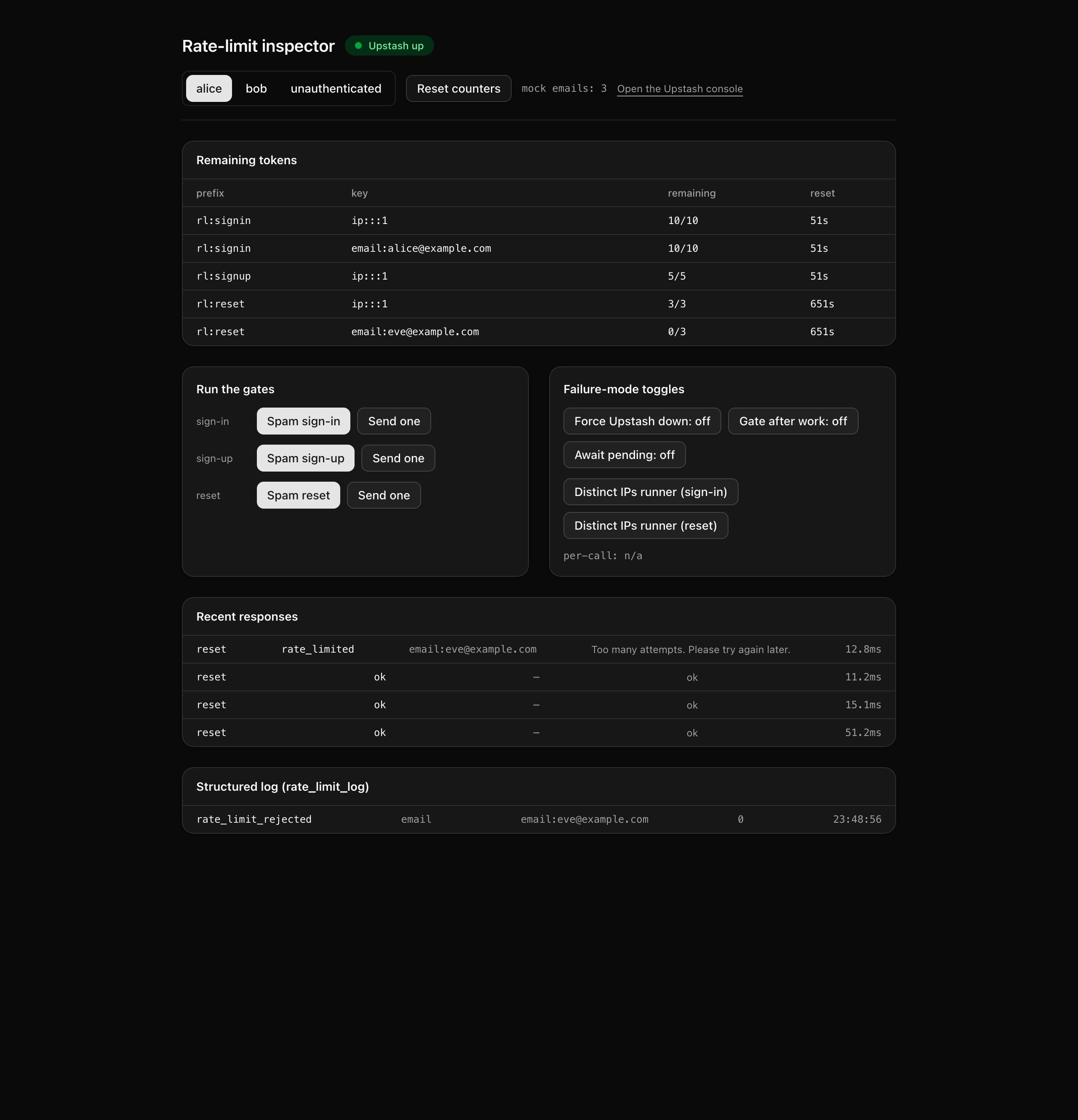
Here’s the feedback loop you’re building toward. On /inspector, “Spam reset” fires four reset requests against eve@example.com, each from a different synthetic IP — a cross-host campaign. The first three come back ok; the fourth flips to rate_limited with the opaque Too many attempts. Please try again later., and its structured-log row records limiter: 'reset', key: 'email:eve@example.com'. Run “Distinct IPs runner (reset)” to switch to one more never-seen IP, and it’s still rejected — on the per-email gate, because that gate is keyed on the victim, not the requester. The mock-email counter ticks up only by the three that got through; the blocked one sent nothing.
Your mission
Section titled “Your mission”Gate the password-reset request so a victim’s inbox — and your Resend cost — stay protected even when the attacker rotates IPs. This is the second dual-keyed endpoint in the project, and structurally it is the sign-in gate again: parse, per-IP check, per-email check, then the work, with the budget riding the Result. What’s worth holding in your head is why the per-email gate earns its place here. Per-IP alone stops one host but misses a campaign spread across many; per-email alone would be a lockout vector if reset did anything stateful, but reset’s per-email gate isn’t about lockout at all — it’s about the email send. Every reset that passes both gates fires one real message, so the gate that survives an IP change is the one standing between an IP-rotating attacker and a victim’s flooded inbox. That survival is the property the tests hammer on, and it’s what makes a same-IP burst a poor demonstration: per-IP is checked first, both gates share the tightest budget in the project, so a same-IP burst trips the per-IP gate before the per-email gate is ever consulted. To watch the per-email gate fire you have to spread the spam across distinct IPs, which is exactly what the inspector’s “Spam reset” does.
Everything you need already exists. resetLimiter (three per fifteen minutes — the tightest budget in the project, because the abuse here is the most expensive), safeLimit, and the reject helper all shipped in the earlier lessons of this chapter; adding this endpoint is one limiter and one wrap, the payoff promised back in the overview. Reuse them, don’t re-declare them — that one-wrap economy is the point. The carried rules are the same ones the sign-in gate already established: both checks run before auth.api.requestPasswordReset so a blocked attacker never triggers the send, the rejection goes back through the opaque rateLimited(...) helper so it reads identically whichever gate tripped, safeLimit keeps the fail-open policy, and pending analytics flush through after() rather than blocking the response. One shape note so you don’t fight the form: reset has no redirect. Sign-in and sign-up returned an ok({ redirectTo }) so the form could navigate; reset returns ok({ sent: true }) — a marker, not a destination — because the form renders an enumeration-uniform confirmation in place. The one thing explicitly out of scope is real email delivery: it’s mocked here so the inspector can count sends, and the live Resend send path is the concern of The welcome email send path.
eve@example.com across distinct IPs return rate_limited on the fourth, with limiter: 'reset' and the logged key: 'email:eve@example.com' — every per-IP bucket stays fresh, so the per-email gate is what trips.eve@example.com is still rate_limited on the per-email gate — the gate survives the IP change.ok({ sent: true }); a rejection returns the opaque rate_limited message, with the gate and key surfacing only in the rate_limit_log row.rate_limit_unavailable rows.Coding time
Section titled “Coding time”Fill in src/app/(auth)/reset/actions.ts against the brief and the tests, reusing resetLimiter, safeLimit, and the rateLimited reject helper — per-IP gate then per-email gate, both before the reset request, the marker on the success Result. Try it before you open the solution.
Reference solution and walkthrough
The whole file. Set it next to the sign-in action from Gate sign-in with dual-keying and the import surface is identical — resetLimiter in place of signInLimiter, the same getClientIp, the same safeLimit, the same rateLimited — which is the “one wrap” claim made concrete.
'use server';
11 collapsed lines
import { headers } from 'next/headers';import { after } from 'next/server';import { z } from 'zod';
import { auth } from '@/lib/auth';import { mapAuthError } from '@/lib/auth/error-mapping';import { getClientIp } from '@/lib/keys';import { resetLimiter } from '@/lib/rate-limit';import { rateLimited } from '@/lib/rate-limit-headers';import { err, ok, type Result } from '@/lib/result';import { safeLimit } from '@/lib/safe-limit';
const ResetSchema = z.strictObject({ email: z.string().trim().toLowerCase().pipe(z.email()),});
8 collapsed lines
// Gate before work, dual-keyed: per-IP then per-email (cheaper first), both// through `safeLimit`, both before `auth.api.requestPasswordReset`. The per-email gate// is the load-bearing one here — it survives an IP switch, so a campaign against// one victim's address can't flood their inbox (and our Resend cost) by rotating// hosts. Tightest budget in the project (3/15m). Reset has no redirect: the form// renders an enumeration-uniform confirmation in place, so the ok payload is a// marker, not a navigation. `pending` analytics flush via `after()`, never awaited// on the path.export const resetAction = async ( _state: Result<{ sent: true }> | null, formData: FormData,): Promise<Result<{ sent: true }>> => { const parsed = ResetSchema.safeParse(Object.fromEntries(formData)); if (!parsed.success) { return err( 'validation', 'Check the highlighted fields.', z.flattenError(parsed.error).fieldErrors, ); }
const ip = getClientIp(await headers()); const email = parsed.data.email;
const ipLimit = await safeLimit(resetLimiter, 'rl:reset', `ip:${ip}`); if (!ipLimit.success) { return rateLimited(ipLimit, 'ip', ip); }
const emailLimit = await safeLimit( resetLimiter, 'rl:reset', `email:${email}`, ); if (!emailLimit.success) { return rateLimited(emailLimit, 'email', email); }
try { // Enumeration-uniform by default: an unknown email returns success without // sending. `redirectTo` is only the link target baked into the email; the // token-consume page is named-not-built — the project verifies the gate. await auth.api.requestPasswordReset({ body: { email, redirectTo: '/sign-in' }, }); } catch (e) { after(ipLimit.pending); after(emailLimit.pending); return mapAuthError(e); }
after(ipLimit.pending); after(emailLimit.pending); return ok({ sent: true });};Walk the four moves that matter, in order.
export const resetAction = async (  _state: Result<{ sent: true }> | null,  formData: FormData,): Promise<Result<{ sent: true }>> => {  const parsed = ResetSchema.safeParse(Object.fromEntries(formData));  if (!parsed.success) {    return err(      'validation',      'Check the highlighted fields.',      z.flattenError(parsed.error).fieldErrors,    );  }
  const ip = getClientIp(await headers());  const email = parsed.data.email;
  const ipLimit = await safeLimit(resetLimiter, 'rl:reset', `ip:${ip}`);  if (!ipLimit.success) {    return rateLimited(ipLimit, 'ip', ip);  }
  const emailLimit = await safeLimit(    resetLimiter,    'rl:reset',    `email:${email}`,  );  if (!emailLimit.success) {    return rateLimited(emailLimit, 'email', email);  }
  try {    await auth.api.requestPasswordReset({      body: { email, redirectTo: '/sign-in' },    });  } catch (e) {    after(ipLimit.pending);    after(emailLimit.pending);    return mapAuthError(e);  }
  after(ipLimit.pending);  after(emailLimit.pending);  return ok({ sent: true });};
Parse the form with the strictObject first, and return on failure before any gate runs. The schema trims and lowercases the email, then pipes it to z.email(), so the normalized address is what flows into the per-email key — and a malformed email short-circuits with a validation result without ever burning a token. This early return is the one part of the wired action a test can call directly without a live request scope, which is why the suite probes it.
export const resetAction = async (  _state: Result<{ sent: true }> | null,  formData: FormData,): Promise<Result<{ sent: true }>> => {  const parsed = ResetSchema.safeParse(Object.fromEntries(formData));  if (!parsed.success) {    return err(      'validation',      'Check the highlighted fields.',      z.flattenError(parsed.error).fieldErrors,    );  }
  const ip = getClientIp(await headers());  const email = parsed.data.email;
  const ipLimit = await safeLimit(resetLimiter, 'rl:reset', `ip:${ip}`);  if (!ipLimit.success) {    return rateLimited(ipLimit, 'ip', ip);  }
  const emailLimit = await safeLimit(    resetLimiter,    'rl:reset',    `email:${email}`,  );  if (!emailLimit.success) {    return rateLimited(emailLimit, 'email', email);  }
  try {    await auth.api.requestPasswordReset({      body: { email, redirectTo: '/sign-in' },    });  } catch (e) {    after(ipLimit.pending);    after(emailLimit.pending);    return mapAuthError(e);  }
  after(ipLimit.pending);  after(emailLimit.pending);  return ok({ sent: true });};
The dual gate, before the send. Per-IP runs first because it’s the cheaper rejection — a noisy host gets stopped without ever touching the shared per-email bucket — then per-email. Both go through safeLimit on the same resetLimiter with the same 'rl:reset' prefix; the keys differ (ip: versus email:). The first to fail returns the opaque rateLimited(...) and stops. That early-return-per-gate structure is what enforces “both must pass.”
export const resetAction = async (  _state: Result<{ sent: true }> | null,  formData: FormData,): Promise<Result<{ sent: true }>> => {  const parsed = ResetSchema.safeParse(Object.fromEntries(formData));  if (!parsed.success) {    return err(      'validation',      'Check the highlighted fields.',      z.flattenError(parsed.error).fieldErrors,    );  }
  const ip = getClientIp(await headers());  const email = parsed.data.email;
  const ipLimit = await safeLimit(resetLimiter, 'rl:reset', `ip:${ip}`);  if (!ipLimit.success) {    return rateLimited(ipLimit, 'ip', ip);  }
  const emailLimit = await safeLimit(    resetLimiter,    'rl:reset',    `email:${email}`,  );  if (!emailLimit.success) {    return rateLimited(emailLimit, 'email', email);  }
  try {    await auth.api.requestPasswordReset({      body: { email, redirectTo: '/sign-in' },    });  } catch (e) {    after(ipLimit.pending);    after(emailLimit.pending);    return mapAuthError(e);  }
  after(ipLimit.pending);  after(emailLimit.pending);  return ok({ sent: true });};
Only once both gates pass do we call auth.api.requestPasswordReset. This is the line that sends mail, so it lives strictly after the gates — a blocked attacker never reaches it. We don’t hand-roll the unknown-email case: Better Auth returns success without sending for an address it doesn’t recognize, so the response is uniform whether or not the account exists, and a thrown error is translated by mapAuthError.
export const resetAction = async (  _state: Result<{ sent: true }> | null,  formData: FormData,): Promise<Result<{ sent: true }>> => {  const parsed = ResetSchema.safeParse(Object.fromEntries(formData));  if (!parsed.success) {    return err(      'validation',      'Check the highlighted fields.',      z.flattenError(parsed.error).fieldErrors,    );  }
  const ip = getClientIp(await headers());  const email = parsed.data.email;
  const ipLimit = await safeLimit(resetLimiter, 'rl:reset', `ip:${ip}`);  if (!ipLimit.success) {    return rateLimited(ipLimit, 'ip', ip);  }
  const emailLimit = await safeLimit(    resetLimiter,    'rl:reset',    `email:${email}`,  );  if (!emailLimit.success) {    return rateLimited(emailLimit, 'email', email);  }
  try {    await auth.api.requestPasswordReset({      body: { email, redirectTo: '/sign-in' },    });  } catch (e) {    after(ipLimit.pending);    after(emailLimit.pending);    return mapAuthError(e);  }
  after(ipLimit.pending);  after(emailLimit.pending);  return ok({ sent: true });};
Flush analytics off-path and return the marker. after(pending) hands each limiter’s analytics write to Next.js’s after() so it runs after the response is on its way rather than blocking the user — and it sits on the catch branch too, because the write should happen whether or not the send threw. The success payload is ok({ sent: true }), not redirect() and not redirectTo: reset has no destination, so the form shows its confirmation in place.
A few decisions worth naming.
Why reset carries a per-email gate at all. Said plainly: every accepted reset sends a real email, so the abuse you’re defending against is a flooded third-party inbox plus Resend cost, not a brute-forced account. The per-IP gate stops one host; the per-email gate is keyed on the victim’s address, so it keeps counting down no matter which host the request comes from. That cross-host survival is the gate’s whole reason for existing here — and the inspector’s “Distinct IPs runner (reset)” exists to prove it by switching to a fresh IP after the budget is spent and watching the email gate reject anyway.
Why the budget is the tightest in the project. Sign-in is ten per minute, sign-up five per ten minutes, reset three per fifteen minutes. The tighter the legitimate frequency and the higher the abuse cost, the tighter the budget should be — and reset sits at the extreme of both: nobody legitimately requests four password resets in a quarter hour, and every request past the limit is a real email you’d rather not send. Low legitimate frequency plus high abuse cost equals the smallest window.
Why the demonstration needs distinct IPs. Per-IP is checked first, and both gates draw on the same three-per-fifteen-minutes budget. A same-IP burst therefore trips the per-IP gate on its fourth call, before the per-email gate is ever consulted — that’s requirement three, the mirror case. To make the per-email gate the thing that fires, the spam has to keep every per-IP bucket fresh, which means a new synthetic IP each call. That’s precisely what “Spam reset” does, and it’s why the cross-host scenario is the one the lesson is built around.
Why after(pending) appears on the catch branch too. The analytics write is bookkeeping about the limiter, not about the credential outcome, so it must flush whether or not requestPasswordReset throws — which is why it appears on both the catch and the success branch. And it goes through after() rather than being awaited inline because awaiting the analytics round-trip on the response path would add latency to every reset for no user benefit; for the full story on after(), see Inline, then after().
Why the ok is a marker, not navigation. Reset deliberately doesn’t redirect. An unknown email and a known one return the identical ok({ sent: true }), and the form renders one enumeration-uniform confirmation in place — “if that address exists, a link is on its way.” The redirectTo: '/sign-in' in the call is not navigation for the requester; it’s only the link target baked into the email the recipient receives. Consuming that token on a reset-completion page is named-not-built here: this project verifies the gate, not the full reset flow.
For the parts this lesson leans on but doesn’t own — dual-keying, gate-before-work, the opaque message, and safeLimit’s fail-open — see Gate sign-in with dual-keying where they were first wired, and the Upstash primitives in the rate-limiting chapter’s dual-keying lesson.
The sliding-window algorithm behind resetLimiter's 3-per-15-minutes budget, and what .limit() hands back.
The requestPasswordReset server API this gate wraps, including its enumeration-uniform reset behaviour.
Moment of truth
Section titled “Moment of truth”Run the lesson’s suite:
pnpm test:lesson 5The suite drives your real helpers — safeLimit, rateLimited, and the live sendEmail mock — composed exactly the way the reset action composes them: per-IP gate then per-email gate, both before the send, against a deterministic in-test limiter at reset’s budget of three, so the run never waits on a live Upstash window. It also calls resetAction directly to confirm the parse early-return returns a validation result rather than the stub’s internal, and reads back the honest rate_limit_log rows through the same database and table the inspector’s log-tail reads, so it needs DATABASE_URL set just as the inspector does. All seven tests pass when the cross-IP campaign trips on the per-email gate on its fourth call and leaves a row keyed email:eve@example.com, the per-email gate still rejects after one more IP switch, a same-IP burst trips on the per-IP gate, the mock-email counter moves by exactly the three that passed, and both gates return the byte-identical opaque message while their honest rows still record which gate fired.
 ✓ tests/lessons/Lesson 5.test.ts (7 tests)
 Test Files  1 passed (1)      Tests  7 passed (7)
The tests drive the helpers but can’t reach the inspector or force a Redis outage. Confirm the rest by hand on /inspector:
ok resets against eve@example.com and a fourth rate_limited row carrying the opaque Too many attempts. Please try again later. and key: email:eve@example.com.rl:reset → email:eve@example.com → 0/3, while the rl:reset → ip:<addr> row stays fresh — proof the per-email gate, not the per-IP gate, did the blocking.rate_limited on the per-email gate. This cross-host survival is the chapter’s load-bearing reset result.3 after the spam run — the three accepted resets each sent one, the blocked fourth sent nothing.rate_limit_rejected row keyed on email:eve@example.com — the gate and key the opaque user message hides.rate_limit_unavailable rows (the fail-open path). Toggle it back off.With reset gated, the surface is complete. Every “Done when” clause the overview set out now has an owning lesson, confirmed in its own Moment of truth: sign-in dual-keyed against credential stuffing and lockout, sign-up gated per-IP against mass registration, reset gated per-IP and per-email against inbox flooding — all of them fail-open under an outage, all of them speaking one opaque message to the user while the honest gate and key land in the log. Better Auth’s built-in limiter is off, and your application wrapper is the single enforcement point across the whole auth surface.
The shape you wrote five times here is the shape every future enforcement point reuses. A webhook receiver keyed by source, an upload endpoint keyed per-user, an AI-generation route keyed per-org or per-user against a daily token budget — each is the same parse, gate-before-work, opaque-reject, fail-open wrap you now have in muscle memory, with a different key and a different budget. You’ve built the pattern; from here, protecting a new endpoint is one limiter and one wrap.