Infinite scroll, polling, and the route handler
The read side comes alive: scroll to the bottom of a thread and a “Load older” button pages in earlier comments, and a comment a coworker posts shows up on its own within ten seconds — no refresh.
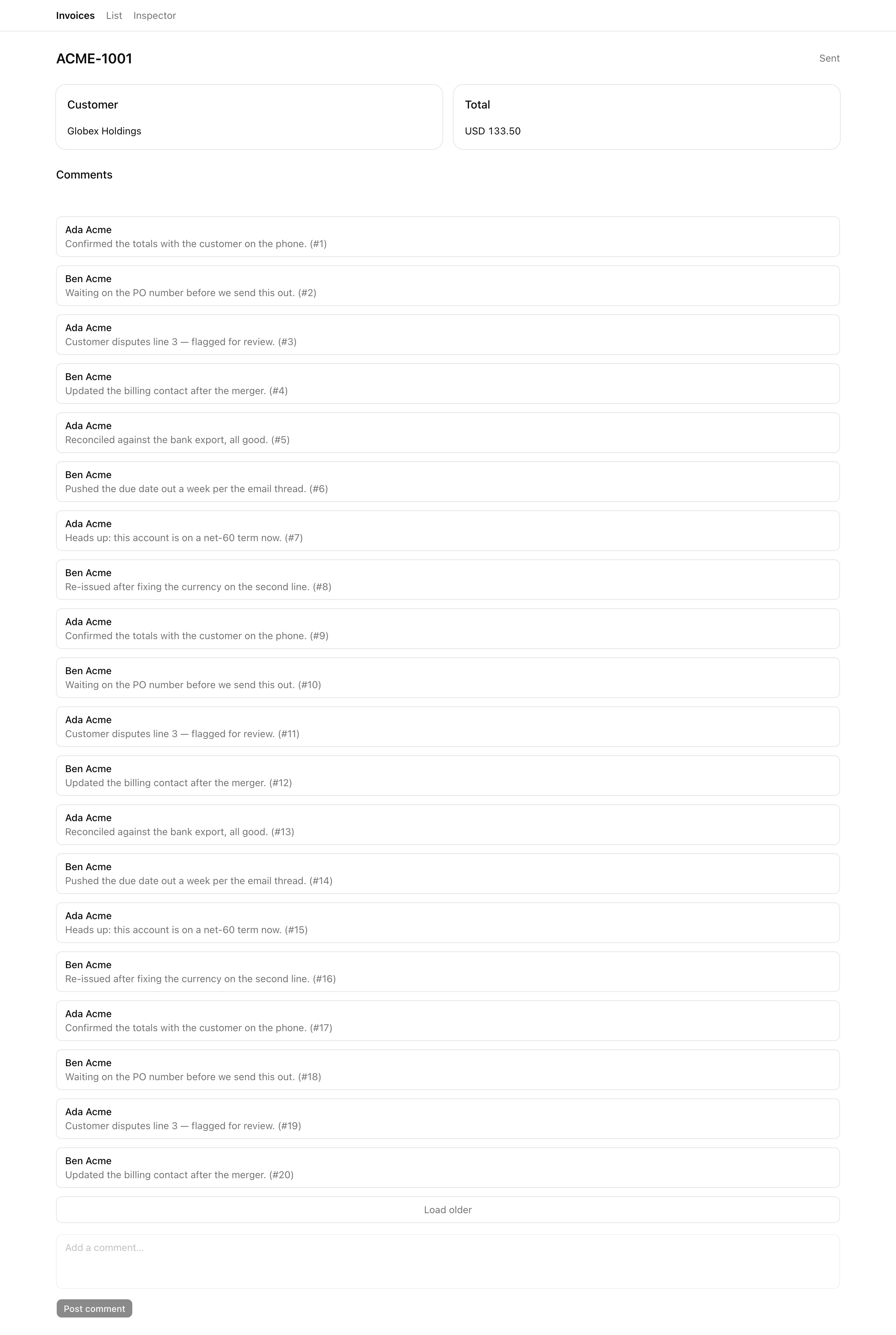
The seeded first page still paints instantly, the way you wired it last lesson. What’s new is everything after that first paint. “Load older” appends earlier pages by hitting a real HTTP endpoint, a background poll refreshes the head of the thread every ten seconds, and the polling goes quiet the moment you switch to another tab. The visible change is mostly behavioral and lives in the network tab — that’s where the seam you’re about to build is observable — but the settled thread looks like this:

Your mission
Section titled “Your mission”The seam to respect here is that client reads travel through a public route handler — GET /api/invoices/[id]/comments — so the very same data is reachable by a future mobile or third-party client, while the Server Component’s prefetch keeps reading the store directly through the server-only listCommentsPage you used last lesson. Two read functions, one wire shape. The reason they have to stay two functions and not one is concrete: the client fetcher must never import the store, getSession, or queries.ts, because any transitive reach into server-only code fails next build the moment a Client Component pulls it in. In a real Postgres app that same mistake would also bundle the database driver into the browser. The handler is wrapped in authedRoute, so the tenancy boundary holds at the read seam exactly as it does at the write seam — a request for another org’s invoice scopes to the acting org and comes back as an empty page, and a caller below the member role is refused with RFC 9457 Problem Details. Both the handler and the fetcher parse the payload through the same shared Zod schema, so if the response ever drifts the client fails loudly instead of rendering broken UI.
On the client, useInfiniteQuery reads the cursor pages newest-first and caps the retained pages at ten — a chat-style thread bounds its memory, unlike a feed-style read-once surface where you’d leave it unbounded — and it polls on a ten-second refetchInterval with refetchIntervalInBackground: false so the browser pauses polling while the tab is hidden. Ten seconds is a deliberate cadence, not a round number: faster floods the connection pool and burns mobile battery, slower starts to feel stale. Keep “Load older” an explicit button rather than an IntersectionObserver that auto-loads on scroll — auto-load is right for an endless feed but wrong for a thread a user might scroll past by accident and not want to keep paging. And surface the poll’s in-flight state with an isFetching chip that’s visually distinct from the per-page “Load older” spinner; that’s the isPending-versus-isFetching distinction you met in the TanStack Query chapter put to work.
One boundary to hold: posting stays unwired this lesson. The thread is read-only — the form does nothing until the next lesson. And “live” here means polling, not WebSockets or Server-Sent Events. Those are out of scope for this course entirely; polling is the threshold-met case for a comment thread, and it’s the only live-update mechanism you need.
GET /api/invoices/[id]/comments requests visible in the network tab; the first-paint data does not.Coding time
Section titled “Coding time”Implement against the brief and the lesson’s tests, then open the walkthrough below.
Reference solution and walkthrough
Three files, in the order the data flows: the client fetcher that builds the request, the route handler that answers it, then the thread component that drives both the paging and the poll.
The client-safe fetcher
Section titled “The client-safe fetcher”This is the module the thread imports to read pages, and the one constraint on it is the load-bearing one: it must stay client-safe. It branches on nothing server-ish and imports no server-only code — only the shared schema. Build the URL against window.location.origin, add the cursor as a search param only when there is one, fetch with the cookie attached, throw on a non-ok response so useInfiniteQuery surfaces the failure, then parse the { data } envelope through commentsPageSchema.
// The CLIENT-safe fetcher. `comment-thread.tsx` imports this module, so it must// never import `getSession`, the store, or `queries.ts` — any transitive// `server-only` reach fails `next build` from a Client Component. The server// prefetch reads the store directly in the page, not through this module.
import { type CommentsPage, commentsPageSchema } from '@/lib/comments/schema';
export type FetchCommentsArgs = {  invoiceId: string;  cursor: string | null;};
export const fetchCommentsPage = async ({  invoiceId,  cursor,}: FetchCommentsArgs): Promise<CommentsPage> => {  const url = new URL(    `/api/invoices/${invoiceId}/comments`,    window.location.origin,  );  if (cursor) {    url.searchParams.set('cursor', cursor);  }
  const res = await fetch(url, { credentials: 'same-origin' });  if (!res.ok) {    throw new Error(`Failed to load comments (${res.status})`);  }
  const json = await res.json();  return commentsPageSchema.parse(json.data);};
Two lines carry more weight than they look. The throw new Error on !res.ok is what lets a 500 or a 403 from the handler reach the query as an error instead of resolving to an empty success — without it, a refused read renders as a thread with no comments, which is a silent lie. And commentsPageSchema.parse(json.data) is the contract enforcement: the schema is a strictObject, so an unexpected field in the response throws right here, on the client, the same way it would on the server. That’s the drift-fails-loudly guarantee from requirement 8. The { data } envelope and the boundary parse are the route-handler conventions from the route handlers chapter; the schema lives in src/lib/comments/schema.ts and is imported by the handler, the fetcher, and next lesson’s action, so a change to the wire shape has exactly one place to change and breaks every consumer at once if you get it wrong.
The route handler
Section titled “The route handler”This is the public read seam. authedRoute takes positional arguments — the minimum role, the query schema, and the handler — and hands your function a parsed query plus a ctx carrying the resolved session, the org, and the dynamic route params. The whole tenancy story is one line: scope listCommentsPage to ctx.orgId.
import { authedRoute } from '@/lib/authed-route';import { listCommentsPage } from '@/lib/comments/queries';import { commentsPageSchema, commentsQuerySchema } from '@/lib/comments/schema';
// The public read seam the client fetcher hits. Tenancy falls out of scoping// the read to `ctx.orgId`: a cross-org `invoiceId` yields an empty page, so no// foreign rows leak. `listCommentsPage` already projects off the server-only// `orgId` column, so the strict `commentsPageSchema.parse` matches.export const GET = authedRoute('member', commentsQuerySchema, (query, ctx) => {  const page = listCommentsPage({    orgId: ctx.orgId,    invoiceId: ctx.params.id,    cursor: query.cursor ?? null,    pageSize: 20,  });  return Response.json({ data: commentsPageSchema.parse(page) });});
authedRoute resolves the session and checks roleAtLeast('member', ...) before your handler body ever runs — a caller below member gets a 403 Problem Details and never reaches the read. Then, because the read is scoped to ctx.orgId and not to the invoiceId alone, a request for an invoice that belongs to another org matches no rows and returns an empty page. No 404, no error — just nothing, which is the correct answer to “show me a resource that, as far as you’re concerned, doesn’t exist.” That’s defense in depth: the tenancy check sits here at the read seam alongside the same scoping in the data layer and the cache tags, so no single layer is the only thing standing between one tenant and another’s data. The authedRoute wrapper, the { data } success envelope, and the Problem Details refusal shape are all from the route handlers chapter; the role-and-tenancy gating is the same authedRoute you met in the organizations and RBAC chapter. Re-read those if the wrapper feels unfamiliar — here you’re just applying it to the comment read.
The thread, in full
Section titled “The thread, in full”This is the central file. The page seeds the cache on first paint, but from here on the thread owns the live read — the cursor paging, the poll, the “Load older” control, and the poll indicator. We’ll step through the four load-bearing parts.
'use client';
import {  type InfiniteData,  useInfiniteQuery,  useMutation,  useQueryClient,} from '@tanstack/react-query';import { Loader2Icon } from 'lucide-react';import { useState } from 'react';import { CommentForm } from '@/app/(app)/invoices/[id]/comment-form';import { addCommentAction } from '@/lib/comments/actions';import { fetchCommentsPage } from '@/lib/comments/fetcher';import { commentKeys } from '@/lib/comments/keys';import type { Comment, CommentsPage } from '@/lib/comments/schema';
export type Session = { userId: string; userName: string };
export const CommentThread = ({  invoiceId,  session,}: {  invoiceId: string;  session: Session;}) => {  const queryClient = useQueryClient();  const [body, setBody] = useState('');
  // The cache is seeded by the page's SSR `prefetchInfiniteQuery` under the same  // key, so `data` is populated on first paint with no loading state. From then  // on the client fetcher hits the route handler: 10s polling (paused on a  // hidden tab) and "Load older" cursor paging, capped at `maxPages: 10`.  const {    data,    isError,    isFetching,    fetchNextPage,    hasNextPage,    isFetchingNextPage,  } = useInfiniteQuery({    queryKey: commentKeys.lists(invoiceId),    queryFn: ({ pageParam }) =>      fetchCommentsPage({ invoiceId, cursor: pageParam }),    initialPageParam: null as string | null,    getNextPageParam: (last) => last.nextCursor ?? undefined,    getPreviousPageParam: (first) => first.prevCursor ?? undefined,    refetchInterval: 10_000,    refetchIntervalInBackground: false,    maxPages: 10,  });
  // The cache-update optimistic add. The mandatory step order:  //   cancelQueries → snapshot whole query data → setQueryData page-0 prepend  //   → onError restore → onSettled invalidate.  // `onSettled.invalidateQueries` refetches, flipping the `optimistic-<uuid>`  // row to its real server id. `updateTag` inside the action handles the Server  // Component cache; this `invalidateQueries` handles the client cache — the two  // halves of the two-system invalidation.  const mutation = useMutation({    mutationFn: async (text: string) => {      const result = await addCommentAction({ invoiceId, body: text });      if (!result.ok) {        throw new Error(result.error.userMessage);      }      return result.data;    },    onMutate: async (text) => {      await queryClient.cancelQueries({        queryKey: commentKeys.lists(invoiceId),      });
      const snapshot = queryClient.getQueryData<InfiniteData<CommentsPage>>(        commentKeys.lists(invoiceId),      );
      const optimistic: Comment = {        id: `optimistic-${crypto.randomUUID()}`,        invoiceId,        authorId: session.userId,        authorName: session.userName,        body: text,        createdAt: new Date().toISOString(),      };
      queryClient.setQueryData<InfiniteData<CommentsPage>>(        commentKeys.lists(invoiceId),        (old) => {          if (!old) {            return old;          }          const [firstPage, ...restPages] = old.pages;          const headPage: CommentsPage = {            comments: [optimistic, ...(firstPage?.comments ?? [])],            nextCursor: firstPage?.nextCursor ?? null,            prevCursor: firstPage?.prevCursor ?? null,          };          return { ...old, pages: [headPage, ...restPages] };        },      );
      return { snapshot };    },    onError: (_error, _text, context) => {      if (context?.snapshot) {        queryClient.setQueryData(          commentKeys.lists(invoiceId),          context.snapshot,        );      }    },    onSuccess: () => {      setBody('');    },    onSettled: () => {      queryClient.invalidateQueries({        queryKey: commentKeys.lists(invoiceId),      });    },  });
  const comments = data?.pages.flatMap((page) => page.comments) ?? [];  const postError =    mutation.isError && mutation.error instanceof Error      ? mutation.error.message      : null;
  return (    <div className="space-y-3">      <div className="flex h-5 items-center justify-end">        {isFetching ? (          <span            data-testid="poll-indicator"            className="flex items-center gap-1 text-xs text-muted-foreground"          >            <Loader2Icon className="size-3 animate-spin" />            Updating…          </span>        ) : null}      </div>
      <CommentForm        body={body}        onBodyChange={setBody}        onPost={(text) => mutation.mutate(text)}        isPending={mutation.isPending}        error={postError}      />
      {isError ? (        <p          data-testid="thread-error"          className="rounded-md border border-destructive/50 px-3 py-2 text-sm text-destructive"        >          Couldn’t load comments. Retrying…        </p>      ) : null}
      <div data-testid="comment-thread" className="space-y-3">        {comments.map((comment) => (          <article            key={comment.id}            data-testid="comment-row"            data-comment-id={comment.id}            className="rounded-md border px-3 py-2 text-sm"          >            <div className="font-medium">{comment.authorName}</div>            <p className="text-muted-foreground">{comment.body}</p>          </article>        ))}      </div>
      <button        type="button"        data-testid="load-older"        onClick={() => fetchNextPage()}        disabled={!hasNextPage || isFetchingNextPage}        className="flex w-full items-center justify-center gap-2 rounded-md border px-3 py-2 text-sm text-muted-foreground disabled:opacity-60"      >        {isFetchingNextPage ? (          <Loader2Icon className="size-4 animate-spin" />        ) : hasNextPage ? (          'Load older'        ) : (          'End of thread'        )}      </button>    </div>  );};
The query config. queryKey is commentKeys.lists(invoiceId) — the exact key the page prefetched, so the hydrated first page is read on mount with no fetch. The queryFn calls the client fetcher, which hits the route handler; initialPageParam: null MUST match the prefetch’s value or the first render fetches cold despite the hydration boundary.
'use client';
import {  type InfiniteData,  useInfiniteQuery,  useMutation,  useQueryClient,} from '@tanstack/react-query';import { Loader2Icon } from 'lucide-react';import { useState } from 'react';import { CommentForm } from '@/app/(app)/invoices/[id]/comment-form';import { addCommentAction } from '@/lib/comments/actions';import { fetchCommentsPage } from '@/lib/comments/fetcher';import { commentKeys } from '@/lib/comments/keys';import type { Comment, CommentsPage } from '@/lib/comments/schema';
export type Session = { userId: string; userName: string };
export const CommentThread = ({  invoiceId,  session,}: {  invoiceId: string;  session: Session;}) => {  const queryClient = useQueryClient();  const [body, setBody] = useState('');
  // The cache is seeded by the page's SSR `prefetchInfiniteQuery` under the same  // key, so `data` is populated on first paint with no loading state. From then  // on the client fetcher hits the route handler: 10s polling (paused on a  // hidden tab) and "Load older" cursor paging, capped at `maxPages: 10`.  const {    data,    isError,    isFetching,    fetchNextPage,    hasNextPage,    isFetchingNextPage,  } = useInfiniteQuery({    queryKey: commentKeys.lists(invoiceId),    queryFn: ({ pageParam }) =>      fetchCommentsPage({ invoiceId, cursor: pageParam }),    initialPageParam: null as string | null,    getNextPageParam: (last) => last.nextCursor ?? undefined,    getPreviousPageParam: (first) => first.prevCursor ?? undefined,    refetchInterval: 10_000,    refetchIntervalInBackground: false,    maxPages: 10,  });
  // The cache-update optimistic add. The mandatory step order:  //   cancelQueries → snapshot whole query data → setQueryData page-0 prepend  //   → onError restore → onSettled invalidate.  // `onSettled.invalidateQueries` refetches, flipping the `optimistic-<uuid>`  // row to its real server id. `updateTag` inside the action handles the Server  // Component cache; this `invalidateQueries` handles the client cache — the two  // halves of the two-system invalidation.  const mutation = useMutation({    mutationFn: async (text: string) => {      const result = await addCommentAction({ invoiceId, body: text });      if (!result.ok) {        throw new Error(result.error.userMessage);      }      return result.data;    },    onMutate: async (text) => {      await queryClient.cancelQueries({        queryKey: commentKeys.lists(invoiceId),      });
      const snapshot = queryClient.getQueryData<InfiniteData<CommentsPage>>(        commentKeys.lists(invoiceId),      );
      const optimistic: Comment = {        id: `optimistic-${crypto.randomUUID()}`,        invoiceId,        authorId: session.userId,        authorName: session.userName,        body: text,        createdAt: new Date().toISOString(),      };
      queryClient.setQueryData<InfiniteData<CommentsPage>>(        commentKeys.lists(invoiceId),        (old) => {          if (!old) {            return old;          }          const [firstPage, ...restPages] = old.pages;          const headPage: CommentsPage = {            comments: [optimistic, ...(firstPage?.comments ?? [])],            nextCursor: firstPage?.nextCursor ?? null,            prevCursor: firstPage?.prevCursor ?? null,          };          return { ...old, pages: [headPage, ...restPages] };        },      );
      return { snapshot };    },    onError: (_error, _text, context) => {      if (context?.snapshot) {        queryClient.setQueryData(          commentKeys.lists(invoiceId),          context.snapshot,        );      }    },    onSuccess: () => {      setBody('');    },    onSettled: () => {      queryClient.invalidateQueries({        queryKey: commentKeys.lists(invoiceId),      });    },  });
  const comments = data?.pages.flatMap((page) => page.comments) ?? [];  const postError =    mutation.isError && mutation.error instanceof Error      ? mutation.error.message      : null;
  return (    <div className="space-y-3">      <div className="flex h-5 items-center justify-end">        {isFetching ? (          <span            data-testid="poll-indicator"            className="flex items-center gap-1 text-xs text-muted-foreground"          >            <Loader2Icon className="size-3 animate-spin" />            Updating…          </span>        ) : null}      </div>
      <CommentForm        body={body}        onBodyChange={setBody}        onPost={(text) => mutation.mutate(text)}        isPending={mutation.isPending}        error={postError}      />
      {isError ? (        <p          data-testid="thread-error"          className="rounded-md border border-destructive/50 px-3 py-2 text-sm text-destructive"        >          Couldn’t load comments. Retrying…        </p>      ) : null}
      <div data-testid="comment-thread" className="space-y-3">        {comments.map((comment) => (          <article            key={comment.id}            data-testid="comment-row"            data-comment-id={comment.id}            className="rounded-md border px-3 py-2 text-sm"          >            <div className="font-medium">{comment.authorName}</div>            <p className="text-muted-foreground">{comment.body}</p>          </article>        ))}      </div>
      <button        type="button"        data-testid="load-older"        onClick={() => fetchNextPage()}        disabled={!hasNextPage || isFetchingNextPage}        className="flex w-full items-center justify-center gap-2 rounded-md border px-3 py-2 text-sm text-muted-foreground disabled:opacity-60"      >        {isFetchingNextPage ? (          <Loader2Icon className="size-4 animate-spin" />        ) : hasNextPage ? (          'Load older'        ) : (          'End of thread'        )}      </button>    </div>  );};
Cursor paging and the cap. getNextPageParam reads last.nextCursor for “Load older”; getPreviousPageParam reads first.prevCursor. getPreviousPageParam is mandatory whenever maxPages is set (the TanStack Query chapter), so a page the cap drops can re-fetch on scroll-back. maxPages: 10 bounds retained memory for a chat-style thread.
'use client';
import {  type InfiniteData,  useInfiniteQuery,  useMutation,  useQueryClient,} from '@tanstack/react-query';import { Loader2Icon } from 'lucide-react';import { useState } from 'react';import { CommentForm } from '@/app/(app)/invoices/[id]/comment-form';import { addCommentAction } from '@/lib/comments/actions';import { fetchCommentsPage } from '@/lib/comments/fetcher';import { commentKeys } from '@/lib/comments/keys';import type { Comment, CommentsPage } from '@/lib/comments/schema';
export type Session = { userId: string; userName: string };
export const CommentThread = ({  invoiceId,  session,}: {  invoiceId: string;  session: Session;}) => {  const queryClient = useQueryClient();  const [body, setBody] = useState('');
  // The cache is seeded by the page's SSR `prefetchInfiniteQuery` under the same  // key, so `data` is populated on first paint with no loading state. From then  // on the client fetcher hits the route handler: 10s polling (paused on a  // hidden tab) and "Load older" cursor paging, capped at `maxPages: 10`.  const {    data,    isError,    isFetching,    fetchNextPage,    hasNextPage,    isFetchingNextPage,  } = useInfiniteQuery({    queryKey: commentKeys.lists(invoiceId),    queryFn: ({ pageParam }) =>      fetchCommentsPage({ invoiceId, cursor: pageParam }),    initialPageParam: null as string | null,    getNextPageParam: (last) => last.nextCursor ?? undefined,    getPreviousPageParam: (first) => first.prevCursor ?? undefined,    refetchInterval: 10_000,    refetchIntervalInBackground: false,    maxPages: 10,  });
  // The cache-update optimistic add. The mandatory step order:  //   cancelQueries → snapshot whole query data → setQueryData page-0 prepend  //   → onError restore → onSettled invalidate.  // `onSettled.invalidateQueries` refetches, flipping the `optimistic-<uuid>`  // row to its real server id. `updateTag` inside the action handles the Server  // Component cache; this `invalidateQueries` handles the client cache — the two  // halves of the two-system invalidation.  const mutation = useMutation({    mutationFn: async (text: string) => {      const result = await addCommentAction({ invoiceId, body: text });      if (!result.ok) {        throw new Error(result.error.userMessage);      }      return result.data;    },    onMutate: async (text) => {      await queryClient.cancelQueries({        queryKey: commentKeys.lists(invoiceId),      });
      const snapshot = queryClient.getQueryData<InfiniteData<CommentsPage>>(        commentKeys.lists(invoiceId),      );
      const optimistic: Comment = {        id: `optimistic-${crypto.randomUUID()}`,        invoiceId,        authorId: session.userId,        authorName: session.userName,        body: text,        createdAt: new Date().toISOString(),      };
      queryClient.setQueryData<InfiniteData<CommentsPage>>(        commentKeys.lists(invoiceId),        (old) => {          if (!old) {            return old;          }          const [firstPage, ...restPages] = old.pages;          const headPage: CommentsPage = {            comments: [optimistic, ...(firstPage?.comments ?? [])],            nextCursor: firstPage?.nextCursor ?? null,            prevCursor: firstPage?.prevCursor ?? null,          };          return { ...old, pages: [headPage, ...restPages] };        },      );
      return { snapshot };    },    onError: (_error, _text, context) => {      if (context?.snapshot) {        queryClient.setQueryData(          commentKeys.lists(invoiceId),          context.snapshot,        );      }    },    onSuccess: () => {      setBody('');    },    onSettled: () => {      queryClient.invalidateQueries({        queryKey: commentKeys.lists(invoiceId),      });    },  });
  const comments = data?.pages.flatMap((page) => page.comments) ?? [];  const postError =    mutation.isError && mutation.error instanceof Error      ? mutation.error.message      : null;
  return (    <div className="space-y-3">      <div className="flex h-5 items-center justify-end">        {isFetching ? (          <span            data-testid="poll-indicator"            className="flex items-center gap-1 text-xs text-muted-foreground"          >            <Loader2Icon className="size-3 animate-spin" />            Updating…          </span>        ) : null}      </div>
      <CommentForm        body={body}        onBodyChange={setBody}        onPost={(text) => mutation.mutate(text)}        isPending={mutation.isPending}        error={postError}      />
      {isError ? (        <p          data-testid="thread-error"          className="rounded-md border border-destructive/50 px-3 py-2 text-sm text-destructive"        >          Couldn’t load comments. Retrying…        </p>      ) : null}
      <div data-testid="comment-thread" className="space-y-3">        {comments.map((comment) => (          <article            key={comment.id}            data-testid="comment-row"            data-comment-id={comment.id}            className="rounded-md border px-3 py-2 text-sm"          >            <div className="font-medium">{comment.authorName}</div>            <p className="text-muted-foreground">{comment.body}</p>          </article>        ))}      </div>
      <button        type="button"        data-testid="load-older"        onClick={() => fetchNextPage()}        disabled={!hasNextPage || isFetchingNextPage}        className="flex w-full items-center justify-center gap-2 rounded-md border px-3 py-2 text-sm text-muted-foreground disabled:opacity-60"      >        {isFetchingNextPage ? (          <Loader2Icon className="size-4 animate-spin" />        ) : hasNextPage ? (          'Load older'        ) : (          'End of thread'        )}      </button>    </div>  );};
The poll. refetchInterval: 10_000 re-reads the head every ten seconds; refetchIntervalInBackground: false lets the framework’s hidden-tab check pause the poll when the tab loses focus and resume it on return.
'use client';
import {  type InfiniteData,  useInfiniteQuery,  useMutation,  useQueryClient,} from '@tanstack/react-query';import { Loader2Icon } from 'lucide-react';import { useState } from 'react';import { CommentForm } from '@/app/(app)/invoices/[id]/comment-form';import { addCommentAction } from '@/lib/comments/actions';import { fetchCommentsPage } from '@/lib/comments/fetcher';import { commentKeys } from '@/lib/comments/keys';import type { Comment, CommentsPage } from '@/lib/comments/schema';
export type Session = { userId: string; userName: string };
export const CommentThread = ({  invoiceId,  session,}: {  invoiceId: string;  session: Session;}) => {  const queryClient = useQueryClient();  const [body, setBody] = useState('');
  // The cache is seeded by the page's SSR `prefetchInfiniteQuery` under the same  // key, so `data` is populated on first paint with no loading state. From then  // on the client fetcher hits the route handler: 10s polling (paused on a  // hidden tab) and "Load older" cursor paging, capped at `maxPages: 10`.  const {    data,    isError,    isFetching,    fetchNextPage,    hasNextPage,    isFetchingNextPage,  } = useInfiniteQuery({    queryKey: commentKeys.lists(invoiceId),    queryFn: ({ pageParam }) =>      fetchCommentsPage({ invoiceId, cursor: pageParam }),    initialPageParam: null as string | null,    getNextPageParam: (last) => last.nextCursor ?? undefined,    getPreviousPageParam: (first) => first.prevCursor ?? undefined,    refetchInterval: 10_000,    refetchIntervalInBackground: false,    maxPages: 10,  });
  // The cache-update optimistic add. The mandatory step order:  //   cancelQueries → snapshot whole query data → setQueryData page-0 prepend  //   → onError restore → onSettled invalidate.  // `onSettled.invalidateQueries` refetches, flipping the `optimistic-<uuid>`  // row to its real server id. `updateTag` inside the action handles the Server  // Component cache; this `invalidateQueries` handles the client cache — the two  // halves of the two-system invalidation.  const mutation = useMutation({    mutationFn: async (text: string) => {      const result = await addCommentAction({ invoiceId, body: text });      if (!result.ok) {        throw new Error(result.error.userMessage);      }      return result.data;    },    onMutate: async (text) => {      await queryClient.cancelQueries({        queryKey: commentKeys.lists(invoiceId),      });
      const snapshot = queryClient.getQueryData<InfiniteData<CommentsPage>>(        commentKeys.lists(invoiceId),      );
      const optimistic: Comment = {        id: `optimistic-${crypto.randomUUID()}`,        invoiceId,        authorId: session.userId,        authorName: session.userName,        body: text,        createdAt: new Date().toISOString(),      };
      queryClient.setQueryData<InfiniteData<CommentsPage>>(        commentKeys.lists(invoiceId),        (old) => {          if (!old) {            return old;          }          const [firstPage, ...restPages] = old.pages;          const headPage: CommentsPage = {            comments: [optimistic, ...(firstPage?.comments ?? [])],            nextCursor: firstPage?.nextCursor ?? null,            prevCursor: firstPage?.prevCursor ?? null,          };          return { ...old, pages: [headPage, ...restPages] };        },      );
      return { snapshot };    },    onError: (_error, _text, context) => {      if (context?.snapshot) {        queryClient.setQueryData(          commentKeys.lists(invoiceId),          context.snapshot,        );      }    },    onSuccess: () => {      setBody('');    },    onSettled: () => {      queryClient.invalidateQueries({        queryKey: commentKeys.lists(invoiceId),      });    },  });
  const comments = data?.pages.flatMap((page) => page.comments) ?? [];  const postError =    mutation.isError && mutation.error instanceof Error      ? mutation.error.message      : null;
  return (    <div className="space-y-3">      <div className="flex h-5 items-center justify-end">        {isFetching ? (          <span            data-testid="poll-indicator"            className="flex items-center gap-1 text-xs text-muted-foreground"          >            <Loader2Icon className="size-3 animate-spin" />            Updating…          </span>        ) : null}      </div>
      <CommentForm        body={body}        onBodyChange={setBody}        onPost={(text) => mutation.mutate(text)}        isPending={mutation.isPending}        error={postError}      />
      {isError ? (        <p          data-testid="thread-error"          className="rounded-md border border-destructive/50 px-3 py-2 text-sm text-destructive"        >          Couldn’t load comments. Retrying…        </p>      ) : null}
      <div data-testid="comment-thread" className="space-y-3">        {comments.map((comment) => (          <article            key={comment.id}            data-testid="comment-row"            data-comment-id={comment.id}            className="rounded-md border px-3 py-2 text-sm"          >            <div className="font-medium">{comment.authorName}</div>            <p className="text-muted-foreground">{comment.body}</p>          </article>        ))}      </div>
      <button        type="button"        data-testid="load-older"        onClick={() => fetchNextPage()}        disabled={!hasNextPage || isFetchingNextPage}        className="flex w-full items-center justify-center gap-2 rounded-md border px-3 py-2 text-sm text-muted-foreground disabled:opacity-60"      >        {isFetchingNextPage ? (          <Loader2Icon className="size-4 animate-spin" />        ) : hasNextPage ? (          'Load older'        ) : (          'End of thread'        )}      </button>    </div>  );};
The render shape. The isFetching “Updating…” chip (data-testid="poll-indicator") is true whenever any read is in flight — including a background poll — so it surfaces the poll, distinct from the “Load older” spinner below, which keys off isFetchingNextPage (true only during a paging fetch). data?.pages.flatMap renders every retained page newest-first; the data-testid="thread-error" element is gated on isError; and the disabled={!hasNextPage || isFetchingNextPage} control reads “Load older” while pages remain and “End of thread” once hasNextPage is false.
The useMutation block is already in the file because the thread is one component, but it’s inert this lesson — the form below it is unwired, so nothing calls mutation.mutate yet. Leave it; the optimistic post is the next lesson, and wiring the read and the write into one leaf is exactly why they share a file. Ignore everything from useMutation down through onSettled for now and read only the query, the render, and the two controls.
A few decisions in there deserve a sentence each.
The two read paths stay split on purpose. The page’s prefetch reads the store in-process with zero HTTP hop; the client reads go out through the public route handler. It is tempting to unify them into one function and call it from both places — don’t. That one function would have to import the store, which drags server-only code into the client bundle and fails the build, and it would erase the HTTP contract that a future mobile or third-party client depends on. Two functions, one wire shape, is the whole point.
maxPages: 10 is the chat-thread choice. An unbounded useInfiniteQuery keeps every page it has ever loaded in the cache until the tab closes. For a comment thread someone might scroll deep into, that’s an unbounded memory cost for pages they’ll never look at again, so the cap drops the oldest retained page as new ones load. A feed-style read-once surface — where you scroll forward and never back — can leave it unbounded. The cap is also why getPreviousPageParam is mandatory: when the cap drops an older page and the user scrolls back to it, the query needs a backward cursor to re-fetch it, or there’s a hole.
refetchIntervalInBackground: false is the battery line. With it false, the framework’s own document.hidden check pauses the poll when the tab is hidden and resumes it when the tab regains focus — no GET fires for a thread nobody is looking at. The inspector’s “Open thread with polling OFF” link (?poll=off) opens the focal invoice as the entry point for demonstrating that pause by hand; the thread hard-wires the background pause, so there’s no runtime toggle to flip.
The client-side parse is the same contract everywhere. commentsPageSchema.parse(json.data) in the fetcher is the Zod boundary parse from the validation and route handlers chapters, applied on the client. Because the one schema is imported by the handler, the fetcher, and next lesson’s action, a drifted response can’t slip through in any of those three contexts — it throws at the boundary, and in the thread that rejection is what flips useInfiniteQuery to isError and paints the thread-error element.
One thing the brief asks for that the tests can’t fully reach: the hidden-tab pause (requirement 5). document.hidden and focus behavior aren’t deterministic in the node test runner, so that one is on the manual checklist below. The data-testid set the thread renders — poll-indicator, comment-thread, comment-row (carrying data-comment-id), load-older, and thread-error — is the contract the tests select against, so keep those exact strings.
The useInfiniteQuery reference for getNextPageParam, the bi-directional getPreviousPageParam, and the maxPages cap you set here.
The GET handler, dynamic-segment params, and query-param parsing the public read seam is built on.
Moment of truth
Section titled “Moment of truth”Run the lesson’s test suite:
pnpm test:lesson 3The suite drives both seams the way the browser would, in a node env. It calls your GET handler with a stand-in request and asserts the response: a full first page of twenty rows for an in-org read, an empty page for a cross-org invoiceId, a freshly inserted coworker comment leading the head page, and a member-level caller admitted by the role gate. It exercises the fetcher against a stubbed fetch, asserting the GET /api/invoices/[id]/comments URL shape with the cursor as a search param, that a clean body parses, and that both a non-ok response and a drifted body (an extra field the strictObject rejects) throw so the query enters its error state. And because the maxPages cap and the thread-error paint only happen on a live client fetch a static render can’t reach, the suite reads the thread source to confirm maxPages: 10, its required getPreviousPageParam, and a thread-error element gated on isError. The suite passes when all of those hold; the pass summary ships with the starter.
The runner can’t open a browser, so a handful of things you confirm by hand — open the network tab and the React Query devtools for these:
/invoices/inv-0001); first paint shows twenty seeded comments instantly. Click “Load older” — the network tab shows GET /api/invoices/[id]/comments?cursor=..., the response renders below the existing rows, the head stays put. Devtools shows data.pages.length growing; click again and the next page appends.data.pages.length caps at ten — the oldest retained page drops while the head page is unchanged. With 240 seeded comments (twelve pages at pageSize: 20), “End of thread” is only reachable after the cap has dropped earlier pages.GET .../comments fires, the new row appears at the top, and the comment audit tail shows the insert — no manual refresh.GET .../comments requests fire while it’s hidden. Switch back; a poll fires within ten seconds. (This is requirement 5, the hidden-tab pause the runner can’t assert.)fetch('/api/invoices/<a-globex-invoice-id>/comments'). The handler scopes to the acting org and returns an empty page — no foreign rows leak. The roleAtLeast('member') gate runs first; all four seeded identities are admin or member so they pass, but the 403 Problem Details branch is the same authedRoute enforcement that would fire for a sub-member caller.strictObject schema rejects it on parse, the client surfaces the error state (data-testid="thread-error"), and reverting recovers the thread on the next poll.With the read seam live, the thread now pages and polls against a real public endpoint, and a coworker’s comment arrives on its own within the poll window. The last lesson wires the write side: the optimistic post through a Server Action, the row that appears the instant you submit and rolls back cleanly if the server rejects it, and the two-system invalidation that keeps the Server Component cache and the TanStack cache in step.